

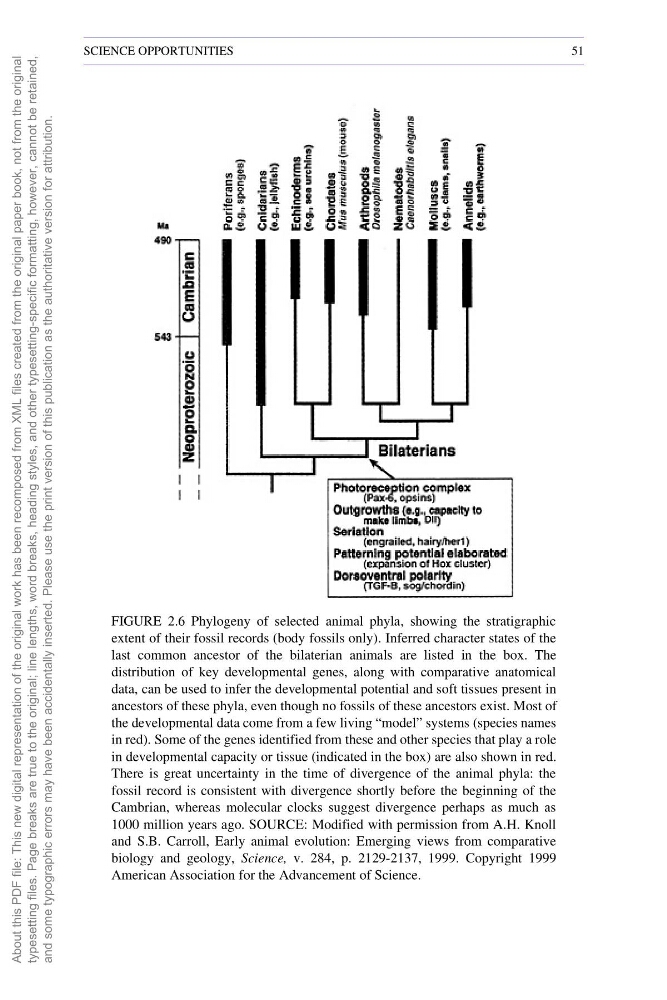
FIGURE 2.6 Phylogeny of selected animal phyla, showing the stratigraphic
extent of their fossil records (body fossils only). Inferred character states of the
last common ancestor of the bilaterian animals are listed in the box. The
distribution of key developmental genes, along with comparative anatomical
data, can be used to infer the developmental potential and soft tissues present in
ancestors of these phyla, even though no fossils of these ancestors exist. Most of
the developmental data come from a few living “model” systems (species names
in red). Some of the genes identified from these and other species that play a role
in developmental capacity or tissue (indicated in the box) are also shown in red.
There is great uncertainty in the time of divergence of the animal phyla: the
fossil record is consistent with divergence shortly before the beginning of the
Cambrian, whereas molecular clocks suggest divergence perhaps as much as
1000 million years ago. SOURCE: Modified with permission from A.H. Knoll
and S.B. Carroll, Early animal evolution: Emerging views from comparative
biology and geology, Science, v. 284, p. 2129-2137, 1999. Copyright 1999
American Association for the Advancement of Science.
SCIENCE OPPORTUNITIES
51
About this PDF file: This new digital representation of the
original work has been recomposed from XML files created
from the original paper book, not from the original
typesetting files. Page breaks are true to the original; line lengths,
word breaks, heading styles, and other typesetting-specific
formatting, however, cannot be retained,
and some typographic errors may have been accidentally inserted.
Please use the print version of this publication as the authoritative
version for attribution.
extent of their fossil records (body fossils only). Inferred character states of the
last common ancestor of the bilaterian animals are listed in the box. The
distribution of key developmental genes, along with comparative anatomical
data, can be used to infer the developmental potential and soft tissues present in
ancestors of these phyla, even though no fossils of these ancestors exist. Most of
the developmental data come from a few living “model” systems (species names
in red). Some of the genes identified from these and other species that play a role
in developmental capacity or tissue (indicated in the box) are also shown in red.
There is great uncertainty in the time of divergence of the animal phyla: the
fossil record is consistent with divergence shortly before the beginning of the
Cambrian, whereas molecular clocks suggest divergence perhaps as much as
1000 million years ago. SOURCE: Modified with permission from A.H. Knoll
and S.B. Carroll, Early animal evolution: Emerging views from comparative
biology and geology, Science, v. 284, p. 2129-2137, 1999. Copyright 1999
American Association for the Advancement of Science.
SCIENCE OPPORTUNITIES
51
About this PDF file: This new digital representation of the
original work has been recomposed from XML files created
from the original paper book, not from the original
typesetting files. Page breaks are true to the original; line lengths,
word breaks, heading styles, and other typesetting-specific
formatting, however, cannot be retained,
and some typographic errors may have been accidentally inserted.
Please use the print version of this publication as the authoritative
version for attribution.