

80
T. A. Deaton et al.
to the self-assembly process with regards to its responsiveness to stimuli, such as
ionic strength and/or pH. Micellization of polyelectrolyte BCPs in a solvent selective
for the polyelectrolyte block has been described based on scaling theories and mean
field theories for both weakly and strongly charged polyelectrolyte blocks [37, 60,
78–80]. Details of the underlying thermodynamics and different theoretical models
for the micellization of polyelectrolyte BCPS have been discussed in several review
articles [38, 60, 63].
One of the most notable theories based on mean-field approximation was the
one developed by Borisov and Zhulina [37, 38]. In this theory, the free energy
of the micelles is described in terms of the degree of polymerization of the polyelectrolyte and hydrophobic blocks, and several external parameters that control
the interaction strength. For example, the second virial coefficient, which represents non-electrostatic excluded-volume interactions, and the Coulomb interactions
between the charged monomers. The model was developed with the local electroneutrality approximation (LEA), which assumes that the local number density of ionized
monomers in a charged corona of the micelle is approximately equal to the local
excess number density of the mobile counterions [63].
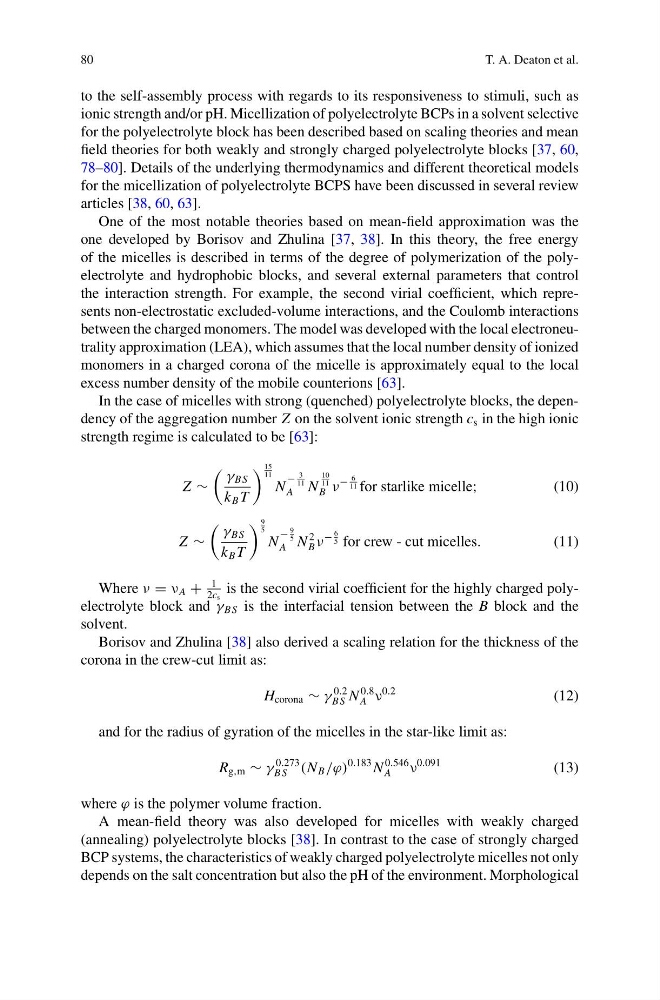
In the case of micelles with strong (quenched) polyelectrolyte blocks, the dependency of the aggregation number Z on the solvent ionic strength c s in the high ionic
strength regime is calculated to be [63]:
Z ∼
γ BS
k B T
15
11
N
−
3
11
A N
10
11
B ν
−
6
11 for starlike micelle;
(10)
Z ∼
γ BS
k B T
9
5
N
−
9
5
A N
2
B ν
−
6
5 for crew - cut micelles.
(11)
Where ν = ν A +
1
2c s
is the second virial coefficient for the highly charged polyelectrolyte block and γ BS is the interfacial tension between the B block and the
solvent.
Borisov and Zhulina [38] also derived a scaling relation for the thickness of the
corona in the crew-cut limit as:
H corona ∼ γ
0.2
BS N
0.8
A ν
0.2
(12)
and for the radius of gyration of the micelles in the star-like limit as:
R g,m ∼ γ
0.273
BS (N B /ϕ)
0.183 N
0.546
A
ν
0.091
(13)
where ϕ is the polymer volume fraction.
A mean-field theory was also developed for micelles with weakly charged
(annealing) polyelectrolyte blocks [38]. In contrast to the case of strongly charged
BCP systems, the characteristics of weakly charged polyelectrolyte micelles not only
depends on the salt concentration but also the pH of the environment. Morphological
T. A. Deaton et al.
to the self-assembly process with regards to its responsiveness to stimuli, such as
ionic strength and/or pH. Micellization of polyelectrolyte BCPs in a solvent selective
for the polyelectrolyte block has been described based on scaling theories and mean
field theories for both weakly and strongly charged polyelectrolyte blocks [37, 60,
78–80]. Details of the underlying thermodynamics and different theoretical models
for the micellization of polyelectrolyte BCPS have been discussed in several review
articles [38, 60, 63].
One of the most notable theories based on mean-field approximation was the
one developed by Borisov and Zhulina [37, 38]. In this theory, the free energy
of the micelles is described in terms of the degree of polymerization of the polyelectrolyte and hydrophobic blocks, and several external parameters that control
the interaction strength. For example, the second virial coefficient, which represents non-electrostatic excluded-volume interactions, and the Coulomb interactions
between the charged monomers. The model was developed with the local electroneutrality approximation (LEA), which assumes that the local number density of ionized
monomers in a charged corona of the micelle is approximately equal to the local
excess number density of the mobile counterions [63].
In the case of micelles with strong (quenched) polyelectrolyte blocks, the dependency of the aggregation number Z on the solvent ionic strength c s in the high ionic
strength regime is calculated to be [63]:
Z ∼
γ BS
k B T
15
11
N
−
3
11
A N
10
11
B ν
−
6
11 for starlike micelle;
(10)
Z ∼
γ BS
k B T
9
5
N
−
9
5
A N
2
B ν
−
6
5 for crew - cut micelles.
(11)
Where ν = ν A +
1
2c s
is the second virial coefficient for the highly charged polyelectrolyte block and γ BS is the interfacial tension between the B block and the
solvent.
Borisov and Zhulina [38] also derived a scaling relation for the thickness of the
corona in the crew-cut limit as:
H corona ∼ γ
0.2
BS N
0.8
A ν
0.2
(12)
and for the radius of gyration of the micelles in the star-like limit as:
R g,m ∼ γ
0.273
BS (N B /ϕ)
0.183 N
0.546
A
ν
0.091
(13)
where ϕ is the polymer volume fraction.
A mean-field theory was also developed for micelles with weakly charged
(annealing) polyelectrolyte blocks [38]. In contrast to the case of strongly charged
BCP systems, the characteristics of weakly charged polyelectrolyte micelles not only
depends on the salt concentration but also the pH of the environment. Morphological