

Dissipative Particle Dynamics Approaches to Modeling …
79
This relation indicates the predominant contribution of the corona thickness to
the radius of gyration of the micelle in the case of star-like micelles.
For crew-cut micelles, the scaling relations were developed based on the theories
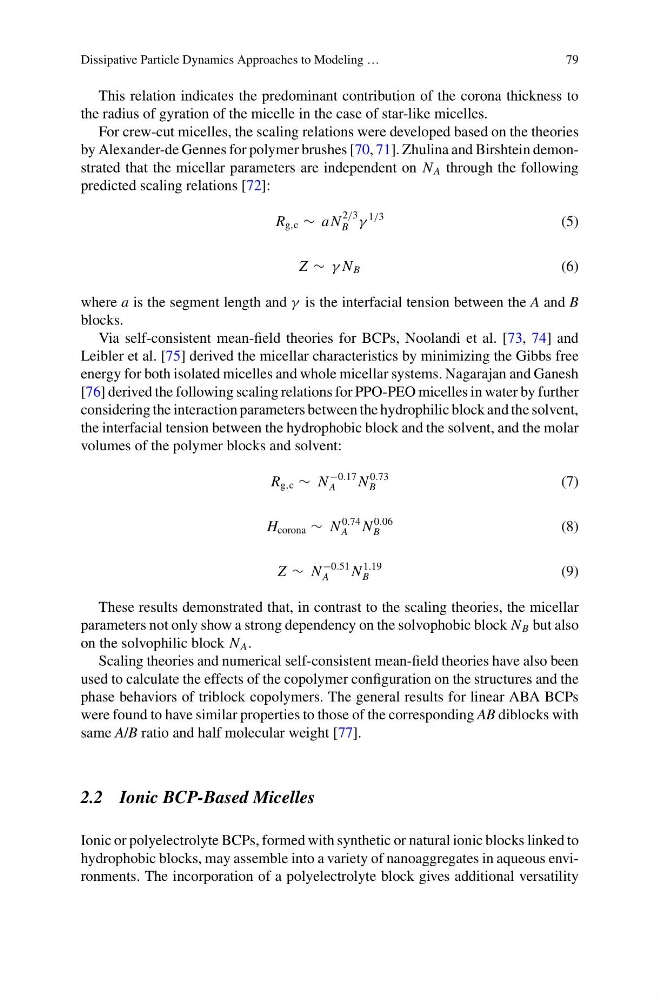
by Alexander-de Gennes for polymer brushes [70, 71]. Zhulina and Birshtein demonstrated that the micellar parameters are independent on N A through the following
predicted scaling relations [72]:
R g,c ∼ a N
2/3
B γ
1/3
(5)
Z ∼ γ N B
(6)
where a is the segment length and γ is the interfacial tension between the A and B
blocks.
Via self-consistent mean-field theories for BCPs, Noolandi et al. [73, 74] and
Leibler et al. [75] derived the micellar characteristics by minimizing the Gibbs free
energy for both isolated micelles and whole micellar systems. Nagarajan and Ganesh
[76] derived the following scaling relations for PPO-PEO micelles in water by further
considering the interaction parameters between the hydrophilic block and the solvent,
the interfacial tension between the hydrophobic block and the solvent, and the molar
volumes of the polymer blocks and solvent:
R g,c ∼ N
−0.17
A
N
0.73
B
(7)
H corona ∼ N
0.74
A N
0.06
B
(8)
Z ∼ N
−0.51
A
N
1.19
B
(9)
These results demonstrated that, in contrast to the scaling theories, the micellar
parameters not only show a strong dependency on the solvophobic block N B but also
on the solvophilic block N A .
Scaling theories and numerical self-consistent mean-field theories have also been
used to calculate the effects of the copolymer configuration on the structures and the
phase behaviors of triblock copolymers. The general results for linear ABA BCPs
were found to have similar properties to those of the corresponding AB diblocks with
same A/B ratio and half molecular weight [77].
2.2 Ionic BCP-Based Micelles
Ionic or polyelectrolyte BCPs, formed with synthetic or natural ionic blocks linked to
hydrophobic blocks, may assemble into a variety of nanoaggregates in aqueous environments. The incorporation of a polyelectrolyte block gives additional versatility
79
This relation indicates the predominant contribution of the corona thickness to
the radius of gyration of the micelle in the case of star-like micelles.
For crew-cut micelles, the scaling relations were developed based on the theories
by Alexander-de Gennes for polymer brushes [70, 71]. Zhulina and Birshtein demonstrated that the micellar parameters are independent on N A through the following
predicted scaling relations [72]:
R g,c ∼ a N
2/3
B γ
1/3
(5)
Z ∼ γ N B
(6)
where a is the segment length and γ is the interfacial tension between the A and B
blocks.
Via self-consistent mean-field theories for BCPs, Noolandi et al. [73, 74] and
Leibler et al. [75] derived the micellar characteristics by minimizing the Gibbs free
energy for both isolated micelles and whole micellar systems. Nagarajan and Ganesh
[76] derived the following scaling relations for PPO-PEO micelles in water by further
considering the interaction parameters between the hydrophilic block and the solvent,
the interfacial tension between the hydrophobic block and the solvent, and the molar
volumes of the polymer blocks and solvent:
R g,c ∼ N
−0.17
A
N
0.73
B
(7)
H corona ∼ N
0.74
A N
0.06
B
(8)
Z ∼ N
−0.51
A
N
1.19
B
(9)
These results demonstrated that, in contrast to the scaling theories, the micellar
parameters not only show a strong dependency on the solvophobic block N B but also
on the solvophilic block N A .
Scaling theories and numerical self-consistent mean-field theories have also been
used to calculate the effects of the copolymer configuration on the structures and the
phase behaviors of triblock copolymers. The general results for linear ABA BCPs
were found to have similar properties to those of the corresponding AB diblocks with
same A/B ratio and half molecular weight [77].
2.2 Ionic BCP-Based Micelles
Ionic or polyelectrolyte BCPs, formed with synthetic or natural ionic blocks linked to
hydrophobic blocks, may assemble into a variety of nanoaggregates in aqueous environments. The incorporation of a polyelectrolyte block gives additional versatility