

Coarse-Grained Modeling and Simulations of Thermoresponsive …
55
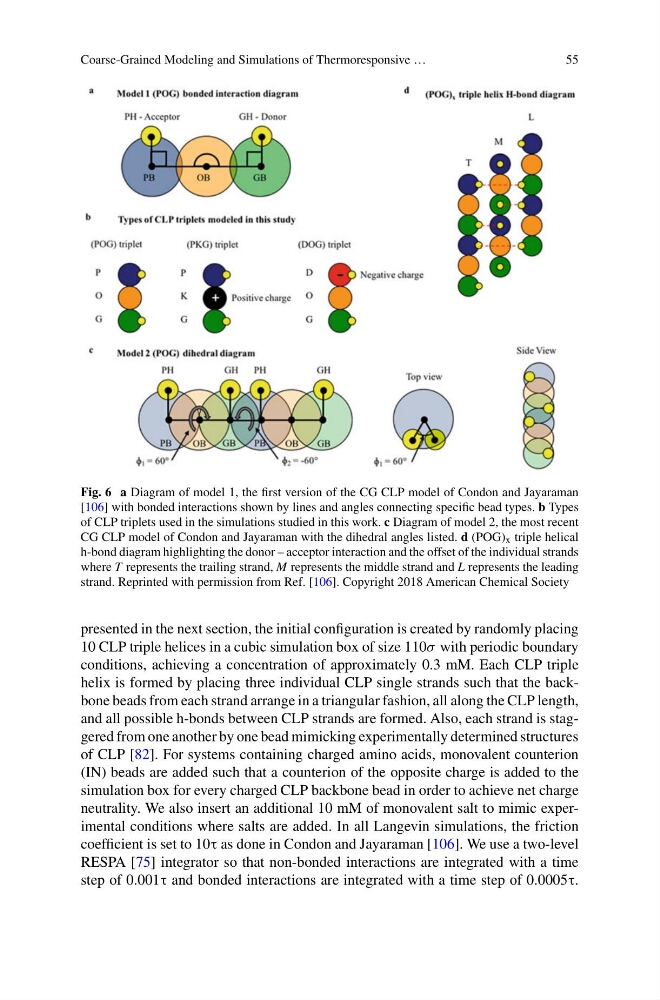
Fig. 6 a Diagram of model 1, the first version of the CG CLP model of Condon and Jayaraman
[106] with bonded interactions shown by lines and angles connecting specific bead types. b Types
of CLP triplets used in the simulations studied in this work. c Diagram of model 2, the most recent
CG CLP model of Condon and Jayaraman with the dihedral angles listed. d (POG) x triple helical
h-bond diagram highlighting the donor – acceptor interaction and the offset of the individual strands
where T represents the trailing strand, M represents the middle strand and L represents the leading
strand. Reprinted with permission from Ref. [106]. Copyright 2018 American Chemical Society
presented in the next section, the initial configuration is created by randomly placing
10 CLP triple helices in a cubic simulation box of size 110σ with periodic boundary
conditions, achieving a concentration of approximately 0.3 mM. Each CLP triple
helix is formed by placing three individual CLP single strands such that the backbone beads from each strand arrange in a triangular fashion, all along the CLP length,
and all possible h-bonds between CLP strands are formed. Also, each strand is staggered from one another by one bead mimicking experimentally determined structures
of CLP [82]. For systems containing charged amino acids, monovalent counterion
(IN) beads are added such that a counterion of the opposite charge is added to the
simulation box for every charged CLP backbone bead in order to achieve net charge
neutrality. We also insert an additional 10 mM of monovalent salt to mimic experimental conditions where salts are added. In all Langevin simulations, the friction
coefficient is set to 10τ as done in Condon and Jayaraman [106]. We use a two-level
RESPA [75] integrator so that non-bonded interactions are integrated with a time
step of 0.001τ and bonded interactions are integrated with a time step of 0.0005τ.
55
Fig. 6 a Diagram of model 1, the first version of the CG CLP model of Condon and Jayaraman
[106] with bonded interactions shown by lines and angles connecting specific bead types. b Types
of CLP triplets used in the simulations studied in this work. c Diagram of model 2, the most recent
CG CLP model of Condon and Jayaraman with the dihedral angles listed. d (POG) x triple helical
h-bond diagram highlighting the donor – acceptor interaction and the offset of the individual strands
where T represents the trailing strand, M represents the middle strand and L represents the leading
strand. Reprinted with permission from Ref. [106]. Copyright 2018 American Chemical Society
presented in the next section, the initial configuration is created by randomly placing
10 CLP triple helices in a cubic simulation box of size 110σ with periodic boundary
conditions, achieving a concentration of approximately 0.3 mM. Each CLP triple
helix is formed by placing three individual CLP single strands such that the backbone beads from each strand arrange in a triangular fashion, all along the CLP length,
and all possible h-bonds between CLP strands are formed. Also, each strand is staggered from one another by one bead mimicking experimentally determined structures
of CLP [82]. For systems containing charged amino acids, monovalent counterion
(IN) beads are added such that a counterion of the opposite charge is added to the
simulation box for every charged CLP backbone bead in order to achieve net charge
neutrality. We also insert an additional 10 mM of monovalent salt to mimic experimental conditions where salts are added. In all Langevin simulations, the friction
coefficient is set to 10τ as done in Condon and Jayaraman [106]. We use a two-level
RESPA [75] integrator so that non-bonded interactions are integrated with a time
step of 0.001τ and bonded interactions are integrated with a time step of 0.0005τ.