

54
A. Jayaraman et al.
interactions, σ ii is set at 0.7σ instead of 0.3σ to ensure that a donor HB bead only
forms an h-bond with a single HB acceptor bead, and vice versa. Next, in order to
account for the directionality of h-bond beads with respect to neighboring h-bond
beads along the same strand, we include two HB bead—BB bead—BB bead—HB
bead dihedral angle potentials:
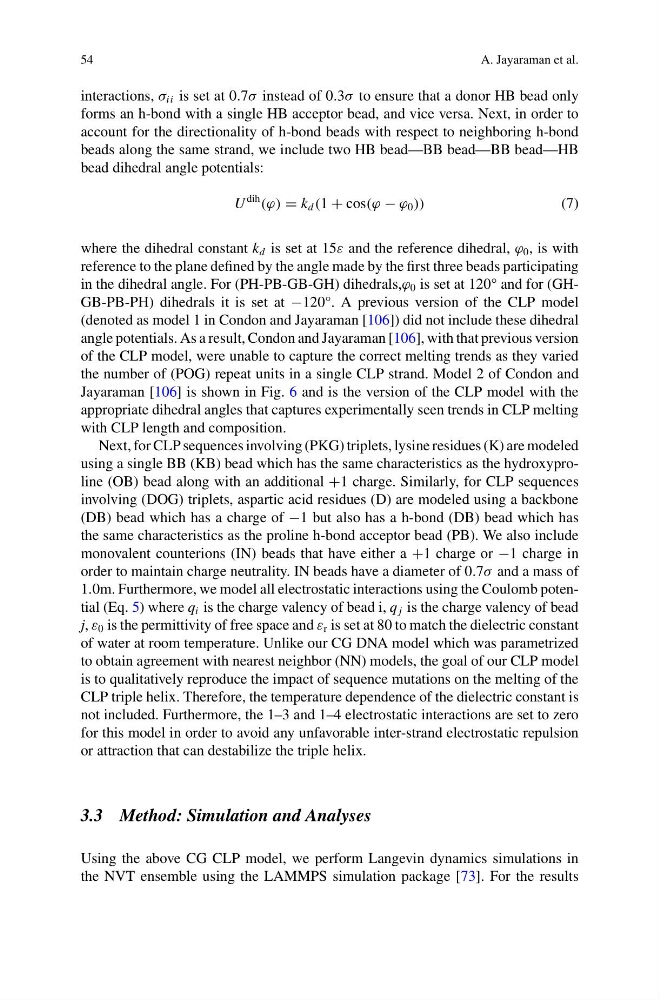
U
dih
(ϕ) = k d (1 + cos(ϕ − ϕ 0 ))
(7)
where the dihedral constant k d is set at 15ε and the reference dihedral, ϕ 0 , is with
reference to the plane defined by the angle made by the first three beads participating
in the dihedral angle. For (PH-PB-GB-GH) dihedrals,ϕ 0 is set at 120° and for (GHGB-PB-PH) dihedrals it is set at −120°. A previous version of the CLP model
(denoted as model 1 in Condon and Jayaraman [106]) did not include these dihedral
angle potentials. As a result, Condon and Jayaraman [106], with that previous version
of the CLP model, were unable to capture the correct melting trends as they varied
the number of (POG) repeat units in a single CLP strand. Model 2 of Condon and
Jayaraman [106] is shown in Fig. 6 and is the version of the CLP model with the
appropriate dihedral angles that captures experimentally seen trends in CLP melting
with CLP length and composition.
Next, for CLP sequences involving (PKG) triplets, lysine residues (K) are modeled
using a single BB (KB) bead which has the same characteristics as the hydroxyproline (OB) bead along with an additional +1 charge. Similarly, for CLP sequences
involving (DOG) triplets, aspartic acid residues (D) are modeled using a backbone
(DB) bead which has a charge of −1 but also has a h-bond (DB) bead which has
the same characteristics as the proline h-bond acceptor bead (PB). We also include
monovalent counterions (IN) beads that have either a +1 charge or −1 charge in
order to maintain charge neutrality. IN beads have a diameter of 0.7σ and a mass of
1.0m. Furthermore, we model all electrostatic interactions using the Coulomb potential (Eq. 5) where q i is the charge valency of bead i, q j is the charge valency of bead
j, ε 0 is the permittivity of free space and ε r is set at 80 to match the dielectric constant
of water at room temperature. Unlike our CG DNA model which was parametrized
to obtain agreement with nearest neighbor (NN) models, the goal of our CLP model
is to qualitatively reproduce the impact of sequence mutations on the melting of the
CLP triple helix. Therefore, the temperature dependence of the dielectric constant is
not included. Furthermore, the 1–3 and 1–4 electrostatic interactions are set to zero
for this model in order to avoid any unfavorable inter-strand electrostatic repulsion
or attraction that can destabilize the triple helix.
3.3 Method: Simulation and Analyses
Using the above CG CLP model, we perform Langevin dynamics simulations in
the NVT ensemble using the LAMMPS simulation package [73]. For the results
A. Jayaraman et al.
interactions, σ ii is set at 0.7σ instead of 0.3σ to ensure that a donor HB bead only
forms an h-bond with a single HB acceptor bead, and vice versa. Next, in order to
account for the directionality of h-bond beads with respect to neighboring h-bond
beads along the same strand, we include two HB bead—BB bead—BB bead—HB
bead dihedral angle potentials:
U
dih
(ϕ) = k d (1 + cos(ϕ − ϕ 0 ))
(7)
where the dihedral constant k d is set at 15ε and the reference dihedral, ϕ 0 , is with
reference to the plane defined by the angle made by the first three beads participating
in the dihedral angle. For (PH-PB-GB-GH) dihedrals,ϕ 0 is set at 120° and for (GHGB-PB-PH) dihedrals it is set at −120°. A previous version of the CLP model
(denoted as model 1 in Condon and Jayaraman [106]) did not include these dihedral
angle potentials. As a result, Condon and Jayaraman [106], with that previous version
of the CLP model, were unable to capture the correct melting trends as they varied
the number of (POG) repeat units in a single CLP strand. Model 2 of Condon and
Jayaraman [106] is shown in Fig. 6 and is the version of the CLP model with the
appropriate dihedral angles that captures experimentally seen trends in CLP melting
with CLP length and composition.
Next, for CLP sequences involving (PKG) triplets, lysine residues (K) are modeled
using a single BB (KB) bead which has the same characteristics as the hydroxyproline (OB) bead along with an additional +1 charge. Similarly, for CLP sequences
involving (DOG) triplets, aspartic acid residues (D) are modeled using a backbone
(DB) bead which has a charge of −1 but also has a h-bond (DB) bead which has
the same characteristics as the proline h-bond acceptor bead (PB). We also include
monovalent counterions (IN) beads that have either a +1 charge or −1 charge in
order to maintain charge neutrality. IN beads have a diameter of 0.7σ and a mass of
1.0m. Furthermore, we model all electrostatic interactions using the Coulomb potential (Eq. 5) where q i is the charge valency of bead i, q j is the charge valency of bead
j, ε 0 is the permittivity of free space and ε r is set at 80 to match the dielectric constant
of water at room temperature. Unlike our CG DNA model which was parametrized
to obtain agreement with nearest neighbor (NN) models, the goal of our CLP model
is to qualitatively reproduce the impact of sequence mutations on the melting of the
CLP triple helix. Therefore, the temperature dependence of the dielectric constant is
not included. Furthermore, the 1–3 and 1–4 electrostatic interactions are set to zero
for this model in order to avoid any unfavorable inter-strand electrostatic repulsion
or attraction that can destabilize the triple helix.
3.3 Method: Simulation and Analyses
Using the above CG CLP model, we perform Langevin dynamics simulations in
the NVT ensemble using the LAMMPS simulation package [73]. For the results