

44
A. Jayaraman et al.
where φ denotes the HB i − BB i − BB j − HB j dihedral angle and k
i j
stacking is the
dihedral force constant (Fig. 2d). The value of k
i j
stacking depends on the identity of
the neighboring i and j nucleobases and is parameterized to match known trends in
DNA melting curves with varying base sequence. These values are not unique but
chosen so that an increase in dihedral force constant will mean an increase in the
alignment of two neighboring nucleobases, and thus, a stronger base–base stacking
interaction. We note that our ONA CG model only captures intra-strand stacking
interactions and does not include any cross-strand stacking interactions.
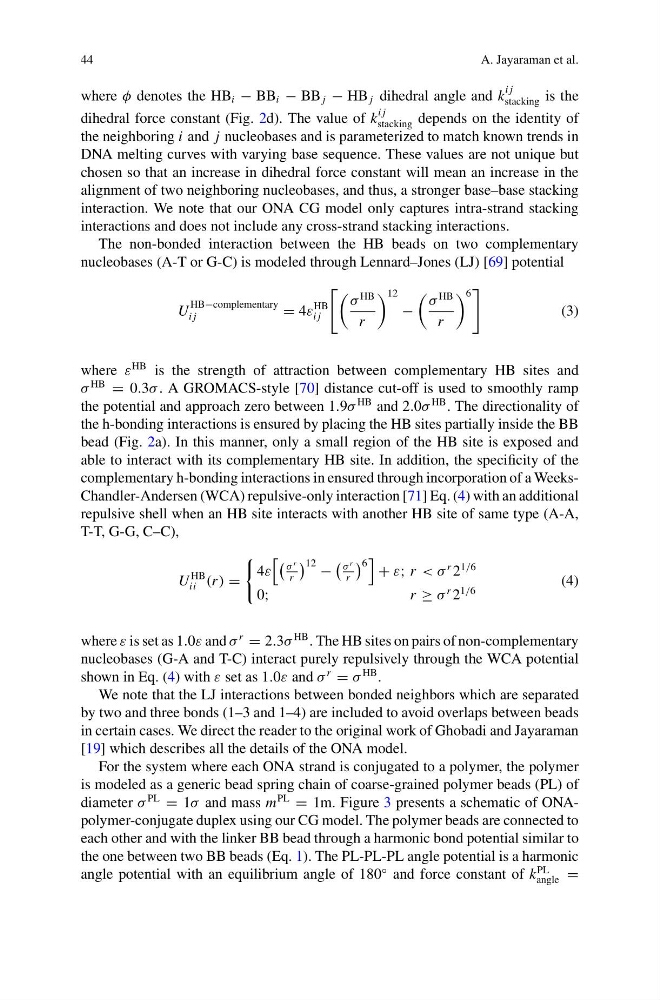
The non-bonded interaction between the HB beads on two complementary
nucleobases (A-T or G-C) is modeled through Lennard–Jones (LJ) [69] potential
U
HB−complementary
i j
= 4ε
HB
i j
σ
HB
r
12
−
σ
HB
r
6
(3)
where ε
HB is the strength of attraction between complementary HB sites and
σ
HB
= 0.3σ . A GROMACS-style [70] distance cut-off is used to smoothly ramp
the potential and approach zero between 1.9σ
HB and 2.0σ
HB . The directionality of
the h-bonding interactions is ensured by placing the HB sites partially inside the BB
bead (Fig. 2a). In this manner, only a small region of the HB site is exposed and
able to interact with its complementary HB site. In addition, the specificity of the
complementary h-bonding interactions in ensured through incorporation of a WeeksChandler-Andersen (WCA) repulsive-only interaction [71] Eq. (4) with an additional
repulsive shell when an HB site interacts with another HB site of same type (A-A,
T-T, G-G, C–C),
U
HB
ii (r ) =
4ε
σ
r
r
12 −
σ
r
r
6
+ ε; r < σ
r 2
1/6
0;
r ≥ σ
r 2
1/6
(4)
where ε is set as 1.0ε and σ
r
= 2.3σ
HB
. The HB sites on pairs of non-complementary
nucleobases (G-A and T-C) interact purely repulsively through the WCA potential
shown in Eq. (4) with ε set as 1.0ε and σ
r
= σ
HB .
We note that the LJ interactions between bonded neighbors which are separated
by two and three bonds (1–3 and 1–4) are included to avoid overlaps between beads
in certain cases. We direct the reader to the original work of Ghobadi and Jayaraman
[19] which describes all the details of the ONA model.
For the system where each ONA strand is conjugated to a polymer, the polymer
is modeled as a generic bead spring chain of coarse-grained polymer beads (PL) of
diameter σ
PL
= 1σ and mass m
PL
= 1m. Figure 3 presents a schematic of ONApolymer-conjugate duplex using our CG model. The polymer beads are connected to
each other and with the linker BB bead through a harmonic bond potential similar to
the one between two BB beads (Eq. 1). The PL-PL-PL angle potential is a harmonic
angle potential with an equilibrium angle of 180
◦ and force constant of k
PL
angle =
A. Jayaraman et al.
where φ denotes the HB i − BB i − BB j − HB j dihedral angle and k
i j
stacking is the
dihedral force constant (Fig. 2d). The value of k
i j
stacking depends on the identity of
the neighboring i and j nucleobases and is parameterized to match known trends in
DNA melting curves with varying base sequence. These values are not unique but
chosen so that an increase in dihedral force constant will mean an increase in the
alignment of two neighboring nucleobases, and thus, a stronger base–base stacking
interaction. We note that our ONA CG model only captures intra-strand stacking
interactions and does not include any cross-strand stacking interactions.
The non-bonded interaction between the HB beads on two complementary
nucleobases (A-T or G-C) is modeled through Lennard–Jones (LJ) [69] potential
U
HB−complementary
i j
= 4ε
HB
i j
σ
HB
r
12
−
σ
HB
r
6
(3)
where ε
HB is the strength of attraction between complementary HB sites and
σ
HB
= 0.3σ . A GROMACS-style [70] distance cut-off is used to smoothly ramp
the potential and approach zero between 1.9σ
HB and 2.0σ
HB . The directionality of
the h-bonding interactions is ensured by placing the HB sites partially inside the BB
bead (Fig. 2a). In this manner, only a small region of the HB site is exposed and
able to interact with its complementary HB site. In addition, the specificity of the
complementary h-bonding interactions in ensured through incorporation of a WeeksChandler-Andersen (WCA) repulsive-only interaction [71] Eq. (4) with an additional
repulsive shell when an HB site interacts with another HB site of same type (A-A,
T-T, G-G, C–C),
U
HB
ii (r ) =
4ε
σ
r
r
12 −
σ
r
r
6
+ ε; r < σ
r 2
1/6
0;
r ≥ σ
r 2
1/6
(4)
where ε is set as 1.0ε and σ
r
= 2.3σ
HB
. The HB sites on pairs of non-complementary
nucleobases (G-A and T-C) interact purely repulsively through the WCA potential
shown in Eq. (4) with ε set as 1.0ε and σ
r
= σ
HB .
We note that the LJ interactions between bonded neighbors which are separated
by two and three bonds (1–3 and 1–4) are included to avoid overlaps between beads
in certain cases. We direct the reader to the original work of Ghobadi and Jayaraman
[19] which describes all the details of the ONA model.
For the system where each ONA strand is conjugated to a polymer, the polymer
is modeled as a generic bead spring chain of coarse-grained polymer beads (PL) of
diameter σ
PL
= 1σ and mass m
PL
= 1m. Figure 3 presents a schematic of ONApolymer-conjugate duplex using our CG model. The polymer beads are connected to
each other and with the linker BB bead through a harmonic bond potential similar to
the one between two BB beads (Eq. 1). The PL-PL-PL angle potential is a harmonic
angle potential with an equilibrium angle of 180
◦ and force constant of k
PL
angle =