

206
L. F. Vega et al.
Structures studied include different families of MOFs (e.g., M-MOF-74, CuBTC,
ZIF-8 and IRMOF-1), zeolites like LTA-4A and FAU-type (a.k.a., zeolite 13X)
[174], activated carbons with different functionalization grade [180], and mesoporous materials such as MCM-41 and silica gel both bare and with alkyl amine
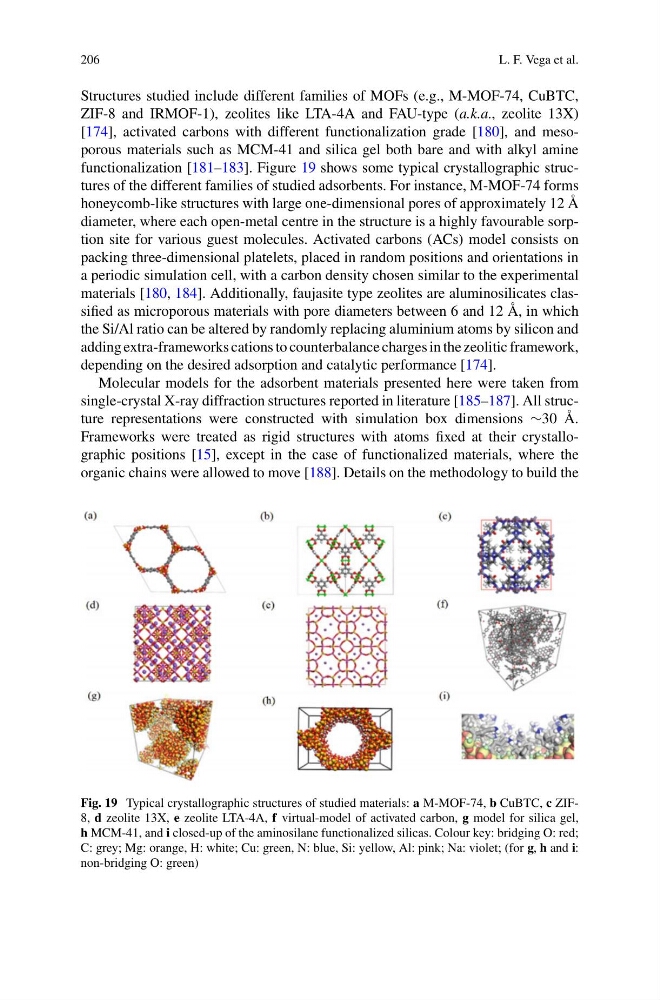
functionalization [181–183]. Figure 19 shows some typical crystallographic structures of the different families of studied adsorbents. For instance, M-MOF-74 forms
honeycomb-like structures with large one-dimensional pores of approximately 12 Å
diameter, where each open-metal centre in the structure is a highly favourable sorption site for various guest molecules. Activated carbons (ACs) model consists on
packing three-dimensional platelets, placed in random positions and orientations in
a periodic simulation cell, with a carbon density chosen similar to the experimental
materials [180, 184]. Additionally, faujasite type zeolites are aluminosilicates classified as microporous materials with pore diameters between 6 and 12 Å, in which
the Si/Al ratio can be altered by randomly replacing aluminium atoms by silicon and
adding extra-frameworks cations to counterbalance charges in the zeolitic framework,
depending on the desired adsorption and catalytic performance [174].
Molecular models for the adsorbent materials presented here were taken from
single-crystal X-ray diffraction structures reported in literature [185–187]. All structure representations were constructed with simulation box dimensions ∼30 Å.
Frameworks were treated as rigid structures with atoms fixed at their crystallographic positions [15], except in the case of functionalized materials, where the
organic chains were allowed to move [188]. Details on the methodology to build the
Fig. 19 Typical crystallographic structures of studied materials: a M-MOF-74, b CuBTC, c ZIF8, d zeolite 13X, e zeolite LTA-4A, f virtual-model of activated carbon, g model for silica gel,
h MCM-41, and i closed-up of the aminosilane functionalized silicas. Colour key: bridging O: red;
C: grey; Mg: orange, H: white; Cu: green, N: blue, Si: yellow, Al: pink; Na: violet; (for g, h and i:
non-bridging O: green)
L. F. Vega et al.
Structures studied include different families of MOFs (e.g., M-MOF-74, CuBTC,
ZIF-8 and IRMOF-1), zeolites like LTA-4A and FAU-type (a.k.a., zeolite 13X)
[174], activated carbons with different functionalization grade [180], and mesoporous materials such as MCM-41 and silica gel both bare and with alkyl amine
functionalization [181–183]. Figure 19 shows some typical crystallographic structures of the different families of studied adsorbents. For instance, M-MOF-74 forms
honeycomb-like structures with large one-dimensional pores of approximately 12 Å
diameter, where each open-metal centre in the structure is a highly favourable sorption site for various guest molecules. Activated carbons (ACs) model consists on
packing three-dimensional platelets, placed in random positions and orientations in
a periodic simulation cell, with a carbon density chosen similar to the experimental
materials [180, 184]. Additionally, faujasite type zeolites are aluminosilicates classified as microporous materials with pore diameters between 6 and 12 Å, in which
the Si/Al ratio can be altered by randomly replacing aluminium atoms by silicon and
adding extra-frameworks cations to counterbalance charges in the zeolitic framework,
depending on the desired adsorption and catalytic performance [174].
Molecular models for the adsorbent materials presented here were taken from
single-crystal X-ray diffraction structures reported in literature [185–187]. All structure representations were constructed with simulation box dimensions ∼30 Å.
Frameworks were treated as rigid structures with atoms fixed at their crystallographic positions [15], except in the case of functionalized materials, where the
organic chains were allowed to move [188]. Details on the methodology to build the
Fig. 19 Typical crystallographic structures of studied materials: a M-MOF-74, b CuBTC, c ZIF8, d zeolite 13X, e zeolite LTA-4A, f virtual-model of activated carbon, g model for silica gel,
h MCM-41, and i closed-up of the aminosilane functionalized silicas. Colour key: bridging O: red;
C: grey; Mg: orange, H: white; Cu: green, N: blue, Si: yellow, Al: pink; Na: violet; (for g, h and i:
non-bridging O: green)