

192
L. F. Vega et al.
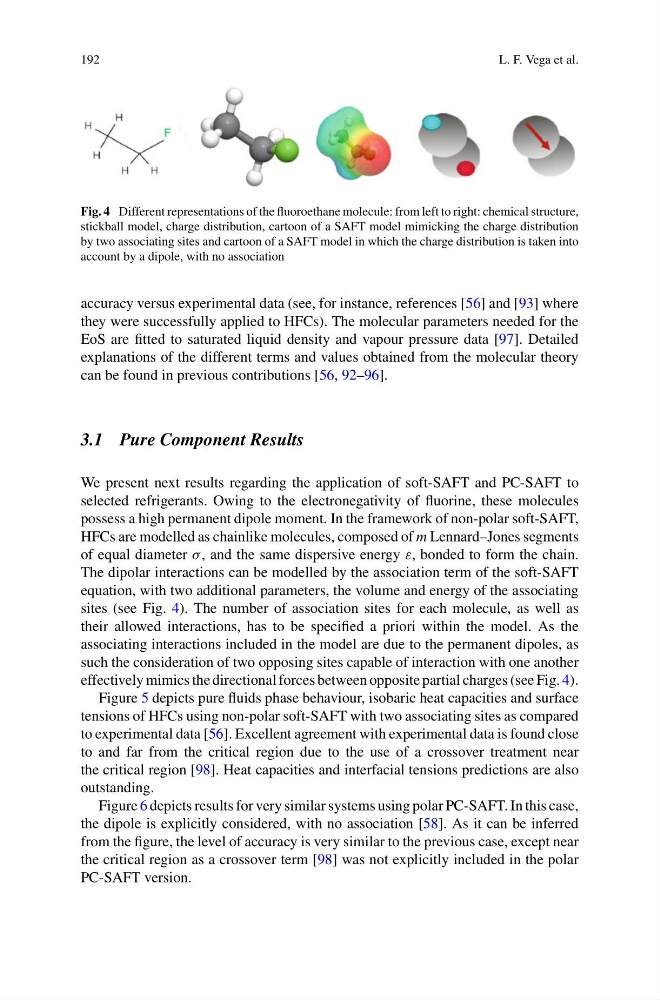
Fig. 4 Different representations of the fluoroethane molecule: from left to right: chemical structure,
stickball model, charge distribution, cartoon of a SAFT model mimicking the charge distribution
by two associating sites and cartoon of a SAFT model in which the charge distribution is taken into
account by a dipole, with no association
accuracy versus experimental data (see, for instance, references [56] and [93] where
they were successfully applied to HFCs). The molecular parameters needed for the
EoS are fitted to saturated liquid density and vapour pressure data [97]. Detailed
explanations of the different terms and values obtained from the molecular theory
can be found in previous contributions [56, 92–96].
3.1 Pure Component Results
We present next results regarding the application of soft-SAFT and PC-SAFT to
selected refrigerants. Owing to the electronegativity of fluorine, these molecules
possess a high permanent dipole moment. In the framework of non-polar soft-SAFT,
HFCs are modelled as chainlike molecules, composed of m Lennard–Jones segments
of equal diameter σ, and the same dispersive energy ε, bonded to form the chain.
The dipolar interactions can be modelled by the association term of the soft-SAFT
equation, with two additional parameters, the volume and energy of the associating
sites (see Fig. 4). The number of association sites for each molecule, as well as
their allowed interactions, has to be specified a priori within the model. As the
associating interactions included in the model are due to the permanent dipoles, as
such the consideration of two opposing sites capable of interaction with one another
effectively mimics the directional forces between opposite partial charges (see Fig. 4).
Figure 5 depicts pure fluids phase behaviour, isobaric heat capacities and surface
tensions of HFCs using non-polar soft-SAFT with two associating sites as compared
to experimental data [56]. Excellent agreement with experimental data is found close
to and far from the critical region due to the use of a crossover treatment near
the critical region [98]. Heat capacities and interfacial tensions predictions are also
outstanding.
Figure 6 depicts results for very similar systems using polar PC-SAFT. In this case,
the dipole is explicitly considered, with no association [58]. As it can be inferred
from the figure, the level of accuracy is very similar to the previous case, except near
the critical region as a crossover term [98] was not explicitly included in the polar
PC-SAFT version.
L. F. Vega et al.
Fig. 4 Different representations of the fluoroethane molecule: from left to right: chemical structure,
stickball model, charge distribution, cartoon of a SAFT model mimicking the charge distribution
by two associating sites and cartoon of a SAFT model in which the charge distribution is taken into
account by a dipole, with no association
accuracy versus experimental data (see, for instance, references [56] and [93] where
they were successfully applied to HFCs). The molecular parameters needed for the
EoS are fitted to saturated liquid density and vapour pressure data [97]. Detailed
explanations of the different terms and values obtained from the molecular theory
can be found in previous contributions [56, 92–96].
3.1 Pure Component Results
We present next results regarding the application of soft-SAFT and PC-SAFT to
selected refrigerants. Owing to the electronegativity of fluorine, these molecules
possess a high permanent dipole moment. In the framework of non-polar soft-SAFT,
HFCs are modelled as chainlike molecules, composed of m Lennard–Jones segments
of equal diameter σ, and the same dispersive energy ε, bonded to form the chain.
The dipolar interactions can be modelled by the association term of the soft-SAFT
equation, with two additional parameters, the volume and energy of the associating
sites (see Fig. 4). The number of association sites for each molecule, as well as
their allowed interactions, has to be specified a priori within the model. As the
associating interactions included in the model are due to the permanent dipoles, as
such the consideration of two opposing sites capable of interaction with one another
effectively mimics the directional forces between opposite partial charges (see Fig. 4).
Figure 5 depicts pure fluids phase behaviour, isobaric heat capacities and surface
tensions of HFCs using non-polar soft-SAFT with two associating sites as compared
to experimental data [56]. Excellent agreement with experimental data is found close
to and far from the critical region due to the use of a crossover treatment near
the critical region [98]. Heat capacities and interfacial tensions predictions are also
outstanding.
Figure 6 depicts results for very similar systems using polar PC-SAFT. In this case,
the dipole is explicitly considered, with no association [58]. As it can be inferred
from the figure, the level of accuracy is very similar to the previous case, except near
the critical region as a crossover term [98] was not explicitly included in the polar
PC-SAFT version.