

Coarse-Grained Force Fields Built on Atomistic …
167
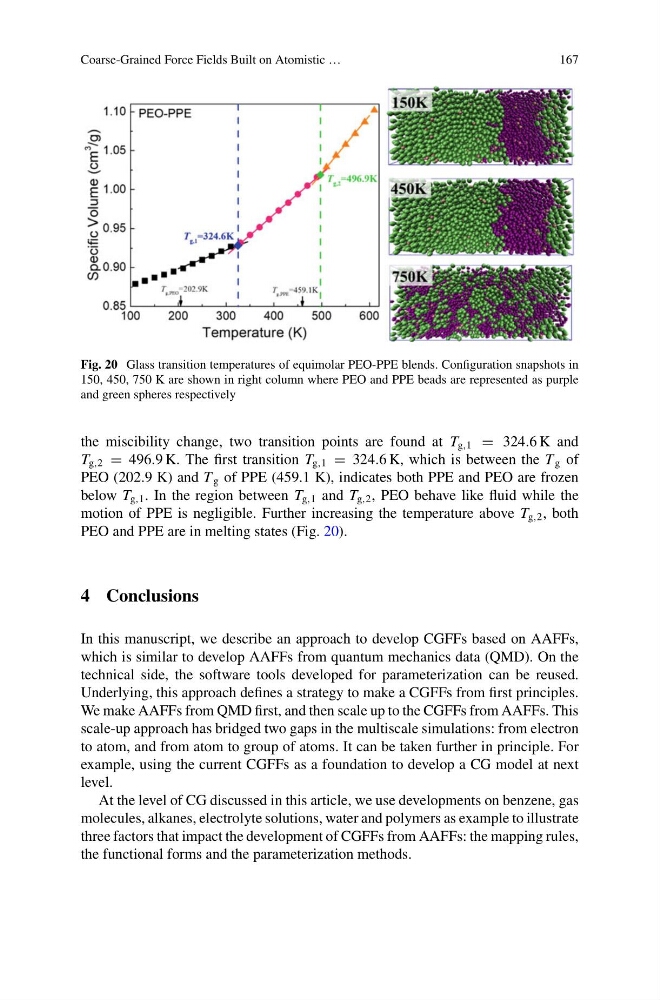
Fig. 20 Glass transition temperatures of equimolar PEO-PPE blends. Configuration snapshots in
150, 450, 750 K are shown in right column where PEO and PPE beads are represented as purple
and green spheres respectively
the miscibility change, two transition points are found at T g,1 = 324.6 K and
T g,2 = 496.9 K. The first transition T g,1 = 324.6 K, which is between the T g of
PEO (202.9 K) and T g of PPE (459.1 K), indicates both PPE and PEO are frozen
below T g,1 . In the region between T g,1 and T g,2 , PEO behave like fluid while the
motion of PPE is negligible. Further increasing the temperature above T g,2 , both
PEO and PPE are in melting states (Fig. 20).
4 Conclusions
In this manuscript, we describe an approach to develop CGFFs based on AAFFs,
which is similar to develop AAFFs from quantum mechanics data (QMD). On the
technical side, the software tools developed for parameterization can be reused.
Underlying, this approach defines a strategy to make a CGFFs from first principles.
We make AAFFs from QMD first, and then scale up to the CGFFs from AAFFs. This
scale-up approach has bridged two gaps in the multiscale simulations: from electron
to atom, and from atom to group of atoms. It can be taken further in principle. For
example, using the current CGFFs as a foundation to develop a CG model at next
level.
At the level of CG discussed in this article, we use developments on benzene, gas
molecules, alkanes, electrolyte solutions, water and polymers as example to illustrate
three factors that impact the development of CGFFs from AAFFs: the mapping rules,
the functional forms and the parameterization methods.
167
Fig. 20 Glass transition temperatures of equimolar PEO-PPE blends. Configuration snapshots in
150, 450, 750 K are shown in right column where PEO and PPE beads are represented as purple
and green spheres respectively
the miscibility change, two transition points are found at T g,1 = 324.6 K and
T g,2 = 496.9 K. The first transition T g,1 = 324.6 K, which is between the T g of
PEO (202.9 K) and T g of PPE (459.1 K), indicates both PPE and PEO are frozen
below T g,1 . In the region between T g,1 and T g,2 , PEO behave like fluid while the
motion of PPE is negligible. Further increasing the temperature above T g,2 , both
PEO and PPE are in melting states (Fig. 20).
4 Conclusions
In this manuscript, we describe an approach to develop CGFFs based on AAFFs,
which is similar to develop AAFFs from quantum mechanics data (QMD). On the
technical side, the software tools developed for parameterization can be reused.
Underlying, this approach defines a strategy to make a CGFFs from first principles.
We make AAFFs from QMD first, and then scale up to the CGFFs from AAFFs. This
scale-up approach has bridged two gaps in the multiscale simulations: from electron
to atom, and from atom to group of atoms. It can be taken further in principle. For
example, using the current CGFFs as a foundation to develop a CG model at next
level.
At the level of CG discussed in this article, we use developments on benzene, gas
molecules, alkanes, electrolyte solutions, water and polymers as example to illustrate
three factors that impact the development of CGFFs from AAFFs: the mapping rules,
the functional forms and the parameterization methods.