

166
H. Sun et al.
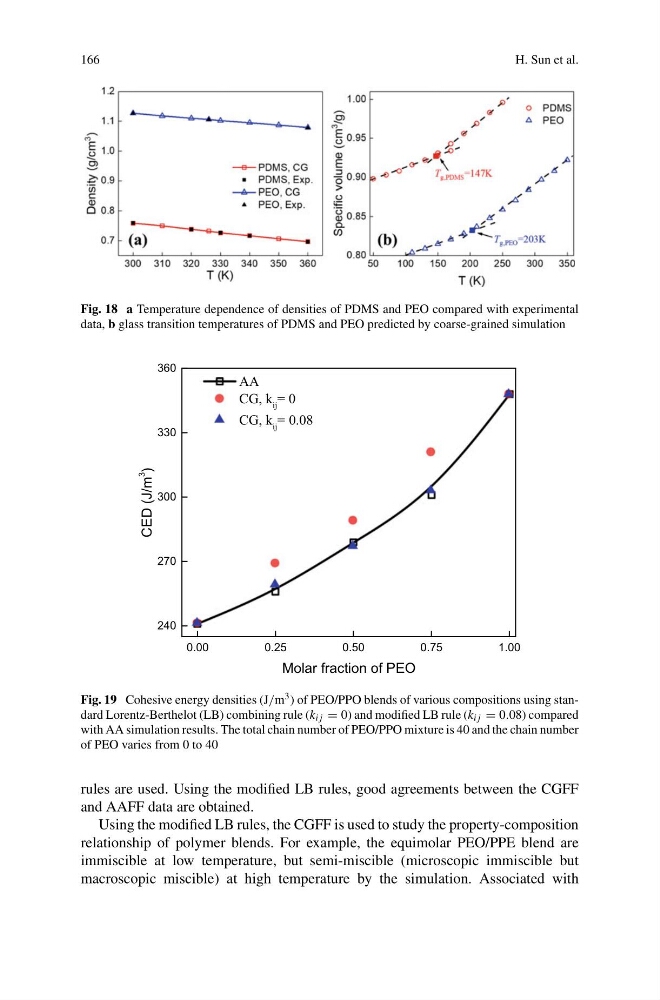
Fig. 18 a Temperature dependence of densities of PDMS and PEO compared with experimental
data, b glass transition temperatures of PDMS and PEO predicted by coarse-grained simulation
0.00
0.25
0.50
0.75
1.00
240
270
300
330
360
CED (J/m
3
)
Molar fraction of PEO
AA
CG, k ij = 0
CG, k ij = 0.08
Fig. 19 Cohesive energy densities (J/m 3 ) of PEO/PPO blends of various compositions using standard Lorentz-Berthelot (LB) combining rule (k i j = 0) and modified LB rule (k i j = 0.08) compared
with AA simulation results. The total chain number of PEO/PPO mixture is 40 and the chain number
of PEO varies from 0 to 40
rules are used. Using the modified LB rules, good agreements between the CGFF
and AAFF data are obtained.
Using the modified LB rules, the CGFF is used to study the property-composition
relationship of polymer blends. For example, the equimolar PEO/PPE blend are
immiscible at low temperature, but semi-miscible (microscopic immiscible but
macroscopic miscible) at high temperature by the simulation. Associated with
H. Sun et al.
Fig. 18 a Temperature dependence of densities of PDMS and PEO compared with experimental
data, b glass transition temperatures of PDMS and PEO predicted by coarse-grained simulation
0.00
0.25
0.50
0.75
1.00
240
270
300
330
360
CED (J/m
3
)
Molar fraction of PEO
AA
CG, k ij = 0
CG, k ij = 0.08
Fig. 19 Cohesive energy densities (J/m 3 ) of PEO/PPO blends of various compositions using standard Lorentz-Berthelot (LB) combining rule (k i j = 0) and modified LB rule (k i j = 0.08) compared
with AA simulation results. The total chain number of PEO/PPO mixture is 40 and the chain number
of PEO varies from 0 to 40
rules are used. Using the modified LB rules, good agreements between the CGFF
and AAFF data are obtained.
Using the modified LB rules, the CGFF is used to study the property-composition
relationship of polymer blends. For example, the equimolar PEO/PPE blend are
immiscible at low temperature, but semi-miscible (microscopic immiscible but
macroscopic miscible) at high temperature by the simulation. Associated with