

Coarse-Grained Force Fields Built on Atomistic …
159
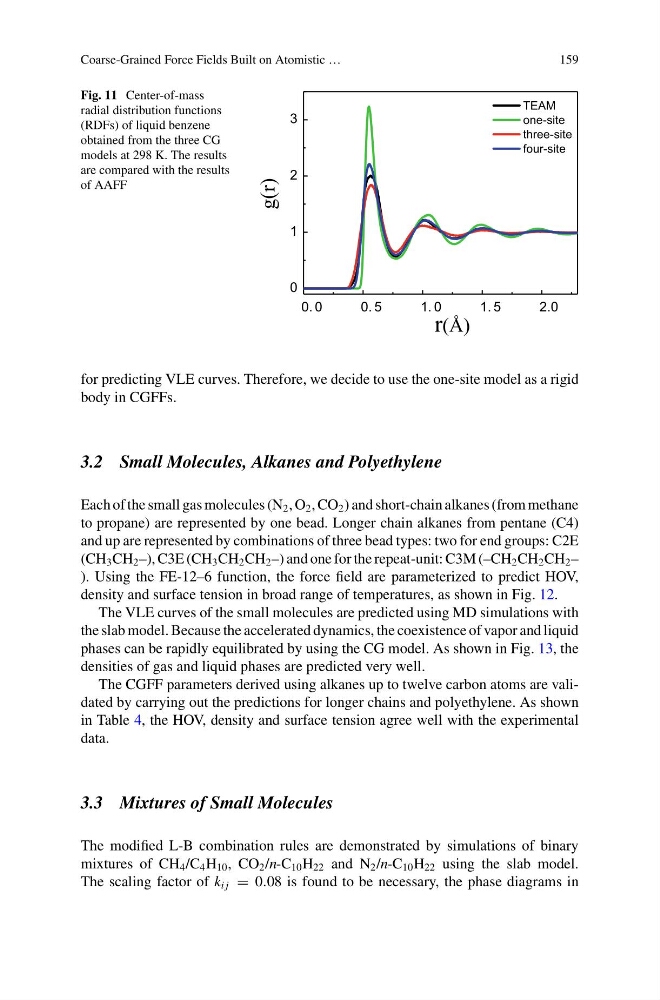
Fig. 11 Center-of-mass
radial distribution functions
(RDFs) of liquid benzene
obtained from the three CG
models at 298 K. The results
are compared with the results
of AAFF
0. 0
0. 5
1. 0
1. 5
2.0
0
1
2
3
r(Å)
TEAM
one-site
three-site
four-site
g(r)
for predicting VLE curves. Therefore, we decide to use the one-site model as a rigid
body in CGFFs.
3.2 Small Molecules, Alkanes and Polyethylene
Each of the small gas molecules (N 2 , O 2 , CO 2 ) and short-chain alkanes (from methane
to propane) are represented by one bead. Longer chain alkanes from pentane (C4)
and up are represented by combinations of three bead types: two for end groups: C2E
(CH 3 CH 2 –), C3E (CH 3 CH 2 CH 2 –) and one for the repeat-unit: C3M (–CH 2 CH 2 CH 2 –
). Using the FE-12–6 function, the force field are parameterized to predict HOV,
density and surface tension in broad range of temperatures, as shown in Fig. 12.
The VLE curves of the small molecules are predicted using MD simulations with
the slab model. Because the accelerated dynamics, the coexistence of vapor and liquid
phases can be rapidly equilibrated by using the CG model. As shown in Fig. 13, the
densities of gas and liquid phases are predicted very well.
The CGFF parameters derived using alkanes up to twelve carbon atoms are validated by carrying out the predictions for longer chains and polyethylene. As shown
in Table 4, the HOV, density and surface tension agree well with the experimental
data.
3.3 Mixtures of Small Molecules
The modified L-B combination rules are demonstrated by simulations of binary
mixtures of CH 4 /C 4 H 10 , CO 2 /n-C 10 H 22 and N 2 /n-C 10 H 22 using the slab model.
The scaling factor of k i j = 0.08 is found to be necessary, the phase diagrams in
159
Fig. 11 Center-of-mass
radial distribution functions
(RDFs) of liquid benzene
obtained from the three CG
models at 298 K. The results
are compared with the results
of AAFF
0. 0
0. 5
1. 0
1. 5
2.0
0
1
2
3
r(Å)
TEAM
one-site
three-site
four-site
g(r)
for predicting VLE curves. Therefore, we decide to use the one-site model as a rigid
body in CGFFs.
3.2 Small Molecules, Alkanes and Polyethylene
Each of the small gas molecules (N 2 , O 2 , CO 2 ) and short-chain alkanes (from methane
to propane) are represented by one bead. Longer chain alkanes from pentane (C4)
and up are represented by combinations of three bead types: two for end groups: C2E
(CH 3 CH 2 –), C3E (CH 3 CH 2 CH 2 –) and one for the repeat-unit: C3M (–CH 2 CH 2 CH 2 –
). Using the FE-12–6 function, the force field are parameterized to predict HOV,
density and surface tension in broad range of temperatures, as shown in Fig. 12.
The VLE curves of the small molecules are predicted using MD simulations with
the slab model. Because the accelerated dynamics, the coexistence of vapor and liquid
phases can be rapidly equilibrated by using the CG model. As shown in Fig. 13, the
densities of gas and liquid phases are predicted very well.
The CGFF parameters derived using alkanes up to twelve carbon atoms are validated by carrying out the predictions for longer chains and polyethylene. As shown
in Table 4, the HOV, density and surface tension agree well with the experimental
data.
3.3 Mixtures of Small Molecules
The modified L-B combination rules are demonstrated by simulations of binary
mixtures of CH 4 /C 4 H 10 , CO 2 /n-C 10 H 22 and N 2 /n-C 10 H 22 using the slab model.
The scaling factor of k i j = 0.08 is found to be necessary, the phase diagrams in