

158
H. Sun et al.
Table 2 The diffusion coefficient, compressibility and thermal expansion coefficient of benzene
calculated using the one-, three- and four-site models at 298 K
One-site
Three-site
Four-site
Experiment
Diffusion coefficient, D
(10 −5 cm 2 /s)
22.83 ± 0.33
3.29 ± 0.003
2.12 ± 0.048
2.27 a
Compressibility (J/m 3 )
1.34 × 10 −9
1.03 × 10 −9
1.04 × 10 −9
9.70 × 10 −10b
Thermal expansion (1/K) 0.000954
0.00104
0.00110
0.00122 c
a From Ref. [49]. b From Ref. [51]. c From Ref. [52]
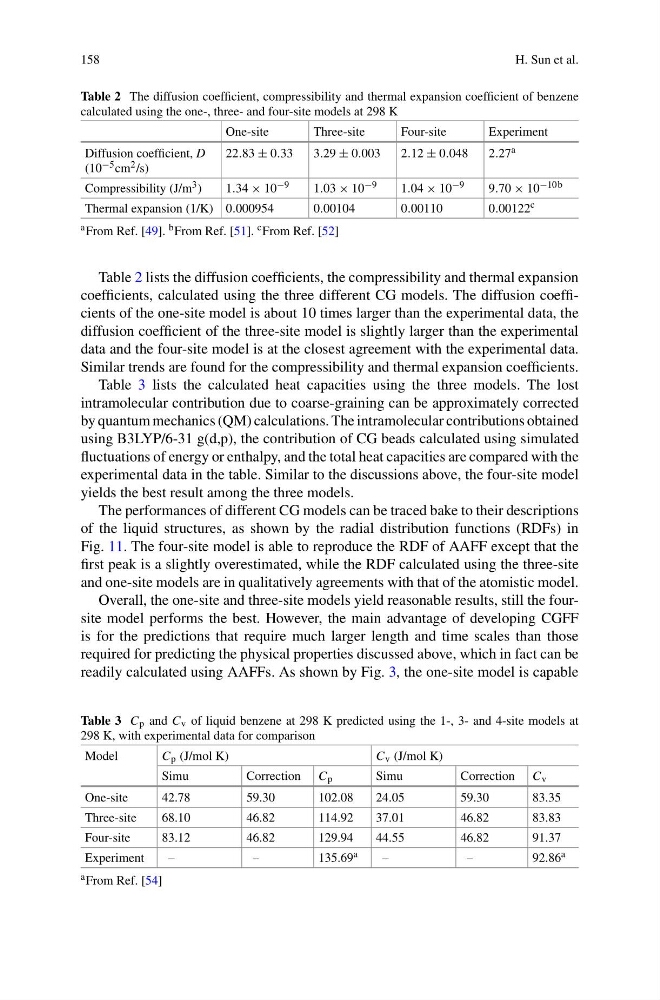
Table 2 lists the diffusion coefficients, the compressibility and thermal expansion
coefficients, calculated using the three different CG models. The diffusion coefficients of the one-site model is about 10 times larger than the experimental data, the
diffusion coefficient of the three-site model is slightly larger than the experimental
data and the four-site model is at the closest agreement with the experimental data.
Similar trends are found for the compressibility and thermal expansion coefficients.
Table 3 lists the calculated heat capacities using the three models. The lost
intramolecular contribution due to coarse-graining can be approximately corrected
by quantum mechanics (QM) calculations. The intramolecular contributions obtained
using B3LYP/6-31 g(d,p), the contribution of CG beads calculated using simulated
fluctuations of energy or enthalpy, and the total heat capacities are compared with the
experimental data in the table. Similar to the discussions above, the four-site model
yields the best result among the three models.
The performances of different CG models can be traced bake to their descriptions
of the liquid structures, as shown by the radial distribution functions (RDFs) in
Fig. 11. The four-site model is able to reproduce the RDF of AAFF except that the
first peak is a slightly overestimated, while the RDF calculated using the three-site
and one-site models are in qualitatively agreements with that of the atomistic model.
Overall, the one-site and three-site models yield reasonable results, still the foursite model performs the best. However, the main advantage of developing CGFF
is for the predictions that require much larger length and time scales than those
required for predicting the physical properties discussed above, which in fact can be
readily calculated using AAFFs. As shown by Fig. 3, the one-site model is capable
Table 3 C p and C v of liquid benzene at 298 K predicted using the 1-, 3- and 4-site models at
298 K, with experimental data for comparison
Model
C p (J/mol K)
C v (J/mol K)
Simu
Correction C p
Simu
Correction C v
One-site
42.78
59.30
102.08
24.05
59.30
83.35
Three-site
68.10
46.82
114.92
37.01
46.82
83.83
Four-site
83.12
46.82
129.94
44.55
46.82
91.37
Experiment
–
–
135.69 a
–
–
92.86 a
a From Ref. [54]
H. Sun et al.
Table 2 The diffusion coefficient, compressibility and thermal expansion coefficient of benzene
calculated using the one-, three- and four-site models at 298 K
One-site
Three-site
Four-site
Experiment
Diffusion coefficient, D
(10 −5 cm 2 /s)
22.83 ± 0.33
3.29 ± 0.003
2.12 ± 0.048
2.27 a
Compressibility (J/m 3 )
1.34 × 10 −9
1.03 × 10 −9
1.04 × 10 −9
9.70 × 10 −10b
Thermal expansion (1/K) 0.000954
0.00104
0.00110
0.00122 c
a From Ref. [49]. b From Ref. [51]. c From Ref. [52]
Table 2 lists the diffusion coefficients, the compressibility and thermal expansion
coefficients, calculated using the three different CG models. The diffusion coefficients of the one-site model is about 10 times larger than the experimental data, the
diffusion coefficient of the three-site model is slightly larger than the experimental
data and the four-site model is at the closest agreement with the experimental data.
Similar trends are found for the compressibility and thermal expansion coefficients.
Table 3 lists the calculated heat capacities using the three models. The lost
intramolecular contribution due to coarse-graining can be approximately corrected
by quantum mechanics (QM) calculations. The intramolecular contributions obtained
using B3LYP/6-31 g(d,p), the contribution of CG beads calculated using simulated
fluctuations of energy or enthalpy, and the total heat capacities are compared with the
experimental data in the table. Similar to the discussions above, the four-site model
yields the best result among the three models.
The performances of different CG models can be traced bake to their descriptions
of the liquid structures, as shown by the radial distribution functions (RDFs) in
Fig. 11. The four-site model is able to reproduce the RDF of AAFF except that the
first peak is a slightly overestimated, while the RDF calculated using the three-site
and one-site models are in qualitatively agreements with that of the atomistic model.
Overall, the one-site and three-site models yield reasonable results, still the foursite model performs the best. However, the main advantage of developing CGFF
is for the predictions that require much larger length and time scales than those
required for predicting the physical properties discussed above, which in fact can be
readily calculated using AAFFs. As shown by Fig. 3, the one-site model is capable
Table 3 C p and C v of liquid benzene at 298 K predicted using the 1-, 3- and 4-site models at
298 K, with experimental data for comparison
Model
C p (J/mol K)
C v (J/mol K)
Simu
Correction C p
Simu
Correction C v
One-site
42.78
59.30
102.08
24.05
59.30
83.35
Three-site
68.10
46.82
114.92
37.01
46.82
83.83
Four-site
83.12
46.82
129.94
44.55
46.82
91.37
Experiment
–
–
135.69 a
–
–
92.86 a
a From Ref. [54]