

Efficient Sampling of High-Dimensional …
137
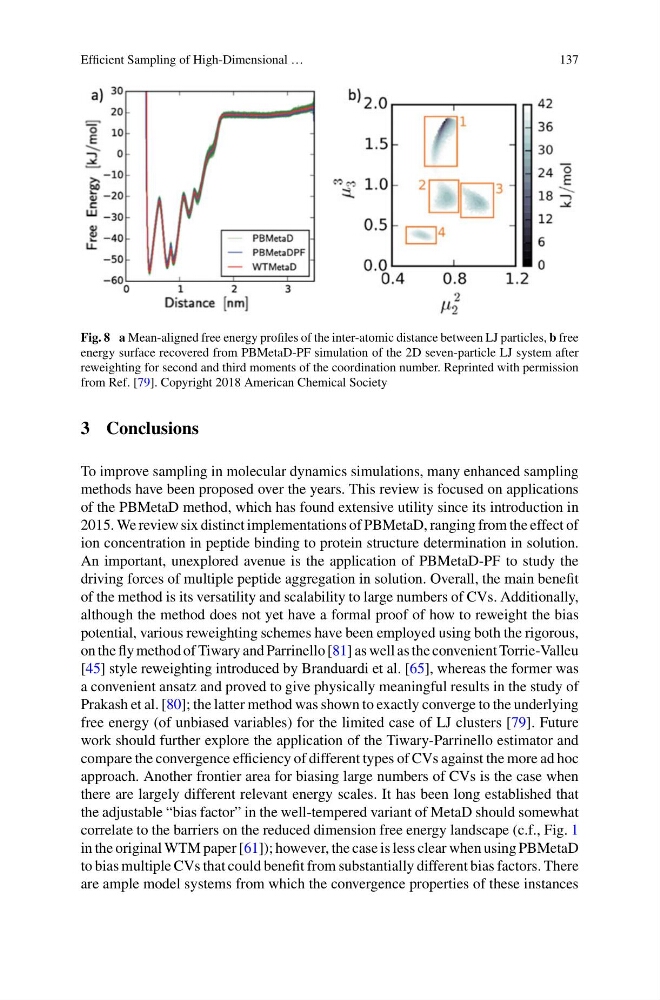
Fig. 8 a Mean-aligned free energy profiles of the inter-atomic distance between LJ particles, b free
energy surface recovered from PBMetaD-PF simulation of the 2D seven-particle LJ system after
reweighting for second and third moments of the coordination number. Reprinted with permission
from Ref. [79]. Copyright 2018 American Chemical Society
3 Conclusions
To improve sampling in molecular dynamics simulations, many enhanced sampling
methods have been proposed over the years. This review is focused on applications
of the PBMetaD method, which has found extensive utility since its introduction in
2015. We review six distinct implementations of PBMetaD, ranging from the effect of
ion concentration in peptide binding to protein structure determination in solution.
An important, unexplored avenue is the application of PBMetaD-PF to study the
driving forces of multiple peptide aggregation in solution. Overall, the main benefit
of the method is its versatility and scalability to large numbers of CVs. Additionally,
although the method does not yet have a formal proof of how to reweight the bias
potential, various reweighting schemes have been employed using both the rigorous,
on the fly method of Tiwary and Parrinello [81] as well as the convenient Torrie-Valleu
[45] style reweighting introduced by Branduardi et al. [65], whereas the former was
a convenient ansatz and proved to give physically meaningful results in the study of
Prakash et al. [80]; the latter method was shown to exactly converge to the underlying
free energy (of unbiased variables) for the limited case of LJ clusters [79]. Future
work should further explore the application of the Tiwary-Parrinello estimator and
compare the convergence efficiency of different types of CVs against the more ad hoc
approach. Another frontier area for biasing large numbers of CVs is the case when
there are largely different relevant energy scales. It has been long established that
the adjustable “bias factor” in the well-tempered variant of MetaD should somewhat
correlate to the barriers on the reduced dimension free energy landscape (c.f., Fig. 1
in the original WTM paper [61]); however, the case is less clear when using PBMetaD
to bias multiple CVs that could benefit from substantially different bias factors. There
are ample model systems from which the convergence properties of these instances
137
Fig. 8 a Mean-aligned free energy profiles of the inter-atomic distance between LJ particles, b free
energy surface recovered from PBMetaD-PF simulation of the 2D seven-particle LJ system after
reweighting for second and third moments of the coordination number. Reprinted with permission
from Ref. [79]. Copyright 2018 American Chemical Society
3 Conclusions
To improve sampling in molecular dynamics simulations, many enhanced sampling
methods have been proposed over the years. This review is focused on applications
of the PBMetaD method, which has found extensive utility since its introduction in
2015. We review six distinct implementations of PBMetaD, ranging from the effect of
ion concentration in peptide binding to protein structure determination in solution.
An important, unexplored avenue is the application of PBMetaD-PF to study the
driving forces of multiple peptide aggregation in solution. Overall, the main benefit
of the method is its versatility and scalability to large numbers of CVs. Additionally,
although the method does not yet have a formal proof of how to reweight the bias
potential, various reweighting schemes have been employed using both the rigorous,
on the fly method of Tiwary and Parrinello [81] as well as the convenient Torrie-Valleu
[45] style reweighting introduced by Branduardi et al. [65], whereas the former was
a convenient ansatz and proved to give physically meaningful results in the study of
Prakash et al. [80]; the latter method was shown to exactly converge to the underlying
free energy (of unbiased variables) for the limited case of LJ clusters [79]. Future
work should further explore the application of the Tiwary-Parrinello estimator and
compare the convergence efficiency of different types of CVs against the more ad hoc
approach. Another frontier area for biasing large numbers of CVs is the case when
there are largely different relevant energy scales. It has been long established that
the adjustable “bias factor” in the well-tempered variant of MetaD should somewhat
correlate to the barriers on the reduced dimension free energy landscape (c.f., Fig. 1
in the original WTM paper [61]); however, the case is less clear when using PBMetaD
to bias multiple CVs that could benefit from substantially different bias factors. There
are ample model systems from which the convergence properties of these instances