

136
S. Alamdari et al.
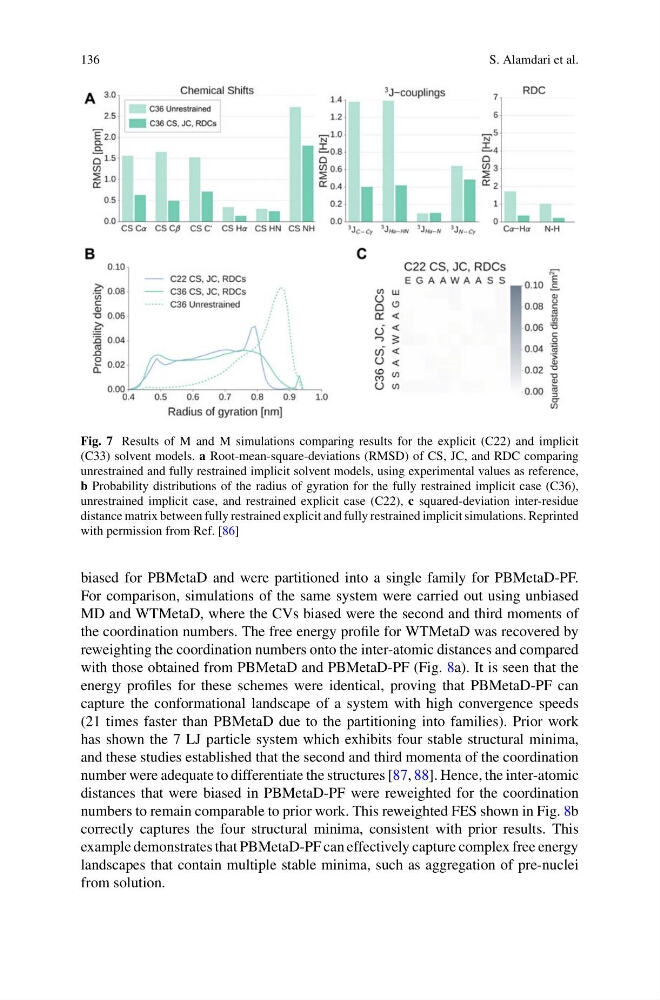
Fig. 7 Results of M and M simulations comparing results for the explicit (C22) and implicit
(C33) solvent models. a Root-mean-square-deviations (RMSD) of CS, JC, and RDC comparing
unrestrained and fully restrained implicit solvent models, using experimental values as reference,
b Probability distributions of the radius of gyration for the fully restrained implicit case (C36),
unrestrained implicit case, and restrained explicit case (C22), c squared-deviation inter-residue
distance matrix between fully restrained explicit and fully restrained implicit simulations. Reprinted
with permission from Ref. [86]
biased for PBMetaD and were partitioned into a single family for PBMetaD-PF.
For comparison, simulations of the same system were carried out using unbiased
MD and WTMetaD, where the CVs biased were the second and third moments of
the coordination numbers. The free energy profile for WTMetaD was recovered by
reweighting the coordination numbers onto the inter-atomic distances and compared
with those obtained from PBMetaD and PBMetaD-PF (Fig. 8a). It is seen that the
energy profiles for these schemes were identical, proving that PBMetaD-PF can
capture the conformational landscape of a system with high convergence speeds
(21 times faster than PBMetaD due to the partitioning into families). Prior work
has shown the 7 LJ particle system which exhibits four stable structural minima,
and these studies established that the second and third momenta of the coordination
number were adequate to differentiate the structures [87, 88]. Hence, the inter-atomic
distances that were biased in PBMetaD-PF were reweighted for the coordination
numbers to remain comparable to prior work. This reweighted FES shown in Fig. 8b
correctly captures the four structural minima, consistent with prior results. This
example demonstrates that PBMetaD-PF can effectively capture complex free energy
landscapes that contain multiple stable minima, such as aggregation of pre-nuclei
from solution.
S. Alamdari et al.
Fig. 7 Results of M and M simulations comparing results for the explicit (C22) and implicit
(C33) solvent models. a Root-mean-square-deviations (RMSD) of CS, JC, and RDC comparing
unrestrained and fully restrained implicit solvent models, using experimental values as reference,
b Probability distributions of the radius of gyration for the fully restrained implicit case (C36),
unrestrained implicit case, and restrained explicit case (C22), c squared-deviation inter-residue
distance matrix between fully restrained explicit and fully restrained implicit simulations. Reprinted
with permission from Ref. [86]
biased for PBMetaD and were partitioned into a single family for PBMetaD-PF.
For comparison, simulations of the same system were carried out using unbiased
MD and WTMetaD, where the CVs biased were the second and third moments of
the coordination numbers. The free energy profile for WTMetaD was recovered by
reweighting the coordination numbers onto the inter-atomic distances and compared
with those obtained from PBMetaD and PBMetaD-PF (Fig. 8a). It is seen that the
energy profiles for these schemes were identical, proving that PBMetaD-PF can
capture the conformational landscape of a system with high convergence speeds
(21 times faster than PBMetaD due to the partitioning into families). Prior work
has shown the 7 LJ particle system which exhibits four stable structural minima,
and these studies established that the second and third momenta of the coordination
number were adequate to differentiate the structures [87, 88]. Hence, the inter-atomic
distances that were biased in PBMetaD-PF were reweighted for the coordination
numbers to remain comparable to prior work. This reweighted FES shown in Fig. 8b
correctly captures the four structural minima, consistent with prior results. This
example demonstrates that PBMetaD-PF can effectively capture complex free energy
landscapes that contain multiple stable minima, such as aggregation of pre-nuclei
from solution.