

132
S. Alamdari et al.
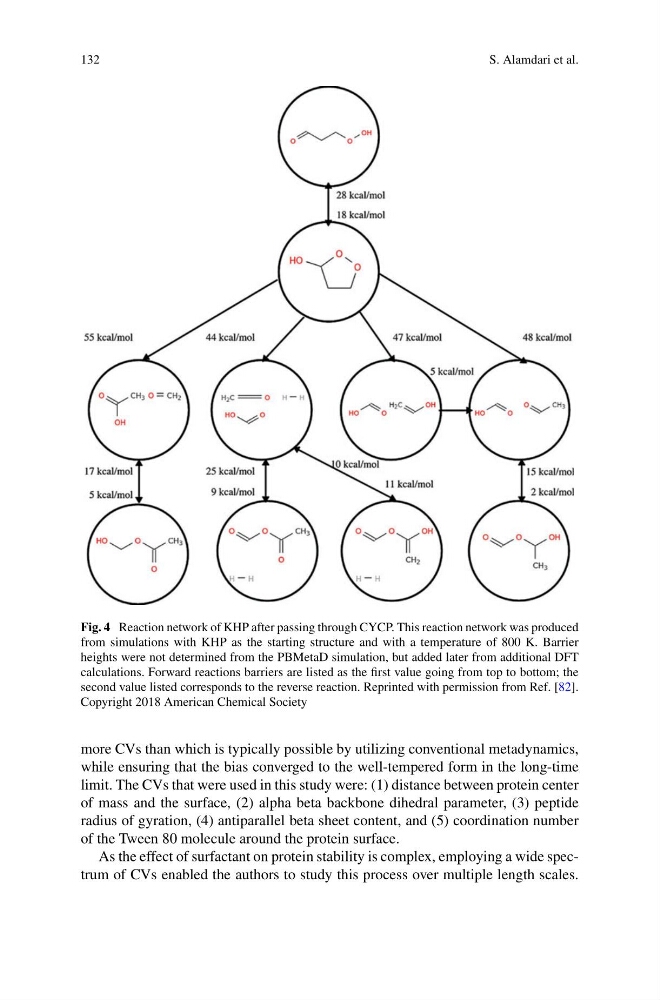
Fig. 4 Reaction network of KHP after passing through CYCP. This reaction network was produced
from simulations with KHP as the starting structure and with a temperature of 800 K. Barrier
heights were not determined from the PBMetaD simulation, but added later from additional DFT
calculations. Forward reactions barriers are listed as the first value going from top to bottom; the
second value listed corresponds to the reverse reaction. Reprinted with permission from Ref. [82].
Copyright 2018 American Chemical Society
more CVs than which is typically possible by utilizing conventional metadynamics,
while ensuring that the bias converged to the well-tempered form in the long-time
limit. The CVs that were used in this study were: (1) distance between protein center
of mass and the surface, (2) alpha beta backbone dihedral parameter, (3) peptide
radius of gyration, (4) antiparallel beta sheet content, and (5) coordination number
of the Tween 80 molecule around the protein surface.
As the effect of surfactant on protein stability is complex, employing a wide spectrum of CVs enabled the authors to study this process over multiple length scales.
S. Alamdari et al.
Fig. 4 Reaction network of KHP after passing through CYCP. This reaction network was produced
from simulations with KHP as the starting structure and with a temperature of 800 K. Barrier
heights were not determined from the PBMetaD simulation, but added later from additional DFT
calculations. Forward reactions barriers are listed as the first value going from top to bottom; the
second value listed corresponds to the reverse reaction. Reprinted with permission from Ref. [82].
Copyright 2018 American Chemical Society
more CVs than which is typically possible by utilizing conventional metadynamics,
while ensuring that the bias converged to the well-tempered form in the long-time
limit. The CVs that were used in this study were: (1) distance between protein center
of mass and the surface, (2) alpha beta backbone dihedral parameter, (3) peptide
radius of gyration, (4) antiparallel beta sheet content, and (5) coordination number
of the Tween 80 molecule around the protein surface.
As the effect of surfactant on protein stability is complex, employing a wide spectrum of CVs enabled the authors to study this process over multiple length scales.