

The Statistical Mechanics of Solution-Phase Nucleation …
113
shows the absolute differences, which are extremely small between low and intermediate concentrations and on average less than 1% between intermediate and high
concentrations where non-idealities become more important.
3.3 Formalism Between Dynamical and Classical Nucleation
Theories
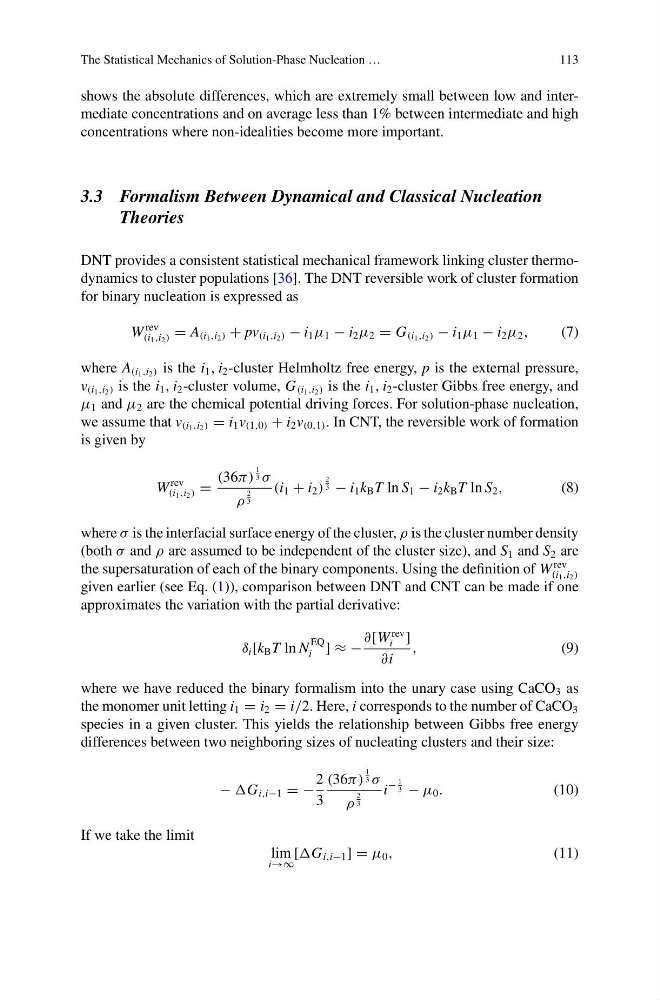
DNT provides a consistent statistical mechanical framework linking cluster thermodynamics to cluster populations [36]. The DNT reversible work of cluster formation
for binary nucleation is expressed as
W
rev
(i 1 ,i 2 ) = A (i 1 ,i 2 ) + pv (i 1 ,i 2 ) − i 1 μ 1 − i 2 μ 2 = G (i 1 ,i 2 ) − i 1 μ 1 − i 2 μ 2 ,
(7)
where A (i 1 ,i 2 ) is the i 1 , i 2 -cluster Helmholtz free energy, p is the external pressure,
v (i 1 ,i 2 ) is the i 1 , i 2 -cluster volume, G (i 1 ,i 2 ) is the i 1 , i 2 -cluster Gibbs free energy, and
μ 1 and μ 2 are the chemical potential driving forces. For solution-phase nucleation,
we assume that v (i 1 ,i 2 ) = i 1 v (1,0) + i 2 v (0,1) . In CNT, the reversible work of formation
is given by
W
rev
(i 1 ,i 2 ) =
(36π)
1
3 σ
ρ
2
3
(i 1 + i 2 )
2
3 − i 1 k B T ln S 1 − i 2 k B T ln S 2 ,
(8)
where σ is the interfacial surface energy of the cluster, ρ is the cluster number density
(both σ and ρ are assumed to be independent of the cluster size), and S 1 and S 2 are
the supersaturation of each of the binary components. Using the definition of W
rev
(i 1 ,i 2 )
given earlier (see Eq. (1)), comparison between DNT and CNT can be made if one
approximates the variation with the partial derivative:
δ i [k B T ln N
EQ
i ] ≈ −
∂[W
rev
i ]
∂i
,
(9)
where we have reduced the binary formalism into the unary case using CaCO 3 as
the monomer unit letting i 1 = i 2 = i/2. Here, i corresponds to the number of CaCO 3
species in a given cluster. This yields the relationship between Gibbs free energy
differences between two neighboring sizes of nucleating clusters and their size:
− G i,i−1 = −
2
3
(36π)
1
3 σ
ρ
2
3
i
−
1
3 − μ 0 .
(10)
If we take the limit
lim
i→∞
[G i,i−1 ] = μ 0 ,
(11)
113
shows the absolute differences, which are extremely small between low and intermediate concentrations and on average less than 1% between intermediate and high
concentrations where non-idealities become more important.
3.3 Formalism Between Dynamical and Classical Nucleation
Theories
DNT provides a consistent statistical mechanical framework linking cluster thermodynamics to cluster populations [36]. The DNT reversible work of cluster formation
for binary nucleation is expressed as
W
rev
(i 1 ,i 2 ) = A (i 1 ,i 2 ) + pv (i 1 ,i 2 ) − i 1 μ 1 − i 2 μ 2 = G (i 1 ,i 2 ) − i 1 μ 1 − i 2 μ 2 ,
(7)
where A (i 1 ,i 2 ) is the i 1 , i 2 -cluster Helmholtz free energy, p is the external pressure,
v (i 1 ,i 2 ) is the i 1 , i 2 -cluster volume, G (i 1 ,i 2 ) is the i 1 , i 2 -cluster Gibbs free energy, and
μ 1 and μ 2 are the chemical potential driving forces. For solution-phase nucleation,
we assume that v (i 1 ,i 2 ) = i 1 v (1,0) + i 2 v (0,1) . In CNT, the reversible work of formation
is given by
W
rev
(i 1 ,i 2 ) =
(36π)
1
3 σ
ρ
2
3
(i 1 + i 2 )
2
3 − i 1 k B T ln S 1 − i 2 k B T ln S 2 ,
(8)
where σ is the interfacial surface energy of the cluster, ρ is the cluster number density
(both σ and ρ are assumed to be independent of the cluster size), and S 1 and S 2 are
the supersaturation of each of the binary components. Using the definition of W
rev
(i 1 ,i 2 )
given earlier (see Eq. (1)), comparison between DNT and CNT can be made if one
approximates the variation with the partial derivative:
δ i [k B T ln N
EQ
i ] ≈ −
∂[W
rev
i ]
∂i
,
(9)
where we have reduced the binary formalism into the unary case using CaCO 3 as
the monomer unit letting i 1 = i 2 = i/2. Here, i corresponds to the number of CaCO 3
species in a given cluster. This yields the relationship between Gibbs free energy
differences between two neighboring sizes of nucleating clusters and their size:
− G i,i−1 = −
2
3
(36π)
1
3 σ
ρ
2
3
i
−
1
3 − μ 0 .
(10)
If we take the limit
lim
i→∞
[G i,i−1 ] = μ 0 ,
(11)