

79
4
for floor coverings until the 1960s, when it was
replaced by PVC floor coverings and carpets. It
was not until the 1980s that there was a partial
renaissance of this product, because some consumers wanted a floor covering based on renewable raw materials. Linoleum is also antistatic
and suitable for rooms with underfloor heating.
New Oleochemical Polymers
The polymerizations described so far follow radical mechanisms and are difficult to control. In
recent years, M. A. R. Meier and S. Mecking in
particular have developed numerous approaches
to find new ways to specifically structured
polymers, in particular with the aid of catalytic processes (7 Sect. 19.2.2). Unfortunately,
the internal double bonds of the unsaturated
oleochemicals are not active enough to enter
so-called siccatives. In this way, varnishes are
formed that can be used for painting purposes.
Another application of this polymerization is
the production of linoleum. The first step is the
gassing of heated linseed oil with air. The resulting rubber-like mass, linoxyn, is processed with
natural resins, e.g. colophony, to the so-called
linoleum cement, which is then further mixed
with cork or wood flour as well as color pigments
or chalk. This mixture is calendared onto jute
fabric. The resulting sheets are matured in 15 m
high, 60 °C thermostatized rooms, the so-called
ripening chambers, for two to four weeks to form
linoleum (. Fig. 4.25).
Linoleum is already a well-known product: Initial examples, the wax or oil cloths,
were already described in 1627. In 1860, Walton received a patent on linoleum. It was used
COOMe
4/5
8/7
[Rh]
+ n C 2 H 4
COOMe
COOMe
5/6
8/7
5/6
8/7
COOMe
5/6
8/7
1:1-Adduct
2:1-Adduct
3:1-Adduct
[Pd]
H 2
COOMe
COOMe
5/6
8/7
5/6
8/7
COOMe
5/6
8/7
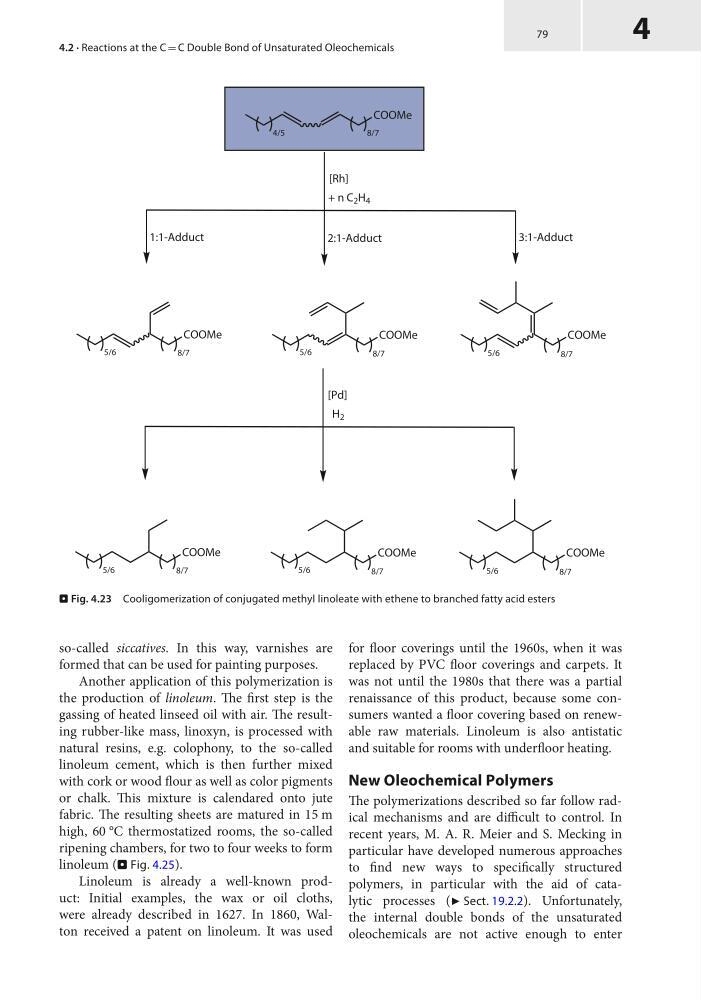
. Fig. 4.23 Cooligomerization of conjugated methyl linoleate with ethene to branched fatty acid esters
4.2 · Reactions at the C = C Double Bond of Unsaturated Oleochemicals
4
for floor coverings until the 1960s, when it was
replaced by PVC floor coverings and carpets. It
was not until the 1980s that there was a partial
renaissance of this product, because some consumers wanted a floor covering based on renewable raw materials. Linoleum is also antistatic
and suitable for rooms with underfloor heating.
New Oleochemical Polymers
The polymerizations described so far follow radical mechanisms and are difficult to control. In
recent years, M. A. R. Meier and S. Mecking in
particular have developed numerous approaches
to find new ways to specifically structured
polymers, in particular with the aid of catalytic processes (7 Sect. 19.2.2). Unfortunately,
the internal double bonds of the unsaturated
oleochemicals are not active enough to enter
so-called siccatives. In this way, varnishes are
formed that can be used for painting purposes.
Another application of this polymerization is
the production of linoleum. The first step is the
gassing of heated linseed oil with air. The resulting rubber-like mass, linoxyn, is processed with
natural resins, e.g. colophony, to the so-called
linoleum cement, which is then further mixed
with cork or wood flour as well as color pigments
or chalk. This mixture is calendared onto jute
fabric. The resulting sheets are matured in 15 m
high, 60 °C thermostatized rooms, the so-called
ripening chambers, for two to four weeks to form
linoleum (. Fig. 4.25).
Linoleum is already a well-known product: Initial examples, the wax or oil cloths,
were already described in 1627. In 1860, Walton received a patent on linoleum. It was used
COOMe
4/5
8/7
[Rh]
+ n C 2 H 4
COOMe
COOMe
5/6
8/7
5/6
8/7
COOMe
5/6
8/7
1:1-Adduct
2:1-Adduct
3:1-Adduct
[Pd]
H 2
COOMe
COOMe
5/6
8/7
5/6
8/7
COOMe
5/6
8/7
. Fig. 4.23 Cooligomerization of conjugated methyl linoleate with ethene to branched fatty acid esters
4.2 · Reactions at the C = C Double Bond of Unsaturated Oleochemicals