

78
Chapter 4 · There is More to Oleochemistry - Reactions at the Fatty Acid Alkyl Chain
4
cooligomerization with ethene, which leads to
unsaturated mono-, di- and triadducts of ethene
(. Fig. 4.23). Hydrogenation of these adducts,
e.g. in the presence of a heterogeneous palladium catalyst, produces saturated fatty acid esters
with an alkyl branching in the middle of the fatty
acid alkyl chain. These are potentially suitable
as lubricants due to their high thermal stability,
relatively low viscosity and their low pour point.
Finally, the chemistry of triple unsaturated
linolenic acid is briefly discussed. If it is conjugated in alkali medium, conjutrienic acids are
formed which can undergo, either thermally
or catalytically, intramolecular Diels–Alder
reaction. Substituted cyclohexadiene rings are
formed by cyclization (. Fig. 4.24). These can be
disproportionated into a mixture of cycloalkanes
and aromatics in the presence of heterogeneous
hydrogenation catalysts, e.g. by palladium on
activated carbon. The cyclic unsaturated fatty
acids can be used for the synthesis of alkyd resins. Their esters with branched diols are synthetic
lubricants for highly stressed aircraft turbines.
Plastic plasticizers are produced on the basis of
cyclohexane derivatives.
It was already mentioned in 7 Sect. 2.2.6 on
linseed oil that linolenic acid tends to polymerize in air and finally forms a solid layer. Linseed
oil is therefore also referred to as “drying oil”.
The primary process of this polymerization is the
formation of hydroperoxides, which decompose
into radicals, which in turn lead to (disordered)
C–C linkages of linolenic acid. This process can
be accelerated by the addition of cobalt salts,
Chemistry of Polyunsaturated Fatty
Acids
In this section “C–C linkages”, some reactions shall
be presented, which are especially common for
polyunsaturated fatty acids, the PUFA, i.e. linoleic
acid and linolenic acid, which occur frequently in
nature. These reactions usually take place in such a
way that the two isolated double bonds in the fatty
alkyl chain first isomerize to a conjugated diene
and only then do these “conjuenic acids” undergo
a subsequent reaction. This isomerization is also
carried out industrially as a single step by heating
the PUFA at high temperatures in the presence of
alkali for a longer period of time.
The conjuenic acids produced in this way
are usually isomeric mixtures. If, for example,
linoleic acid, which has two cis-double bonds in
positions 9 and 12, is used as substrate, a single
conjugation leads to two conjuenic acids with
double bonds in positions 9 and 11 or 10 and 12,
respectively. However, since the double bonds
can still be in cis or trans, a broad mixture of isomers results.
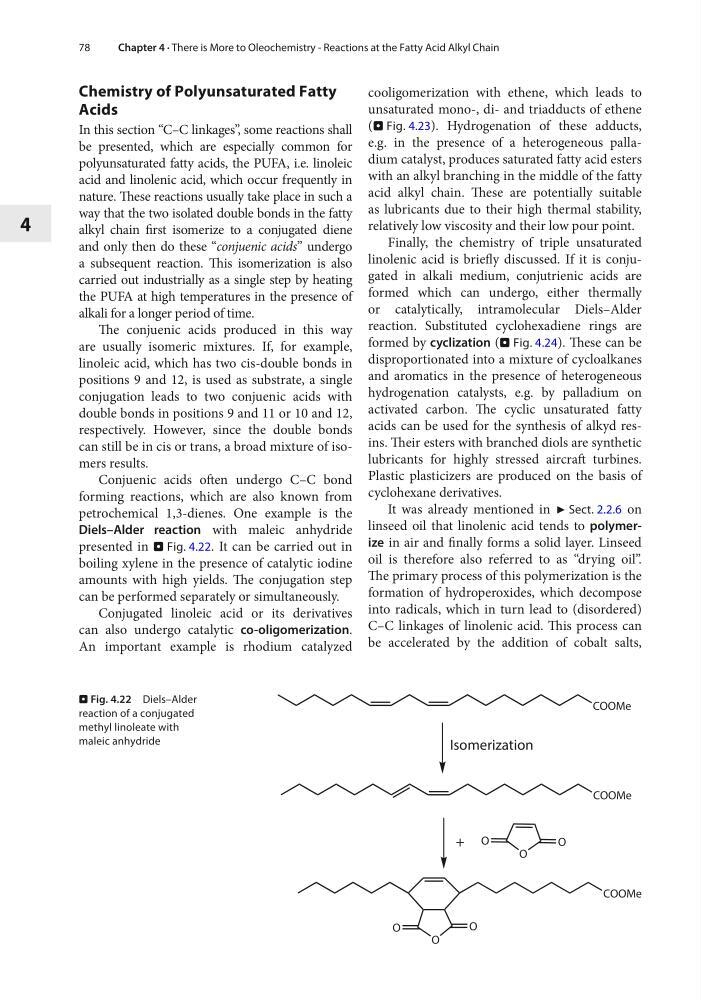
Conjuenic acids often undergo C–C bond
forming reactions, which are also known from
petrochemical 1,3-dienes. One example is the
Diels–Alder reaction with maleic anhydride
presented in . Fig. 4.22. It can be carried out in
boiling xylene in the presence of catalytic iodine
amounts with high yields. The conjugation step
can be performed separately or simultaneously.
Conjugated linoleic acid or its derivatives
can also undergo catalytic co-oligomerization.
An important example is rhodium catalyzed
. Fig. 4.22 Diels–Alder
reaction of a conjugated
methyl linoleate with
maleic anhydride
COOMe
Isomerization
COOMe
O
O
O
+
COOMe
O
O
O
Chapter 4 · There is More to Oleochemistry - Reactions at the Fatty Acid Alkyl Chain
4
cooligomerization with ethene, which leads to
unsaturated mono-, di- and triadducts of ethene
(. Fig. 4.23). Hydrogenation of these adducts,
e.g. in the presence of a heterogeneous palladium catalyst, produces saturated fatty acid esters
with an alkyl branching in the middle of the fatty
acid alkyl chain. These are potentially suitable
as lubricants due to their high thermal stability,
relatively low viscosity and their low pour point.
Finally, the chemistry of triple unsaturated
linolenic acid is briefly discussed. If it is conjugated in alkali medium, conjutrienic acids are
formed which can undergo, either thermally
or catalytically, intramolecular Diels–Alder
reaction. Substituted cyclohexadiene rings are
formed by cyclization (. Fig. 4.24). These can be
disproportionated into a mixture of cycloalkanes
and aromatics in the presence of heterogeneous
hydrogenation catalysts, e.g. by palladium on
activated carbon. The cyclic unsaturated fatty
acids can be used for the synthesis of alkyd resins. Their esters with branched diols are synthetic
lubricants for highly stressed aircraft turbines.
Plastic plasticizers are produced on the basis of
cyclohexane derivatives.
It was already mentioned in 7 Sect. 2.2.6 on
linseed oil that linolenic acid tends to polymerize in air and finally forms a solid layer. Linseed
oil is therefore also referred to as “drying oil”.
The primary process of this polymerization is the
formation of hydroperoxides, which decompose
into radicals, which in turn lead to (disordered)
C–C linkages of linolenic acid. This process can
be accelerated by the addition of cobalt salts,
Chemistry of Polyunsaturated Fatty
Acids
In this section “C–C linkages”, some reactions shall
be presented, which are especially common for
polyunsaturated fatty acids, the PUFA, i.e. linoleic
acid and linolenic acid, which occur frequently in
nature. These reactions usually take place in such a
way that the two isolated double bonds in the fatty
alkyl chain first isomerize to a conjugated diene
and only then do these “conjuenic acids” undergo
a subsequent reaction. This isomerization is also
carried out industrially as a single step by heating
the PUFA at high temperatures in the presence of
alkali for a longer period of time.
The conjuenic acids produced in this way
are usually isomeric mixtures. If, for example,
linoleic acid, which has two cis-double bonds in
positions 9 and 12, is used as substrate, a single
conjugation leads to two conjuenic acids with
double bonds in positions 9 and 11 or 10 and 12,
respectively. However, since the double bonds
can still be in cis or trans, a broad mixture of isomers results.
Conjuenic acids often undergo C–C bond
forming reactions, which are also known from
petrochemical 1,3-dienes. One example is the
Diels–Alder reaction with maleic anhydride
presented in . Fig. 4.22. It can be carried out in
boiling xylene in the presence of catalytic iodine
amounts with high yields. The conjugation step
can be performed separately or simultaneously.
Conjugated linoleic acid or its derivatives
can also undergo catalytic co-oligomerization.
An important example is rhodium catalyzed
. Fig. 4.22 Diels–Alder
reaction of a conjugated
methyl linoleate with
maleic anhydride
COOMe
Isomerization
COOMe
O
O
O
+
COOMe
O
O
O