

71
4
catalysts are salts or complexes of tungsten,
molybdenum or ruthenium. They have been used
in the petrochemical industry since the 1960s. In
oleochemistry, metathesis has been known for
a long time, but it is only in recent years that the
development of new catalysts has made industrial implementation possible. Important newer
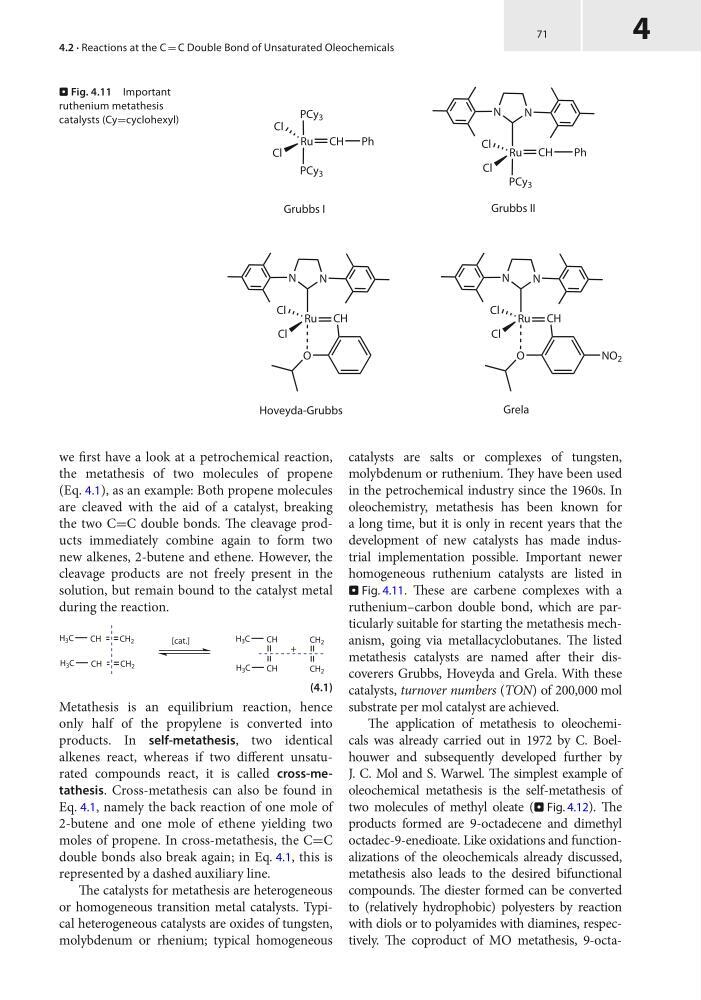
homogeneous ruthenium catalysts are listed in
. Fig. 4.11. These are carbene complexes with a
ruthenium–carbon double bond, which are particularly suitable for starting the metathesis mechanism, going via metallacyclobutanes. The listed
metathesis catalysts are named after their discoverers Grubbs, Hoveyda and Grela. With these
catalysts, turnover numbers (TON) of 200,000 mol
substrate per mol catalyst are achieved.
The application of metathesis to oleochemicals was already carried out in 1972 by C. Boelhouwer and subsequently developed further by
J. C. Mol and S. Warwel. The simplest example of
oleochemical metathesis is the self-metathesis of
two molecules of methyl oleate (. Fig. 4.12). The
products formed are 9-octadecene and dimethyl
octadec-9-enedioate. Like oxidations and functionalizations of the oleochemicals already discussed,
metathesis also leads to the desired bifunctional
compounds. The diester formed can be converted
to (relatively hydrophobic) polyesters by reaction
with diols or to polyamides with diamines, respectively. The coproduct of MO metathesis, 9-octawe first have a look at a petrochemical reaction,
the metathesis of two molecules of propene
(Eq. 4.1), as an example: Both propene molecules
are cleaved with the aid of a catalyst, breaking
the two C=C double bonds. The cleavage products immediately combine again to form two
new alkenes, 2-butene and ethene. However, the
cleavage products are not freely present in the
solution, but remain bound to the catalyst metal
during the reaction.
Metathesis is an equilibrium reaction, hence
only half of the propylene is converted into
products. In self-metathesis, two identical
alkenes react, whereas if two different unsaturated compounds react, it is called cross-metathesis. Cross-metathesis can also be found in
Eq. 4.1, namely the back reaction of one mole of
2-butene and one mole of ethene yielding two
moles of propene. In cross-metathesis, the C=C
double bonds also break again; in Eq. 4.1, this is
represented by a dashed auxiliary line.
The catalysts for metathesis are heterogeneous
or homogeneous transition metal catalysts. Typical heterogeneous catalysts are oxides of tungsten,
molybdenum or rhenium; typical homogeneous
(4.1)
. Fig. 4.11 Important
ruthenium metathesis
catalysts (Cy=cyclohexyl)
Ru CH
PCy 3
PCy 3
Cl
Cl
Ph
Grubbs I
Ru CH
PCy 3
Cl
Cl
Ph
N
N
Grubbs II
Ru CH
Cl
Cl
N
N
O
Hoveyda-Grubbs
Ru CH
Cl
Cl
N
N
O
Grela
NO 2
4.2 · Reactions at the C = C Double Bond of Unsaturated Oleochemicals
4
catalysts are salts or complexes of tungsten,
molybdenum or ruthenium. They have been used
in the petrochemical industry since the 1960s. In
oleochemistry, metathesis has been known for
a long time, but it is only in recent years that the
development of new catalysts has made industrial implementation possible. Important newer
homogeneous ruthenium catalysts are listed in
. Fig. 4.11. These are carbene complexes with a
ruthenium–carbon double bond, which are particularly suitable for starting the metathesis mechanism, going via metallacyclobutanes. The listed
metathesis catalysts are named after their discoverers Grubbs, Hoveyda and Grela. With these
catalysts, turnover numbers (TON) of 200,000 mol
substrate per mol catalyst are achieved.
The application of metathesis to oleochemicals was already carried out in 1972 by C. Boelhouwer and subsequently developed further by
J. C. Mol and S. Warwel. The simplest example of
oleochemical metathesis is the self-metathesis of
two molecules of methyl oleate (. Fig. 4.12). The
products formed are 9-octadecene and dimethyl
octadec-9-enedioate. Like oxidations and functionalizations of the oleochemicals already discussed,
metathesis also leads to the desired bifunctional
compounds. The diester formed can be converted
to (relatively hydrophobic) polyesters by reaction
with diols or to polyamides with diamines, respectively. The coproduct of MO metathesis, 9-octawe first have a look at a petrochemical reaction,
the metathesis of two molecules of propene
(Eq. 4.1), as an example: Both propene molecules
are cleaved with the aid of a catalyst, breaking
the two C=C double bonds. The cleavage products immediately combine again to form two
new alkenes, 2-butene and ethene. However, the
cleavage products are not freely present in the
solution, but remain bound to the catalyst metal
during the reaction.
Metathesis is an equilibrium reaction, hence
only half of the propylene is converted into
products. In self-metathesis, two identical
alkenes react, whereas if two different unsaturated compounds react, it is called cross-metathesis. Cross-metathesis can also be found in
Eq. 4.1, namely the back reaction of one mole of
2-butene and one mole of ethene yielding two
moles of propene. In cross-metathesis, the C=C
double bonds also break again; in Eq. 4.1, this is
represented by a dashed auxiliary line.
The catalysts for metathesis are heterogeneous
or homogeneous transition metal catalysts. Typical heterogeneous catalysts are oxides of tungsten,
molybdenum or rhenium; typical homogeneous
(4.1)
. Fig. 4.11 Important
ruthenium metathesis
catalysts (Cy=cyclohexyl)
Ru CH
PCy 3
PCy 3
Cl
Cl
Ph
Grubbs I
Ru CH
PCy 3
Cl
Cl
Ph
N
N
Grubbs II
Ru CH
Cl
Cl
N
N
O
Hoveyda-Grubbs
Ru CH
Cl
Cl
N
N
O
Grela
NO 2
4.2 · Reactions at the C = C Double Bond of Unsaturated Oleochemicals