

70
Chapter 4 · There is More to Oleochemistry - Reactions at the Fatty Acid Alkyl Chain
4
110 °C is obtained. These polyamides are used as
adhesives for shoes, packaging and bookbinding.
They are sold as solids, liquefy upon brief heating
during application and are then applied thinly
to the adhesive surfaces. An immediate adhesive
effect occurs, which after cooling leads to a very
strong binding of the two parts. Because of this
procedure, these adhesives are also known as
“hot melts”.
Important by-products of dimer fatty acid
synthesis are monomer fatty acids and trimer
fatty acids. The monomer fatty acids contain a
large amount of branched fatty acids, especially
methyl-branched acids.
The dimer fatty acids can also be reduced to the
corresponding diols. These dimer diols may again
be important for polyesters or polyurethanes.
Metathesis
A particularly exciting reaction is metathesis. It
is a C–C bond forming and a C–C bond breaking reaction at the same time. In order to understand the functional principle of this reaction,
Dimerization
A further C–C bond formation is dimerization
to dimer fatty acids. These can already be produced by heating PUFA to 300–400 °C. More
frequently, however, catalytic processes are
used with special clays as heterogeneous catalysts, e.g. with montmorillonite. These reactions
do not produce a uniform product, but always
a complex mixture of dimer fatty acids. Some
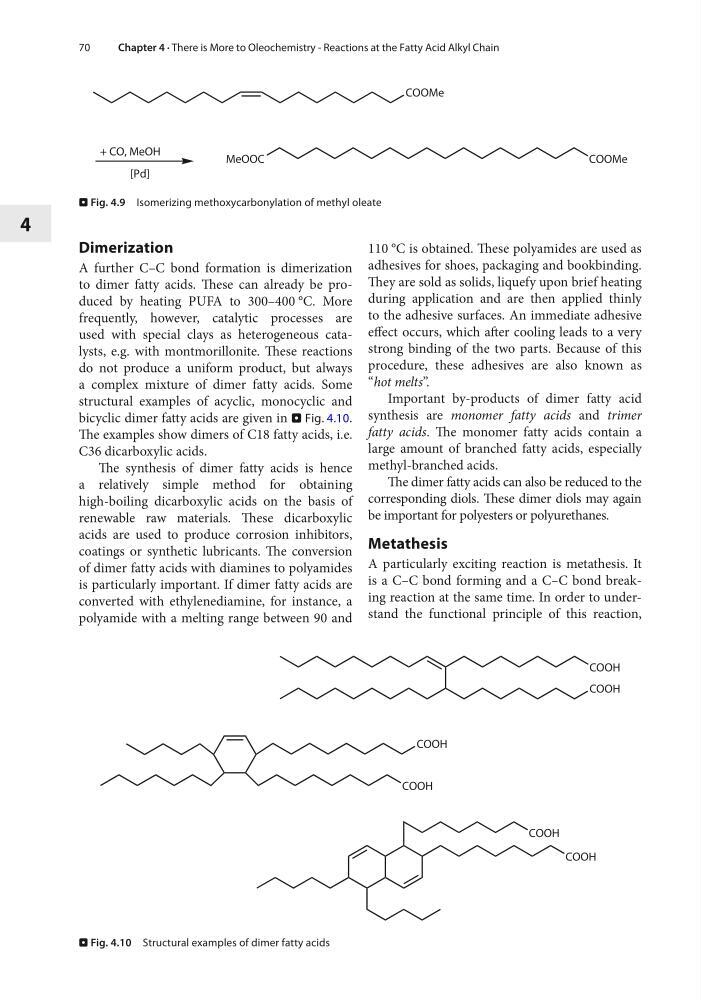
structural examples of acyclic, monocyclic and
bicyclic dimer fatty acids are given in . Fig. 4.10.
The examples show dimers of C18 fatty acids, i.e.
C36 dicarboxylic acids.
The synthesis of dimer fatty acids is hence
a relatively simple method for obtaining
high-boiling dicarboxylic acids on the basis of
renewable raw materials. These dicarboxylic
acids are used to produce corrosion inhibitors,
coatings or synthetic lubricants. The conversion
of dimer fatty acids with diamines to polyamides
is particularly important. If dimer fatty acids are
converted with ethylenediamine, for instance, a
polyamide with a melting range between 90 and
COOMe
+ CO, MeOH
[Pd]
MeOOC
COOMe
. Fig. 4.9 Isomerizing methoxycarbonylation of methyl oleate
COOH
COOH
COOH
COOH
COOH
COOH
. Fig. 4.10 Structural examples of dimer fatty acids
Chapter 4 · There is More to Oleochemistry - Reactions at the Fatty Acid Alkyl Chain
4
110 °C is obtained. These polyamides are used as
adhesives for shoes, packaging and bookbinding.
They are sold as solids, liquefy upon brief heating
during application and are then applied thinly
to the adhesive surfaces. An immediate adhesive
effect occurs, which after cooling leads to a very
strong binding of the two parts. Because of this
procedure, these adhesives are also known as
“hot melts”.
Important by-products of dimer fatty acid
synthesis are monomer fatty acids and trimer
fatty acids. The monomer fatty acids contain a
large amount of branched fatty acids, especially
methyl-branched acids.
The dimer fatty acids can also be reduced to the
corresponding diols. These dimer diols may again
be important for polyesters or polyurethanes.
Metathesis
A particularly exciting reaction is metathesis. It
is a C–C bond forming and a C–C bond breaking reaction at the same time. In order to understand the functional principle of this reaction,
Dimerization
A further C–C bond formation is dimerization
to dimer fatty acids. These can already be produced by heating PUFA to 300–400 °C. More
frequently, however, catalytic processes are
used with special clays as heterogeneous catalysts, e.g. with montmorillonite. These reactions
do not produce a uniform product, but always
a complex mixture of dimer fatty acids. Some
structural examples of acyclic, monocyclic and
bicyclic dimer fatty acids are given in . Fig. 4.10.
The examples show dimers of C18 fatty acids, i.e.
C36 dicarboxylic acids.
The synthesis of dimer fatty acids is hence
a relatively simple method for obtaining
high-boiling dicarboxylic acids on the basis of
renewable raw materials. These dicarboxylic
acids are used to produce corrosion inhibitors,
coatings or synthetic lubricants. The conversion
of dimer fatty acids with diamines to polyamides
is particularly important. If dimer fatty acids are
converted with ethylenediamine, for instance, a
polyamide with a melting range between 90 and
COOMe
+ CO, MeOH
[Pd]
MeOOC
COOMe
. Fig. 4.9 Isomerizing methoxycarbonylation of methyl oleate
COOH
COOH
COOH
COOH
COOH
COOH
. Fig. 4.10 Structural examples of dimer fatty acids