

68
Chapter 4 · There is More to Oleochemistry - Reactions at the Fatty Acid Alkyl Chain
4
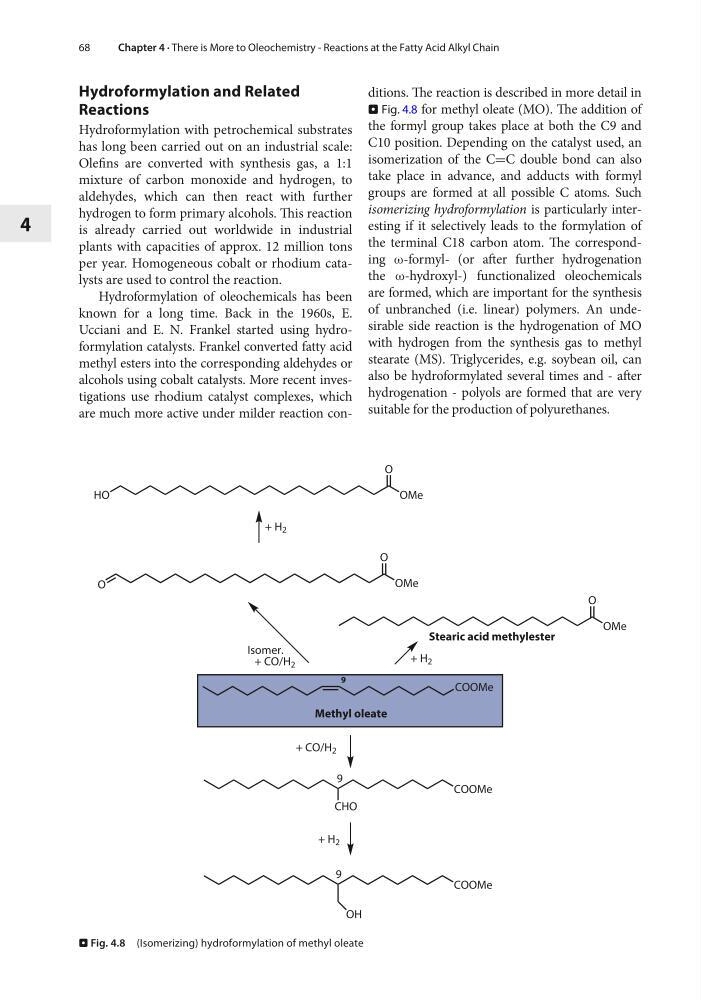
ditions. The reaction is described in more detail in
. Fig. 4.8 for methyl oleate (MO). The addition of
the formyl group takes place at both the C9 and
C10 position. Depending on the catalyst used, an
isomerization of the C=C double bond can also
take place in advance, and adducts with formyl
groups are formed at all possible C atoms. Such
isomerizing hydroformylation is particularly interesting if it selectively leads to the formylation of
the terminal C18 carbon atom. The corresponding ω-formyl- (or after further hydrogenation
the ω-hydroxyl-) functionalized oleochemicals
are formed, which are important for the synthesis
of unbranched (i.e. linear) polymers. An undesirable side reaction is the hydrogenation of MO
with hydrogen from the synthesis gas to methyl
stearate (MS). Triglycerides, e.g. soybean oil, can
also be hydroformylated several times and - after
hydrogenation - polyols are formed that are very
suitable for the production of polyurethanes.
Hydroformylation and Related
Reactions
Hydroformylation with petrochemical substrates
has long been carried out on an industrial scale:
Olefins are converted with synthesis gas, a 1:1
mixture of carbon monoxide and hydrogen, to
aldehydes, which can then react with further
hydrogen to form primary alcohols. This reaction
is already carried out worldwide in industrial
plants with capacities of approx. 12 million tons
per year. Homogeneous cobalt or rhodium catalysts are used to control the reaction.
Hydroformylation of oleochemicals has been
known for a long time. Back in the 1960s, E.
Ucciani and E. N. Frankel started using hydroformylation catalysts. Frankel converted fatty acid
methyl esters into the corresponding aldehydes or
alcohols using cobalt catalysts. More recent investigations use rhodium catalyst complexes, which
are much more active under milder reaction conCOOMe
9
Methyl oleate
+ CO/H 2
COOMe
CHO
+ H 2
9
COOMe
9
OH
+ H 2
Stearic acid methylester
Isomer.
+ CO/H 2
+ H 2
HO
OMe
O
O
OMe
O
OMe
O
. Fig. 4.8 (Isomerizing) hydroformylation of methyl oleate
Chapter 4 · There is More to Oleochemistry - Reactions at the Fatty Acid Alkyl Chain
4
ditions. The reaction is described in more detail in
. Fig. 4.8 for methyl oleate (MO). The addition of
the formyl group takes place at both the C9 and
C10 position. Depending on the catalyst used, an
isomerization of the C=C double bond can also
take place in advance, and adducts with formyl
groups are formed at all possible C atoms. Such
isomerizing hydroformylation is particularly interesting if it selectively leads to the formylation of
the terminal C18 carbon atom. The corresponding ω-formyl- (or after further hydrogenation
the ω-hydroxyl-) functionalized oleochemicals
are formed, which are important for the synthesis
of unbranched (i.e. linear) polymers. An undesirable side reaction is the hydrogenation of MO
with hydrogen from the synthesis gas to methyl
stearate (MS). Triglycerides, e.g. soybean oil, can
also be hydroformylated several times and - after
hydrogenation - polyols are formed that are very
suitable for the production of polyurethanes.
Hydroformylation and Related
Reactions
Hydroformylation with petrochemical substrates
has long been carried out on an industrial scale:
Olefins are converted with synthesis gas, a 1:1
mixture of carbon monoxide and hydrogen, to
aldehydes, which can then react with further
hydrogen to form primary alcohols. This reaction
is already carried out worldwide in industrial
plants with capacities of approx. 12 million tons
per year. Homogeneous cobalt or rhodium catalysts are used to control the reaction.
Hydroformylation of oleochemicals has been
known for a long time. Back in the 1960s, E.
Ucciani and E. N. Frankel started using hydroformylation catalysts. Frankel converted fatty acid
methyl esters into the corresponding aldehydes or
alcohols using cobalt catalysts. More recent investigations use rhodium catalyst complexes, which
are much more active under milder reaction conCOOMe
9
Methyl oleate
+ CO/H 2
COOMe
CHO
+ H 2
9
COOMe
9
OH
+ H 2
Stearic acid methylester
Isomer.
+ CO/H 2
+ H 2
HO
OMe
O
O
OMe
O
OMe
O
. Fig. 4.8 (Isomerizing) hydroformylation of methyl oleate