

58
Chapter 3 · The Basics of Oleochemistry - Basic Oleochemicals
3
excellent biodegradability, they are (so far)
less important than FAE, as the ester bond is
quite reactive and therefore tends to undesirable secondary reactions.
Summary (Take-Home Messages)
5 The most important basic chemicals in
oleochemistry are fatty acids, fatty acid
esters, fatty alcohols and the coproduct
glycerol.
5 Fat splitting is the conversion of
triglycerides with water to fatty acids and
glycerol. Due to a high excess of water
and continuous separation of glycerol,
the equilibrium reaction can be shifted to
the fatty acid side.
5 Industrially, fat splitting is mainly
carried out as continuously operated
pressure–fat splitting with pressures up
to 40 bar and temperatures up to 260 °C.
The reactors are columns in which the
fat and the water phase are reacted in
countercurrent mode.
5 Fatty acids are usually purified by
continuous distillation. They are used
as soaps or as additives for rubbers,
paper, lubricants, paints or personal care
products.
(3.4)
+ n C 2 H 4 O
C
O
O
COOH
n
O H
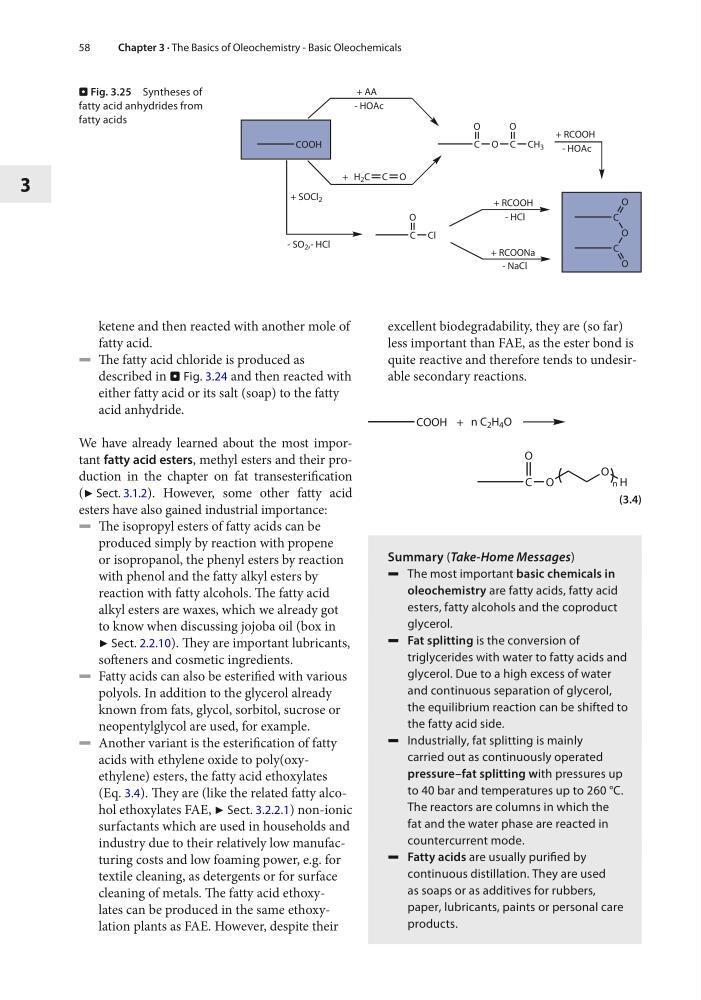
ketene and then reacted with another mole of
fatty acid.
5 The fatty acid chloride is produced as
described in . Fig. 3.24 and then reacted with
either fatty acid or its salt (soap) to the fatty
acid anhydride.
We have already learned about the most important fatty acid esters, methyl esters and their production in the chapter on fat transesterification
(7 Sect. 3.1.2). However, some other fatty acid
esters have also gained industrial importance:
5 The isopropyl esters of fatty acids can be
produced simply by reaction with propene
or isopropanol, the phenyl esters by reaction
with phenol and the fatty alkyl esters by
reaction with fatty alcohols. The fatty acid
alkyl esters are waxes, which we already got
to know when discussing jojoba oil (box in
7 Sect. 2.2.10). They are important lubricants,
softeners and cosmetic ingredients.
5 Fatty acids can also be esterified with various
polyols. In addition to the glycerol already
known from fats, glycol, sorbitol, sucrose or
neopentylglycol are used, for example.
5 Another variant is the esterification of fatty
acids with ethylene oxide to poly(oxyethylene) esters, the fatty acid ethoxylates
(Eq. 3.4). They are (like the related fatty alcohol ethoxylates FAE, 7 Sect. 3.2.2.1) non-ionic
surfactants which are used in households and
industry due to their relatively low manufacturing costs and low foaming power, e.g. for
textile cleaning, as detergents or for surface
cleaning of metals. The fatty acid ethoxylates can be produced in the same ethoxylation plants as FAE. However, despite their
. Fig. 3.25 Syntheses of
fatty acid anhydrides from
fatty acids
COOH
C
O
O
+ AA
- HOAc
H 2 C C O
+
C
O
Cl
C CH 3
O
C
O
O
C
O
+ RCOOH
- HOAc
+ RCOOH
- HCl
+ RCOONa
- NaCl
+ SOCl 2
- SO 2 ,- HCl
Chapter 3 · The Basics of Oleochemistry - Basic Oleochemicals
3
excellent biodegradability, they are (so far)
less important than FAE, as the ester bond is
quite reactive and therefore tends to undesirable secondary reactions.
Summary (Take-Home Messages)
5 The most important basic chemicals in
oleochemistry are fatty acids, fatty acid
esters, fatty alcohols and the coproduct
glycerol.
5 Fat splitting is the conversion of
triglycerides with water to fatty acids and
glycerol. Due to a high excess of water
and continuous separation of glycerol,
the equilibrium reaction can be shifted to
the fatty acid side.
5 Industrially, fat splitting is mainly
carried out as continuously operated
pressure–fat splitting with pressures up
to 40 bar and temperatures up to 260 °C.
The reactors are columns in which the
fat and the water phase are reacted in
countercurrent mode.
5 Fatty acids are usually purified by
continuous distillation. They are used
as soaps or as additives for rubbers,
paper, lubricants, paints or personal care
products.
(3.4)
+ n C 2 H 4 O
C
O
O
COOH
n
O H
ketene and then reacted with another mole of
fatty acid.
5 The fatty acid chloride is produced as
described in . Fig. 3.24 and then reacted with
either fatty acid or its salt (soap) to the fatty
acid anhydride.
We have already learned about the most important fatty acid esters, methyl esters and their production in the chapter on fat transesterification
(7 Sect. 3.1.2). However, some other fatty acid
esters have also gained industrial importance:
5 The isopropyl esters of fatty acids can be
produced simply by reaction with propene
or isopropanol, the phenyl esters by reaction
with phenol and the fatty alkyl esters by
reaction with fatty alcohols. The fatty acid
alkyl esters are waxes, which we already got
to know when discussing jojoba oil (box in
7 Sect. 2.2.10). They are important lubricants,
softeners and cosmetic ingredients.
5 Fatty acids can also be esterified with various
polyols. In addition to the glycerol already
known from fats, glycol, sorbitol, sucrose or
neopentylglycol are used, for example.
5 Another variant is the esterification of fatty
acids with ethylene oxide to poly(oxyethylene) esters, the fatty acid ethoxylates
(Eq. 3.4). They are (like the related fatty alcohol ethoxylates FAE, 7 Sect. 3.2.2.1) non-ionic
surfactants which are used in households and
industry due to their relatively low manufacturing costs and low foaming power, e.g. for
textile cleaning, as detergents or for surface
cleaning of metals. The fatty acid ethoxylates can be produced in the same ethoxylation plants as FAE. However, despite their
. Fig. 3.25 Syntheses of
fatty acid anhydrides from
fatty acids
COOH
C
O
O
+ AA
- HOAc
H 2 C C O
+
C
O
Cl
C CH 3
O
C
O
O
C
O
+ RCOOH
- HOAc
+ RCOOH
- HCl
+ RCOONa
- NaCl
+ SOCl 2
- SO 2 ,- HCl