

57
3
3.2 · Reactions at the Carboxy Group of Fatty Acids
of a carboxyethylbetain from dodecyldimethylamine and acrylic acid.
Fatty amine oxides should also be mentioned
as derivatives of fatty amines: They are mostly
obtained by oxidation of fatty alkyldimethylamines with hydrogen peroxide (Eq. 3.3) and
behave like weak cationic surfactants. In amine
oxides, the nitrogen and oxygen atoms are linked
by a covalent bond, with a higher electron density at the oxygen atom. Accordingly, the fatty
amine oxides have a high dipole moment and
preferably dissolve in polar solvents.
(3.2)
C 12 H 25 NMe 2
CH 2 CH COOH
+
C 12 H 25 NMe 2 CH 2 CH 2 COO
(3.3)
N
Me
Me
+ H 2 O 2
N
Me
Me
O + H 2 O
a single stage at 280–360 °C at ambient pressure; e.g. silica gel, aluminum oxide, bauxite
or iron oxide are used as catalysts. Processes
that directly convert triglycerides into fatty
nitriles are particularly interesting: First, the
fat is converted with ammonia in the presence of tin catalysts into a mixture of fatty
nitriles, fatty amides and glycerol, the glycerol
is then separated, and the reaction is continued until complete conversion is achieved.
5 In the second stage, the hydrogenation of the
fatty nitriles to the fatty amines takes place.
As . Fig. 3.23 shows, primary, secondary and
tertiary amines can be produced via imines as
intermediates. The selectivity of the process
can be controlled by both the addition of
ammonia and the nature of the catalyst, for
instance, nickel and cobalt catalysts promote
the formation of primary amines.
Fatty amines can also be produced from fatty
alcohols (7 Sect. 3.2.1), either by reaction with
ammonia or primary or secondary amines.
Equation 3.1 shows as an example the reaction of
a fatty alcohol with dimethylamine to a dimethylalkylamine. The reaction is carried out in the
presence of hydrogen with a copper catalyst.
Fatty amines are used in many areas:
5 Primary fatty amines RNH 2 and their salts are
used, for example, as flotation agents, corrosion inhibitors, lubricants, bactericides or fuel
additives.
5 Secondary fatty amines R 2 NH are usually
further processed to their corresponding
quaternary dialkyldimethylammonium salts
R 2 Me 2 N + X − , e.g. by methylation with methyl
chloride. Distearyldimethylammonium
chloride is an important plasticizer, and
didecyldimethylammonium chloride is an
important bactericide.
5 Tertiary fatty amines R 3 N are used as
emulsifiers, fungicides, foam regulators or
cosmetic ingredients. They are also used for
the production of amphoteric surfactants,
the so-called betaines. These contain both
a cationic and an anionic group and are
particularly skin-friendly detergents. Equation 3.2 shows as an example the production
(3.1)
+ HNMe 2
OH
+ H 2
CuO/Cr 2 O 3
NMe 2 + H 2 O
COOH
C
O
Cl
+ SOCl 2
- SO 2 , -HCl
+ PCl 3
- HOPCl 2
+ COCl 2
- CO 2 , -HCl
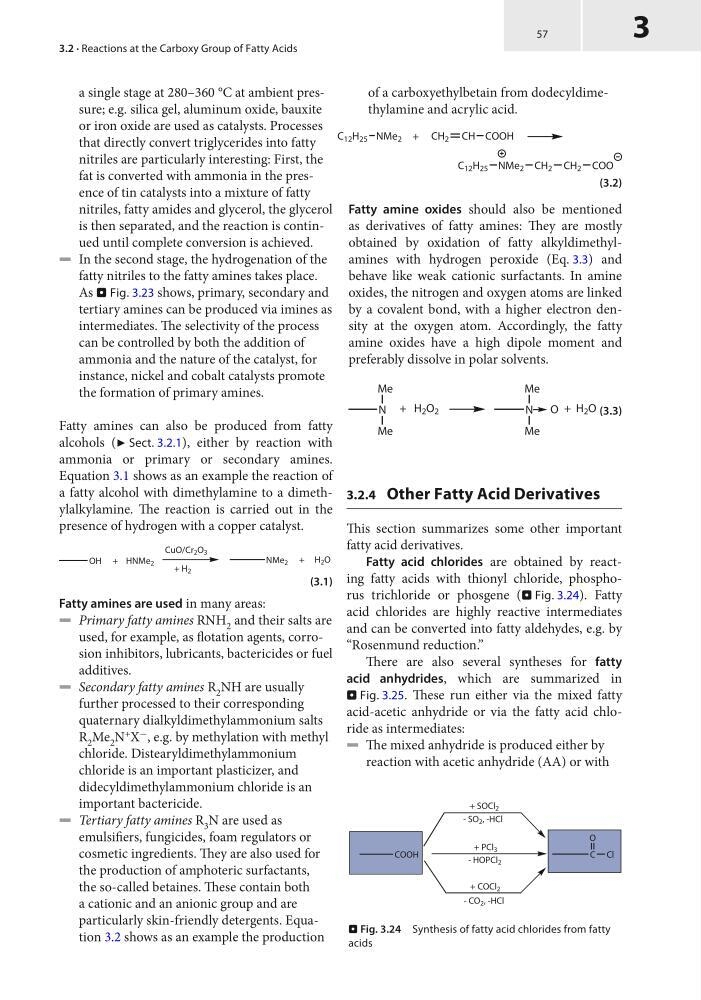
. Fig. 3.24 Synthesis of fatty acid chlorides from fatty
acids
3.2.4 Other Fatty Acid Derivatives
This section summarizes some other important
fatty acid derivatives.
Fatty acid chlorides are obtained by reacting fatty acids with thionyl chloride, phosphorus trichloride or phosgene (. Fig. 3.24). Fatty
acid chlorides are highly reactive intermediates
and can be converted into fatty aldehydes, e.g. by
“Rosenmund reduction. ”
There are also several syntheses for fatty
acid anhydrides, which are summarized in
. Fig. 3.25. These run either via the mixed fatty
acid-acetic anhydride or via the fatty acid chloride as intermediates:
5 The mixed anhydride is produced either by
reaction with acetic anhydride (AA) or with
3
3.2 · Reactions at the Carboxy Group of Fatty Acids
of a carboxyethylbetain from dodecyldimethylamine and acrylic acid.
Fatty amine oxides should also be mentioned
as derivatives of fatty amines: They are mostly
obtained by oxidation of fatty alkyldimethylamines with hydrogen peroxide (Eq. 3.3) and
behave like weak cationic surfactants. In amine
oxides, the nitrogen and oxygen atoms are linked
by a covalent bond, with a higher electron density at the oxygen atom. Accordingly, the fatty
amine oxides have a high dipole moment and
preferably dissolve in polar solvents.
(3.2)
C 12 H 25 NMe 2
CH 2 CH COOH
+
C 12 H 25 NMe 2 CH 2 CH 2 COO
(3.3)
N
Me
Me
+ H 2 O 2
N
Me
Me
O + H 2 O
a single stage at 280–360 °C at ambient pressure; e.g. silica gel, aluminum oxide, bauxite
or iron oxide are used as catalysts. Processes
that directly convert triglycerides into fatty
nitriles are particularly interesting: First, the
fat is converted with ammonia in the presence of tin catalysts into a mixture of fatty
nitriles, fatty amides and glycerol, the glycerol
is then separated, and the reaction is continued until complete conversion is achieved.
5 In the second stage, the hydrogenation of the
fatty nitriles to the fatty amines takes place.
As . Fig. 3.23 shows, primary, secondary and
tertiary amines can be produced via imines as
intermediates. The selectivity of the process
can be controlled by both the addition of
ammonia and the nature of the catalyst, for
instance, nickel and cobalt catalysts promote
the formation of primary amines.
Fatty amines can also be produced from fatty
alcohols (7 Sect. 3.2.1), either by reaction with
ammonia or primary or secondary amines.
Equation 3.1 shows as an example the reaction of
a fatty alcohol with dimethylamine to a dimethylalkylamine. The reaction is carried out in the
presence of hydrogen with a copper catalyst.
Fatty amines are used in many areas:
5 Primary fatty amines RNH 2 and their salts are
used, for example, as flotation agents, corrosion inhibitors, lubricants, bactericides or fuel
additives.
5 Secondary fatty amines R 2 NH are usually
further processed to their corresponding
quaternary dialkyldimethylammonium salts
R 2 Me 2 N + X − , e.g. by methylation with methyl
chloride. Distearyldimethylammonium
chloride is an important plasticizer, and
didecyldimethylammonium chloride is an
important bactericide.
5 Tertiary fatty amines R 3 N are used as
emulsifiers, fungicides, foam regulators or
cosmetic ingredients. They are also used for
the production of amphoteric surfactants,
the so-called betaines. These contain both
a cationic and an anionic group and are
particularly skin-friendly detergents. Equation 3.2 shows as an example the production
(3.1)
+ HNMe 2
OH
+ H 2
CuO/Cr 2 O 3
NMe 2 + H 2 O
COOH
C
O
Cl
+ SOCl 2
- SO 2 , -HCl
+ PCl 3
- HOPCl 2
+ COCl 2
- CO 2 , -HCl
. Fig. 3.24 Synthesis of fatty acid chlorides from fatty
acids
3.2.4 Other Fatty Acid Derivatives
This section summarizes some other important
fatty acid derivatives.
Fatty acid chlorides are obtained by reacting fatty acids with thionyl chloride, phosphorus trichloride or phosgene (. Fig. 3.24). Fatty
acid chlorides are highly reactive intermediates
and can be converted into fatty aldehydes, e.g. by
“Rosenmund reduction. ”
There are also several syntheses for fatty
acid anhydrides, which are summarized in
. Fig. 3.25. These run either via the mixed fatty
acid-acetic anhydride or via the fatty acid chloride as intermediates:
5 The mixed anhydride is produced either by
reaction with acetic anhydride (AA) or with