

334
Chapter 19 · Plastics from Nature - Biopolymers
19
5 For the production of biogenic polyamides,
aminocarboxylic acids (or their cyclic representatives, the so-called lactams) or a combination of a dicarboxylic acid and a diamine
can be applied.
When combining two different monomers, it is
possible to obtain only one from renewable raw
materials, so that polymers exist that only contain a certain proportion of biogenic raw materials (BOX: Radiocarbon dating).
Many polyesters are well biodegradable; most
polyamides are not. In principle, however, the
compostability of each new combination must
be investigated (BOX: Composting bioplastics).
Due to the excellent biodegradability of certain
polyesters, they are also produced from petrochemical raw materials. These are also marketed
as biopolymers, although they do not consist of
biogenic monomers.
Polylactic Acid
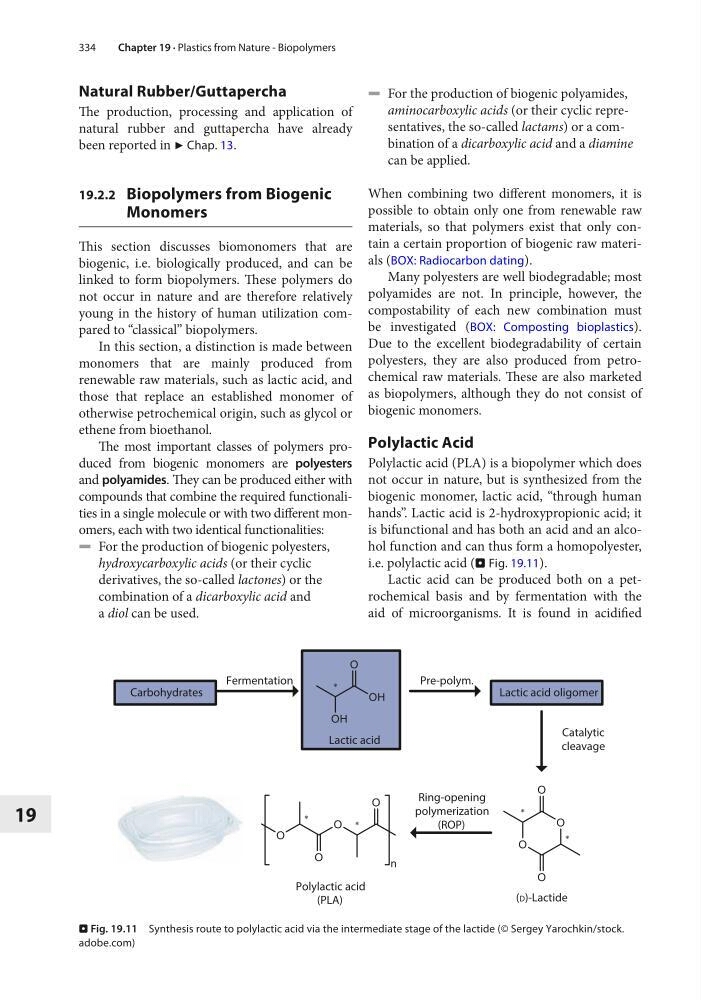
Polylactic acid (PLA) is a biopolymer which does
not occur in nature, but is synthesized from the
biogenic monomer, lactic acid, “through human
hands”. Lactic acid is 2-hydroxypropionic acid; it
is bifunctional and has both an acid and an alcohol function and can thus form a homopolyester,
i.e. polylactic acid (. Fig. 19.11).
Lactic acid can be produced both on a petrochemical basis and by fermentation with the
aid of microorganisms. It is found in acidified
Natural Rubber/Guttapercha
The production, processing and application of
natural rubber and guttapercha have already
been reported in 7 Chap. 13.
19.2.2 Biopolymers from Biogenic
Monomers
This section discusses biomonomers that are
biogenic, i.e. biologically produced, and can be
linked to form biopolymers. These polymers do
not occur in nature and are therefore relatively
young in the history of human utilization compared to “classical” biopolymers.
In this section, a distinction is made between
monomers that are mainly produced from
renewable raw materials, such as lactic acid, and
those that replace an established monomer of
otherwise petrochemical origin, such as glycol or
ethene from bioethanol.
The most important classes of polymers produced from biogenic monomers are polyesters
and polyamides. They can be produced either with
compounds that combine the required functionalities in a single molecule or with two different monomers, each with two identical functionalities:
5 For the production of biogenic polyesters,
hydroxycarboxylic acids (or their cyclic
derivatives, the so-called lactones) or the
combination of a dicarboxylic acid and
a diol can be used.
Carbohydrates
Fermentation
Lactic acid
Pre-polym.
Lactic acid oligomer
Catalytic
cleavage
(D)-Lactide
Ring-opening
polymerization
(ROP)
Polylactic acid
(PLA)
. Fig. 19.11 Synthesis route to polylactic acid via the intermediate stage of the lactide (© Sergey Yarochkin/stock.
adobe.com)
Chapter 19 · Plastics from Nature - Biopolymers
19
5 For the production of biogenic polyamides,
aminocarboxylic acids (or their cyclic representatives, the so-called lactams) or a combination of a dicarboxylic acid and a diamine
can be applied.
When combining two different monomers, it is
possible to obtain only one from renewable raw
materials, so that polymers exist that only contain a certain proportion of biogenic raw materials (BOX: Radiocarbon dating).
Many polyesters are well biodegradable; most
polyamides are not. In principle, however, the
compostability of each new combination must
be investigated (BOX: Composting bioplastics).
Due to the excellent biodegradability of certain
polyesters, they are also produced from petrochemical raw materials. These are also marketed
as biopolymers, although they do not consist of
biogenic monomers.
Polylactic Acid
Polylactic acid (PLA) is a biopolymer which does
not occur in nature, but is synthesized from the
biogenic monomer, lactic acid, “through human
hands”. Lactic acid is 2-hydroxypropionic acid; it
is bifunctional and has both an acid and an alcohol function and can thus form a homopolyester,
i.e. polylactic acid (. Fig. 19.11).
Lactic acid can be produced both on a petrochemical basis and by fermentation with the
aid of microorganisms. It is found in acidified
Natural Rubber/Guttapercha
The production, processing and application of
natural rubber and guttapercha have already
been reported in 7 Chap. 13.
19.2.2 Biopolymers from Biogenic
Monomers
This section discusses biomonomers that are
biogenic, i.e. biologically produced, and can be
linked to form biopolymers. These polymers do
not occur in nature and are therefore relatively
young in the history of human utilization compared to “classical” biopolymers.
In this section, a distinction is made between
monomers that are mainly produced from
renewable raw materials, such as lactic acid, and
those that replace an established monomer of
otherwise petrochemical origin, such as glycol or
ethene from bioethanol.
The most important classes of polymers produced from biogenic monomers are polyesters
and polyamides. They can be produced either with
compounds that combine the required functionalities in a single molecule or with two different monomers, each with two identical functionalities:
5 For the production of biogenic polyesters,
hydroxycarboxylic acids (or their cyclic
derivatives, the so-called lactones) or the
combination of a dicarboxylic acid and
a diol can be used.
Carbohydrates
Fermentation
Lactic acid
Pre-polym.
Lactic acid oligomer
Catalytic
cleavage
(D)-Lactide
Ring-opening
polymerization
(ROP)
Polylactic acid
(PLA)
. Fig. 19.11 Synthesis route to polylactic acid via the intermediate stage of the lactide (© Sergey Yarochkin/stock.
adobe.com)