

333
19
increase the degree of polymerization and produce a duromeric product.
The most popular application of shellac is
undoubtedly the record, which until the 1960s
was made of shellac, but was subsequently
replaced by petrochemical polyvinyl chloride
(PVC, hence the name “vinyl” for a record).
Nowadays, shellac is still produced and used.
However, production has declined significantly
from over 50,000 t a −1 in the 1950s to about
20,000 t a −1 . The reason for this is the comparatively expensive production method. Important
applications today are in cosmetics as an additive
to hair sprays and in pharmacy as a coating for
tablets. In particular, the film-forming properties
and food suitability of this natural product are
exploited.
Shellac
Shellac is a natural resin produced by female
scale insects to protect their brood. These animals live in Southeast Asia and India on bushes
and trees, from which the so-called stick varnish
can be harvested by scraping off the branches. It
is the only biogenic plastic of animal origin that
has gained commercial importance. Shellac is
made of various polyhydroxycarboxylic acids,
which form a three-dimensional network via
ester groups. In the first harvested stock varnish,
the average molar mass of approx. 1000 Dalton
is still relatively low. Considering the molecular
weights of the two main components aleuritic
acid and shellolic acid (. Fig. 19.10), these are
tri- to tetramers. Further processing steps, such
as forming by pressing and simultaneous heating,
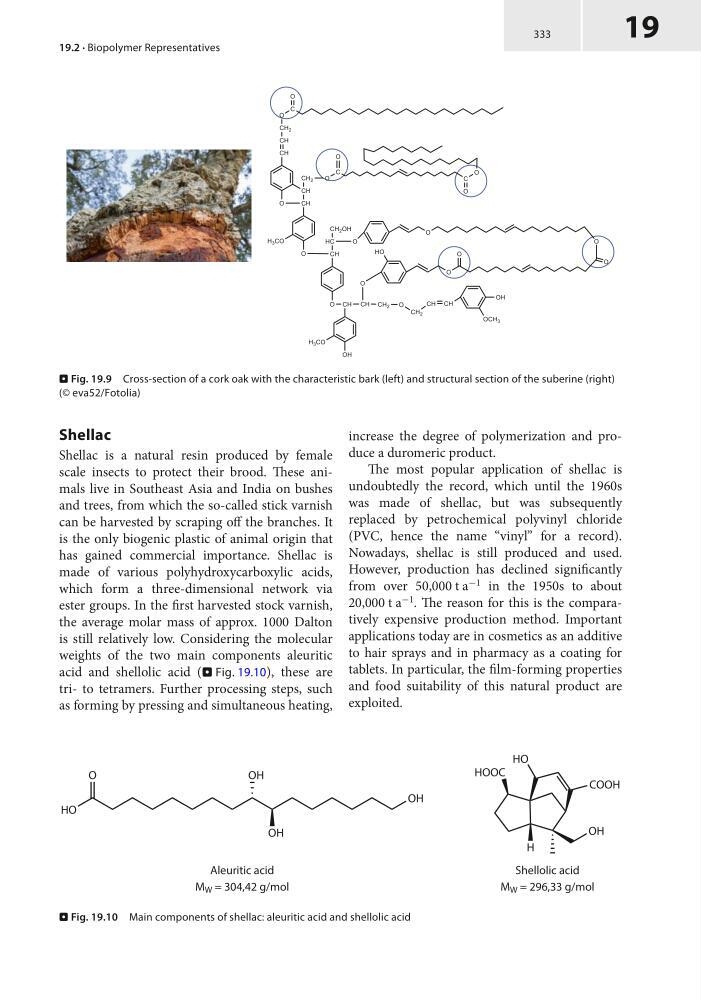
. Fig. 19.9 Cross-section of a cork oak with the characteristic bark (left) and structural section of the suberine (right)
(© eva52/Fotolia)
HO
OH
O
OH
OH
Aleuritic acid
M W = 304,42 g/mol
H
HOOC
HO
COOH
OH
Shellolic acid
M W = 296,33 g/mol
. Fig. 19.10 Main components of shellac: aleuritic acid and shellolic acid
19.2 · Biopolymer Representatives
19
increase the degree of polymerization and produce a duromeric product.
The most popular application of shellac is
undoubtedly the record, which until the 1960s
was made of shellac, but was subsequently
replaced by petrochemical polyvinyl chloride
(PVC, hence the name “vinyl” for a record).
Nowadays, shellac is still produced and used.
However, production has declined significantly
from over 50,000 t a −1 in the 1950s to about
20,000 t a −1 . The reason for this is the comparatively expensive production method. Important
applications today are in cosmetics as an additive
to hair sprays and in pharmacy as a coating for
tablets. In particular, the film-forming properties
and food suitability of this natural product are
exploited.
Shellac
Shellac is a natural resin produced by female
scale insects to protect their brood. These animals live in Southeast Asia and India on bushes
and trees, from which the so-called stick varnish
can be harvested by scraping off the branches. It
is the only biogenic plastic of animal origin that
has gained commercial importance. Shellac is
made of various polyhydroxycarboxylic acids,
which form a three-dimensional network via
ester groups. In the first harvested stock varnish,
the average molar mass of approx. 1000 Dalton
is still relatively low. Considering the molecular
weights of the two main components aleuritic
acid and shellolic acid (. Fig. 19.10), these are
tri- to tetramers. Further processing steps, such
as forming by pressing and simultaneous heating,
. Fig. 19.9 Cross-section of a cork oak with the characteristic bark (left) and structural section of the suberine (right)
(© eva52/Fotolia)
HO
OH
O
OH
OH
Aleuritic acid
M W = 304,42 g/mol
H
HOOC
HO
COOH
OH
Shellolic acid
M W = 296,33 g/mol
. Fig. 19.10 Main components of shellac: aleuritic acid and shellolic acid
19.2 · Biopolymer Representatives