

274
Chapter 15 · Showing Your Colors Sustainably! - Natural Dyes
15
BOX: “Holy” Yellow from India: Indian Yellow
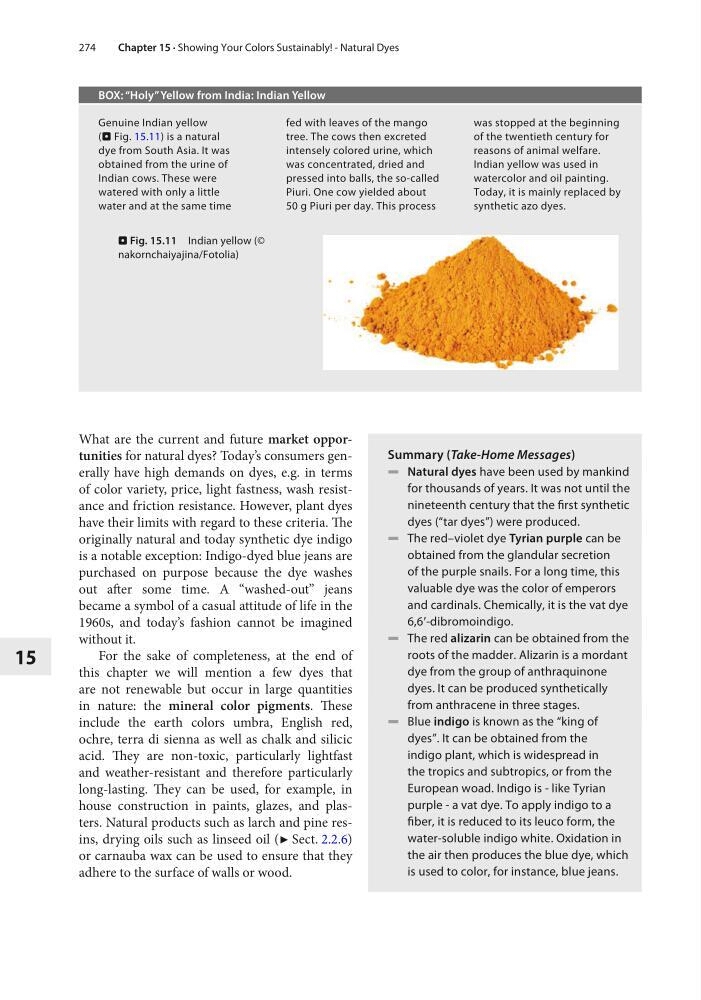
Genuine Indian yellow
(. Fig. 15.11) is a natural
dye from South Asia. It was
obtained from the urine of
Indian cows. These were
watered with only a little
water and at the same time
fed with leaves of the mango
tree. The cows then excreted
intensely colored urine, which
was concentrated, dried and
pressed into balls, the so-called
Piuri. One cow yielded about
50 g Piuri per day. This process
was stopped at the beginning
of the twentieth century for
reasons of animal welfare.
Indian yellow was used in
watercolor and oil painting.
Today, it is mainly replaced by
synthetic azo dyes.
. Fig. 15.11 Indian yellow (©
nakornchaiyajina/Fotolia)
What are the current and future market opportunities for natural dyes? Today’s consumers generally have high demands on dyes, e.g. in terms
of color variety, price, light fastness, wash resistance and friction resistance. However, plant dyes
have their limits with regard to these criteria. The
originally natural and today synthetic dye indigo
is a notable exception: Indigo-dyed blue jeans are
purchased on purpose because the dye washes
out after some time. A “washed-out” jeans
became a symbol of a casual attitude of life in the
1960s, and today’s fashion cannot be imagined
without it.
For the sake of completeness, at the end of
this chapter we will mention a few dyes that
are not renewable but occur in large quantities
in nature: the mineral color pigments. These
include the earth colors umbra, English red,
ochre, terra di sienna as well as chalk and silicic
acid. They are non-toxic, particularly lightfast
and weather-resistant and therefore particularly
long-lasting. They can be used, for example, in
house construction in paints, glazes, and plasters. Natural products such as larch and pine resins, drying oils such as linseed oil (7 Sect. 2.2.6)
or carnauba wax can be used to ensure that they
adhere to the surface of walls or wood.
Summary (Take-Home Messages)
5 Natural dyes have been used by mankind
for thousands of years. It was not until the
nineteenth century that the first synthetic
dyes (“tar dyes”) were produced.
5 The red–violet dye Tyrian purple can be
obtained from the glandular secretion
of the purple snails. For a long time, this
valuable dye was the color of emperors
and cardinals. Chemically, it is the vat dye
6,6′-dibromoindigo.
5 The red alizarin can be obtained from the
roots of the madder. Alizarin is a mordant
dye from the group of anthraquinone
dyes. It can be produced synthetically
from anthracene in three stages.
5 Blue indigo is known as the “king of
dyes”. It can be obtained from the
indigo plant, which is widespread in
the tropics and subtropics, or from the
European woad. Indigo is - like Tyrian
purple - a vat dye. To apply indigo to a
fiber, it is reduced to its leuco form, the
water-soluble indigo white. Oxidation in
the air then produces the blue dye, which
is used to color, for instance, blue jeans.
Chapter 15 · Showing Your Colors Sustainably! - Natural Dyes
15
BOX: “Holy” Yellow from India: Indian Yellow
Genuine Indian yellow
(. Fig. 15.11) is a natural
dye from South Asia. It was
obtained from the urine of
Indian cows. These were
watered with only a little
water and at the same time
fed with leaves of the mango
tree. The cows then excreted
intensely colored urine, which
was concentrated, dried and
pressed into balls, the so-called
Piuri. One cow yielded about
50 g Piuri per day. This process
was stopped at the beginning
of the twentieth century for
reasons of animal welfare.
Indian yellow was used in
watercolor and oil painting.
Today, it is mainly replaced by
synthetic azo dyes.
. Fig. 15.11 Indian yellow (©
nakornchaiyajina/Fotolia)
What are the current and future market opportunities for natural dyes? Today’s consumers generally have high demands on dyes, e.g. in terms
of color variety, price, light fastness, wash resistance and friction resistance. However, plant dyes
have their limits with regard to these criteria. The
originally natural and today synthetic dye indigo
is a notable exception: Indigo-dyed blue jeans are
purchased on purpose because the dye washes
out after some time. A “washed-out” jeans
became a symbol of a casual attitude of life in the
1960s, and today’s fashion cannot be imagined
without it.
For the sake of completeness, at the end of
this chapter we will mention a few dyes that
are not renewable but occur in large quantities
in nature: the mineral color pigments. These
include the earth colors umbra, English red,
ochre, terra di sienna as well as chalk and silicic
acid. They are non-toxic, particularly lightfast
and weather-resistant and therefore particularly
long-lasting. They can be used, for example, in
house construction in paints, glazes, and plasters. Natural products such as larch and pine resins, drying oils such as linseed oil (7 Sect. 2.2.6)
or carnauba wax can be used to ensure that they
adhere to the surface of walls or wood.
Summary (Take-Home Messages)
5 Natural dyes have been used by mankind
for thousands of years. It was not until the
nineteenth century that the first synthetic
dyes (“tar dyes”) were produced.
5 The red–violet dye Tyrian purple can be
obtained from the glandular secretion
of the purple snails. For a long time, this
valuable dye was the color of emperors
and cardinals. Chemically, it is the vat dye
6,6′-dibromoindigo.
5 The red alizarin can be obtained from the
roots of the madder. Alizarin is a mordant
dye from the group of anthraquinone
dyes. It can be produced synthetically
from anthracene in three stages.
5 Blue indigo is known as the “king of
dyes”. It can be obtained from the
indigo plant, which is widespread in
the tropics and subtropics, or from the
European woad. Indigo is - like Tyrian
purple - a vat dye. To apply indigo to a
fiber, it is reduced to its leuco form, the
water-soluble indigo white. Oxidation in
the air then produces the blue dye, which
is used to color, for instance, blue jeans.