

12
Chapter 1 · The Overview - Introduction
1
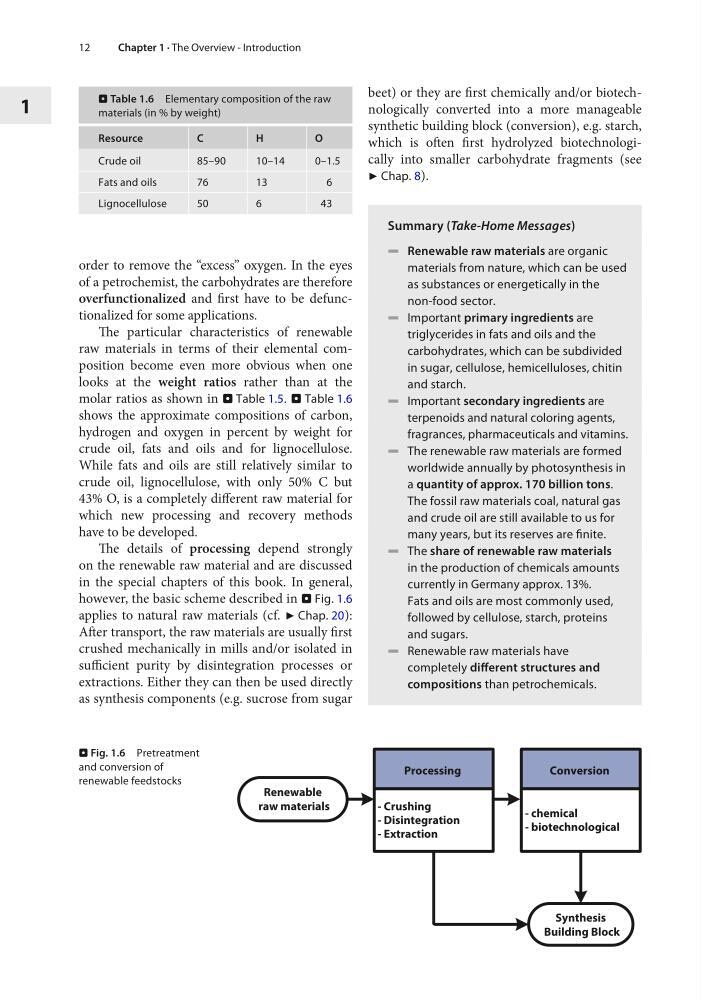
beet) or they are first chemically and/or biotechnologically converted into a more manageable
synthetic building block (conversion), e.g. starch,
which is often first hydrolyzed biotechnologically into smaller carbohydrate fragments (see
7 Chap. 8).
Summary (Take-Home Messages)
5 Renewable raw materials are organic
materials from nature, which can be used
as substances or energetically in the
non-food sector.
5 Important primary ingredients are
triglycerides in fats and oils and the
carbohydrates, which can be subdivided
in sugar, cellulose, hemicelluloses, chitin
and starch.
5 Important secondary ingredients are
terpenoids and natural coloring agents,
fragrances, pharmaceuticals and vitamins.
5 The renewable raw materials are formed
worldwide annually by photosynthesis in
a quantity of approx. 170 billion tons.
The fossil raw materials coal, natural gas
and crude oil are still available to us for
many years, but its reserves are finite.
5 The share of renewable raw materials
in the production of chemicals amounts
currently in Germany approx. 13%.
Fats and oils are most commonly used,
followed by cellulose, starch, proteins
and sugars.
5 Renewable raw materials have
completely different structures and
compositions than petrochemicals.
order to remove the “excess” oxygen. In the eyes
of a petrochemist, the carbohydrates are therefore
overfunctionalized and first have to be defunctionalized for some applications.
The particular characteristics of renewable
raw materials in terms of their elemental composition become even more obvious when one
looks at the weight ratios rather than at the
molar ratios as shown in . Table 1.5. . Table 1.6
shows the approximate compositions of carbon,
hydrogen and oxygen in percent by weight for
crude oil, fats and oils and for lignocellulose.
While fats and oils are still relatively similar to
crude oil, lignocellulose, with only 50% C but
43% O, is a completely different raw material for
which new processing and recovery methods
have to be developed.
The details of processing depend strongly
on the renewable raw material and are discussed
in the special chapters of this book. In general,
however, the basic scheme described in . Fig. 1.6
applies to natural raw materials (cf. 7 Chap. 20):
After transport, the raw materials are usually first
crushed mechanically in mills and/or isolated in
sufficient purity by disintegration processes or
extractions. Either they can then be used directly
as synthesis components (e.g. sucrose from sugar
. Table 1.6 Elementary composition of the raw
materials (in % by weight)
Resource
C
H
O
Crude oil
85–90
10–14
0–1.5
Fats and oils
76
13
6
Lignocellulose
50
6
43
. Fig. 1.6 Pretreatment
and conversion of
renewable feedstocks
Processing
- Crushing
- Disintegration
- Extraction
Renewable
raw materials
Synthesis
Building Block
Conversion
- chemical
- biotechnological
Chapter 1 · The Overview - Introduction
1
beet) or they are first chemically and/or biotechnologically converted into a more manageable
synthetic building block (conversion), e.g. starch,
which is often first hydrolyzed biotechnologically into smaller carbohydrate fragments (see
7 Chap. 8).
Summary (Take-Home Messages)
5 Renewable raw materials are organic
materials from nature, which can be used
as substances or energetically in the
non-food sector.
5 Important primary ingredients are
triglycerides in fats and oils and the
carbohydrates, which can be subdivided
in sugar, cellulose, hemicelluloses, chitin
and starch.
5 Important secondary ingredients are
terpenoids and natural coloring agents,
fragrances, pharmaceuticals and vitamins.
5 The renewable raw materials are formed
worldwide annually by photosynthesis in
a quantity of approx. 170 billion tons.
The fossil raw materials coal, natural gas
and crude oil are still available to us for
many years, but its reserves are finite.
5 The share of renewable raw materials
in the production of chemicals amounts
currently in Germany approx. 13%.
Fats and oils are most commonly used,
followed by cellulose, starch, proteins
and sugars.
5 Renewable raw materials have
completely different structures and
compositions than petrochemicals.
order to remove the “excess” oxygen. In the eyes
of a petrochemist, the carbohydrates are therefore
overfunctionalized and first have to be defunctionalized for some applications.
The particular characteristics of renewable
raw materials in terms of their elemental composition become even more obvious when one
looks at the weight ratios rather than at the
molar ratios as shown in . Table 1.5. . Table 1.6
shows the approximate compositions of carbon,
hydrogen and oxygen in percent by weight for
crude oil, fats and oils and for lignocellulose.
While fats and oils are still relatively similar to
crude oil, lignocellulose, with only 50% C but
43% O, is a completely different raw material for
which new processing and recovery methods
have to be developed.
The details of processing depend strongly
on the renewable raw material and are discussed
in the special chapters of this book. In general,
however, the basic scheme described in . Fig. 1.6
applies to natural raw materials (cf. 7 Chap. 20):
After transport, the raw materials are usually first
crushed mechanically in mills and/or isolated in
sufficient purity by disintegration processes or
extractions. Either they can then be used directly
as synthesis components (e.g. sucrose from sugar
. Table 1.6 Elementary composition of the raw
materials (in % by weight)
Resource
C
H
O
Crude oil
85–90
10–14
0–1.5
Fats and oils
76
13
6
Lignocellulose
50
6
43
. Fig. 1.6 Pretreatment
and conversion of
renewable feedstocks
Processing
- Crushing
- Disintegration
- Extraction
Renewable
raw materials
Synthesis
Building Block
Conversion
- chemical
- biotechnological