

11
1
1.4 Advantages and Disadvantages of Renewable Raw Materials
present in the form of carboxylic acid, aldehyde, ketone and/or alcohol groups and makes
the molecules relatively hydrophilic, i.e. water
soluble. For example, comparing the formulas of the industrially important C 6 hydrocarbons n-hexene[C 6 H 12 ], cyclohexane[C 6 H 12 ]
and benzene[C 6 H 6 ] with the C 6 carbohydrate
glucose[C 6 H 12 O 6 ] reveals that the carbohydrate
must have completely different properties: The
hydrocarbons are almost insoluble in water,
whereas glucose is very soluble in water due to its
hydroxyl groups. If you want to use glucose for a
similar chemistry as with hydrocarbons, you have
to dehydrate or hydrogenate the carbohydrate in
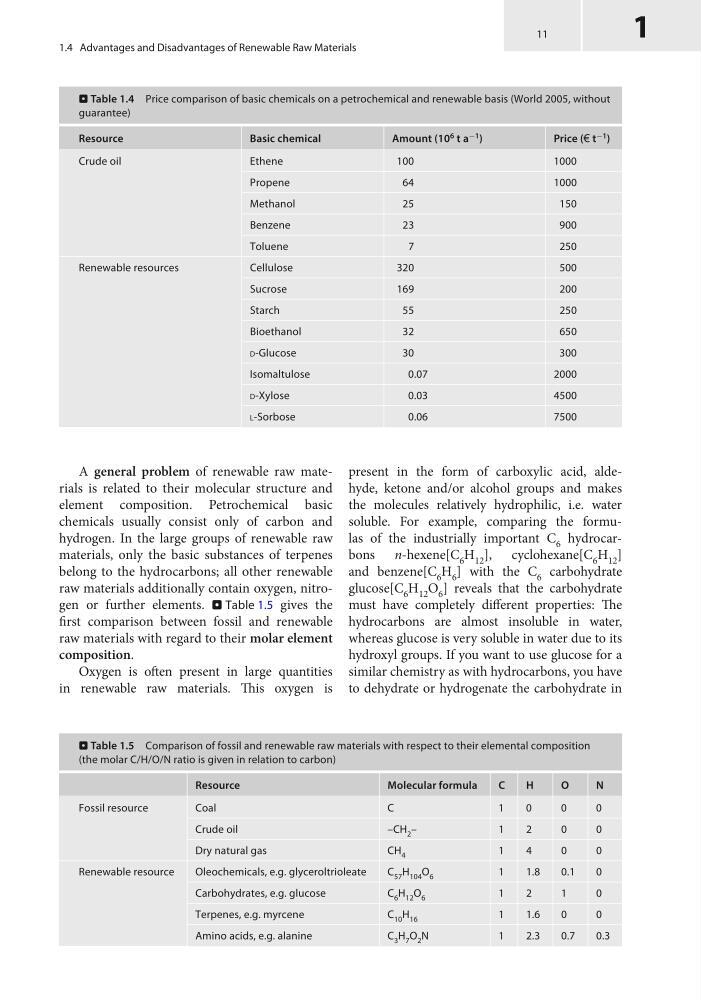
A general problem of renewable raw materials is related to their molecular structure and
element composition. Petrochemical basic
chemicals usually consist only of carbon and
hydrogen. In the large groups of renewable raw
materials, only the basic substances of terpenes
belong to the hydrocarbons; all other renewable
raw materials additionally contain oxygen, nitrogen or further elements. . Table 1.5 gives the
first comparison between fossil and renewable
raw materials with regard to their molar element
composition.
Oxygen is often present in large quantities
in renewable raw materials. This oxygen is
. Table 1.4 Price comparison of basic chemicals on a petrochemical and renewable basis (World 2005, without
guarantee)
Resource
Basic chemical
Amount (10 6 t a −1 )
Price (€ t −1 )
Crude oil
Ethene
100
1000
Propene
64
1000
Methanol
25
150
Benzene
23
900
Toluene
7
250
Renewable resources
Cellulose
320
500
Sucrose
169
200
Starch
55
250
Bioethanol
32
650
d-Glucose
30
300
Isomaltulose
0.07
2000
d-Xylose
0.03
4500
l-Sorbose
0.06
7500
. Table 1.5 Comparison of fossil and renewable raw materials with respect to their elemental composition
(the molar C/H/O/N ratio is given in relation to carbon)
Resource
Molecular formula
C
H
O
N
Fossil resource
Coal
C
1
0
0
0
Crude oil
–CH 2 –
1
2
0
0
Dry natural gas
CH 4
1
4
0
0
Renewable resource
Oleochemicals, e.g. glyceroltrioleate
C 57 H 104 O 6
1
1.8
0.1
0
Carbohydrates, e.g. glucose
C 6 H 12 O 6
1
2
1
0
Terpenes, e.g. myrcene
C 10 H 16
1
1.6
0
0
Amino acids, e.g. alanine
C 3 H 7 O 2 N
1
2.3
0.7
0.3
1
1.4 Advantages and Disadvantages of Renewable Raw Materials
present in the form of carboxylic acid, aldehyde, ketone and/or alcohol groups and makes
the molecules relatively hydrophilic, i.e. water
soluble. For example, comparing the formulas of the industrially important C 6 hydrocarbons n-hexene[C 6 H 12 ], cyclohexane[C 6 H 12 ]
and benzene[C 6 H 6 ] with the C 6 carbohydrate
glucose[C 6 H 12 O 6 ] reveals that the carbohydrate
must have completely different properties: The
hydrocarbons are almost insoluble in water,
whereas glucose is very soluble in water due to its
hydroxyl groups. If you want to use glucose for a
similar chemistry as with hydrocarbons, you have
to dehydrate or hydrogenate the carbohydrate in
A general problem of renewable raw materials is related to their molecular structure and
element composition. Petrochemical basic
chemicals usually consist only of carbon and
hydrogen. In the large groups of renewable raw
materials, only the basic substances of terpenes
belong to the hydrocarbons; all other renewable
raw materials additionally contain oxygen, nitrogen or further elements. . Table 1.5 gives the
first comparison between fossil and renewable
raw materials with regard to their molar element
composition.
Oxygen is often present in large quantities
in renewable raw materials. This oxygen is
. Table 1.4 Price comparison of basic chemicals on a petrochemical and renewable basis (World 2005, without
guarantee)
Resource
Basic chemical
Amount (10 6 t a −1 )
Price (€ t −1 )
Crude oil
Ethene
100
1000
Propene
64
1000
Methanol
25
150
Benzene
23
900
Toluene
7
250
Renewable resources
Cellulose
320
500
Sucrose
169
200
Starch
55
250
Bioethanol
32
650
d-Glucose
30
300
Isomaltulose
0.07
2000
d-Xylose
0.03
4500
l-Sorbose
0.06
7500
. Table 1.5 Comparison of fossil and renewable raw materials with respect to their elemental composition
(the molar C/H/O/N ratio is given in relation to carbon)
Resource
Molecular formula
C
H
O
N
Fossil resource
Coal
C
1
0
0
0
Crude oil
–CH 2 –
1
2
0
0
Dry natural gas
CH 4
1
4
0
0
Renewable resource
Oleochemicals, e.g. glyceroltrioleate
C 57 H 104 O 6
1
1.8
0.1
0
Carbohydrates, e.g. glucose
C 6 H 12 O 6
1
2
1
0
Terpenes, e.g. myrcene
C 10 H 16
1
1.6
0
0
Amino acids, e.g. alanine
C 3 H 7 O 2 N
1
2.3
0.7
0.3