

253
14
All 20 proteinogenic amino acids are shown in
. Fig. 14.3 with their chemical structures. The
figure also shows whether the is essential (e) or
non-essential (n-e). In addition, the abbreviations of the amino acids common in protein
chemistry consisting of three letters (often the
first letters) are found here. There is a further
one-letter code for experts, which is not introduced herein.
In the following, the 20 proteinogenic amino
acids are once again listed alphabetically with
their most important occurrences, syntheses and
applications:
Alanine (Ala) was isolated in 1888 from the
protein silk fibroin, in which it occurs particularly abundantly (35%). It also occurs in 9% of
gelatine. Synthetically, it is easily accessible by a
Strecker synthesis of acetaldehyde (. Fig. 14.4):
In a first step, acetaldehyde reacts with hydrocyanic acid to cyanohydrin, which is converted
with ammonia into aminonitrile. This is finally
hydrolyzed to alanine in the presence of concentrated mineral acid, whereby ammonia is split
off. The Strecker synthesis of alanine produces
a racemate, i.e. not only the naturally occurring
l-enantiomer.
other hand, have to ingest certain amino acids,
the so-called essential amino acids, with their
diet. In addition to proteinogenic amino acids,
there are also several hundred non-proteinogenic
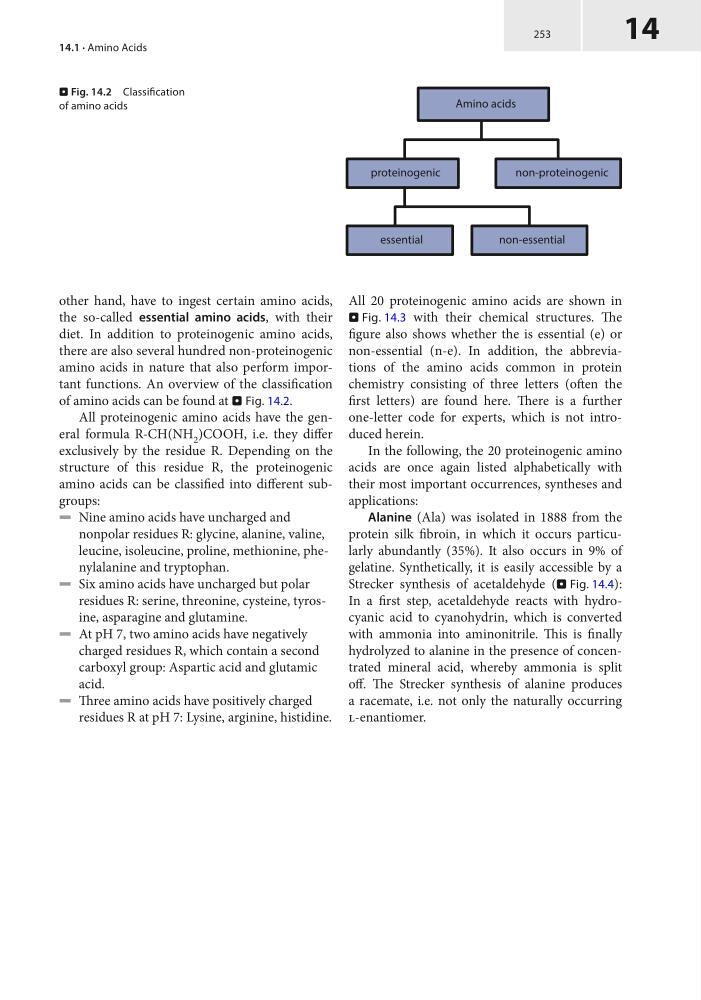
amino acids in nature that also perform important functions. An overview of the classification
of amino acids can be found at . Fig. 14.2.
All proteinogenic amino acids have the general formula R-CH(NH 2 )COOH, i.e. they differ
exclusively by the residue R. Depending on the
structure of this residue R, the proteinogenic
amino acids can be classified into different subgroups:
5 Nine amino acids have uncharged and
nonpolar residues R: glycine, alanine, valine,
leucine, isoleucine, proline, methionine, phenylalanine and tryptophan.
5 Six amino acids have uncharged but polar
residues R: serine, threonine, cysteine, tyrosine, asparagine and glutamine.
5 At pH 7, two amino acids have negatively
charged residues R, which contain a second
carboxyl group: Aspartic acid and glutamic
acid.
5 Three amino acids have positively charged
residues R at pH 7: Lysine, arginine, histidine.
. Fig. 14.2 Classification
of amino acids
Amino acids
proteinogenic
non-proteinogenic
essential
non-essential
14.1 · Amino Acids
14
All 20 proteinogenic amino acids are shown in
. Fig. 14.3 with their chemical structures. The
figure also shows whether the is essential (e) or
non-essential (n-e). In addition, the abbreviations of the amino acids common in protein
chemistry consisting of three letters (often the
first letters) are found here. There is a further
one-letter code for experts, which is not introduced herein.
In the following, the 20 proteinogenic amino
acids are once again listed alphabetically with
their most important occurrences, syntheses and
applications:
Alanine (Ala) was isolated in 1888 from the
protein silk fibroin, in which it occurs particularly abundantly (35%). It also occurs in 9% of
gelatine. Synthetically, it is easily accessible by a
Strecker synthesis of acetaldehyde (. Fig. 14.4):
In a first step, acetaldehyde reacts with hydrocyanic acid to cyanohydrin, which is converted
with ammonia into aminonitrile. This is finally
hydrolyzed to alanine in the presence of concentrated mineral acid, whereby ammonia is split
off. The Strecker synthesis of alanine produces
a racemate, i.e. not only the naturally occurring
l-enantiomer.
other hand, have to ingest certain amino acids,
the so-called essential amino acids, with their
diet. In addition to proteinogenic amino acids,
there are also several hundred non-proteinogenic
amino acids in nature that also perform important functions. An overview of the classification
of amino acids can be found at . Fig. 14.2.
All proteinogenic amino acids have the general formula R-CH(NH 2 )COOH, i.e. they differ
exclusively by the residue R. Depending on the
structure of this residue R, the proteinogenic
amino acids can be classified into different subgroups:
5 Nine amino acids have uncharged and
nonpolar residues R: glycine, alanine, valine,
leucine, isoleucine, proline, methionine, phenylalanine and tryptophan.
5 Six amino acids have uncharged but polar
residues R: serine, threonine, cysteine, tyrosine, asparagine and glutamine.
5 At pH 7, two amino acids have negatively
charged residues R, which contain a second
carboxyl group: Aspartic acid and glutamic
acid.
5 Three amino acids have positively charged
residues R at pH 7: Lysine, arginine, histidine.
. Fig. 14.2 Classification
of amino acids
Amino acids
proteinogenic
non-proteinogenic
essential
non-essential
14.1 · Amino Acids