

252
Chapter 14 · Building Blocks of Life - Amino Acids
14
highly soluble in water and very poorly soluble
in organic solvents. The bifunctional character
of the amino acids can be recognized by their
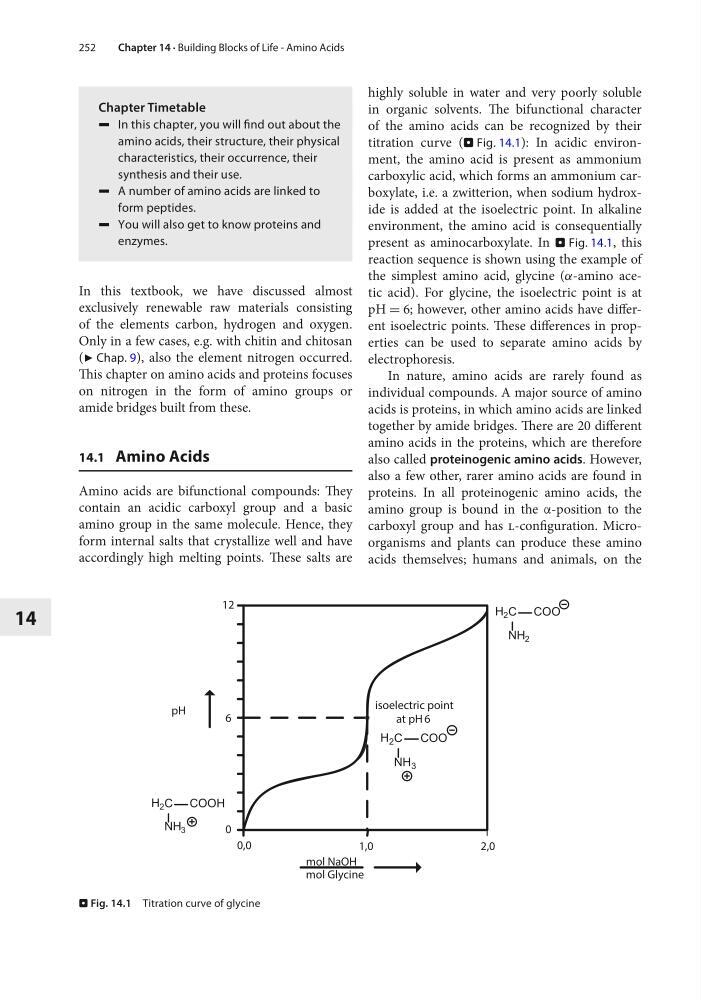
titration curve (. Fig. 14.1): In acidic environment, the amino acid is present as ammonium
carboxylic acid, which forms an ammonium carboxylate, i.e. a zwitterion, when sodium hydroxide is added at the isoelectric point. In alkaline
environment, the amino acid is consequentially
present as aminocarboxylate. In . Fig. 14.1, this
reaction sequence is shown using the example of
the simplest amino acid, glycine (α-amino acetic acid). For glycine, the isoelectric point is at
pH = 6; however, other amino acids have different isoelectric points. These differences in properties can be used to separate amino acids by
electrophoresis.
In nature, amino acids are rarely found as
individual compounds. A major source of amino
acids is proteins, in which amino acids are linked
together by amide bridges. There are 20 different
amino acids in the proteins, which are therefore
also called proteinogenic amino acids. However,
also a few other, rarer amino acids are found in
proteins. In all proteinogenic amino acids, the
amino group is bound in the α-position to the
carboxyl group and has l-configuration. Microorganisms and plants can produce these amino
acids themselves; humans and animals, on the
Chapter Timetable
5 In this chapter, you will find out about the
amino acids, their structure, their physical
characteristics, their occurrence, their
synthesis and their use.
5 A number of amino acids are linked to
form peptides.
5 You will also get to know proteins and
enzymes.
In this textbook, we have discussed almost
exclusively renewable raw materials consisting
of the elements carbon, hydrogen and oxygen.
Only in a few cases, e.g. with chitin and chitosan
(7 Chap. 9), also the element nitrogen occurred.
This chapter on amino acids and proteins focuses
on nitrogen in the form of amino groups or
amide bridges built from these.
14.1 Amino Acids
Amino acids are bifunctional compounds: They
contain an acidic carboxyl group and a basic
amino group in the same molecule. Hence, they
form internal salts that crystallize well and have
accordingly high melting points. These salts are
isoelectric point
at pH 6
H 2 C
NH 3
COOH
0
6
12
0,0
1,0
2,0
H 2 C
NH 3
COO
H 2 C
NH 2
COO
pH
mol NaOH
mol Glycine
. Fig. 14.1 Titration curve of glycine
Chapter 14 · Building Blocks of Life - Amino Acids
14
highly soluble in water and very poorly soluble
in organic solvents. The bifunctional character
of the amino acids can be recognized by their
titration curve (. Fig. 14.1): In acidic environment, the amino acid is present as ammonium
carboxylic acid, which forms an ammonium carboxylate, i.e. a zwitterion, when sodium hydroxide is added at the isoelectric point. In alkaline
environment, the amino acid is consequentially
present as aminocarboxylate. In . Fig. 14.1, this
reaction sequence is shown using the example of
the simplest amino acid, glycine (α-amino acetic acid). For glycine, the isoelectric point is at
pH = 6; however, other amino acids have different isoelectric points. These differences in properties can be used to separate amino acids by
electrophoresis.
In nature, amino acids are rarely found as
individual compounds. A major source of amino
acids is proteins, in which amino acids are linked
together by amide bridges. There are 20 different
amino acids in the proteins, which are therefore
also called proteinogenic amino acids. However,
also a few other, rarer amino acids are found in
proteins. In all proteinogenic amino acids, the
amino group is bound in the α-position to the
carboxyl group and has l-configuration. Microorganisms and plants can produce these amino
acids themselves; humans and animals, on the
Chapter Timetable
5 In this chapter, you will find out about the
amino acids, their structure, their physical
characteristics, their occurrence, their
synthesis and their use.
5 A number of amino acids are linked to
form peptides.
5 You will also get to know proteins and
enzymes.
In this textbook, we have discussed almost
exclusively renewable raw materials consisting
of the elements carbon, hydrogen and oxygen.
Only in a few cases, e.g. with chitin and chitosan
(7 Chap. 9), also the element nitrogen occurred.
This chapter on amino acids and proteins focuses
on nitrogen in the form of amino groups or
amide bridges built from these.
14.1 Amino Acids
Amino acids are bifunctional compounds: They
contain an acidic carboxyl group and a basic
amino group in the same molecule. Hence, they
form internal salts that crystallize well and have
accordingly high melting points. These salts are
isoelectric point
at pH 6
H 2 C
NH 3
COOH
0
6
12
0,0
1,0
2,0
H 2 C
NH 3
COO
H 2 C
NH 2
COO
pH
mol NaOH
mol Glycine
. Fig. 14.1 Titration curve of glycine