

237
13
BOX: Dandelion Tires
Which garden owner has
not often been annoyed by
the dandelion (Taraxacum
officinale)? It reproduces
quickly and turns the most
beautiful English lawn into a
weed meadow. However, a
close relative of dandelion, the
Russian dandelion (Taraxacum
koksaghyz), is currently a
popular research object: From
its root, a latex can be extracted
that can be further processed
into rubber. This latex contains
very pure poly(cis-1,4-isoprene)
with a high molecular weight
and is therefore very comparable
to the rubber from hevea
brasiliensis.
Unfortunately, the dandelion
currently supplies only about
1 ml of rubber per root.
Considering that a truck
tire contains up to 25 kg of
natural rubber, dandelion
tire production is completely
uneconomical so far. This is set
to change: Biotechnologists
at the University of Münster
(Germany) are working
together with other research
institutes and the tire company
Continental to use DNA analyses
to grow Russian dandelions
for stronger latex production.
The plant’s rubber content
should be increased to at least
10%. The aim is to turn the
weed dandelion into a robust
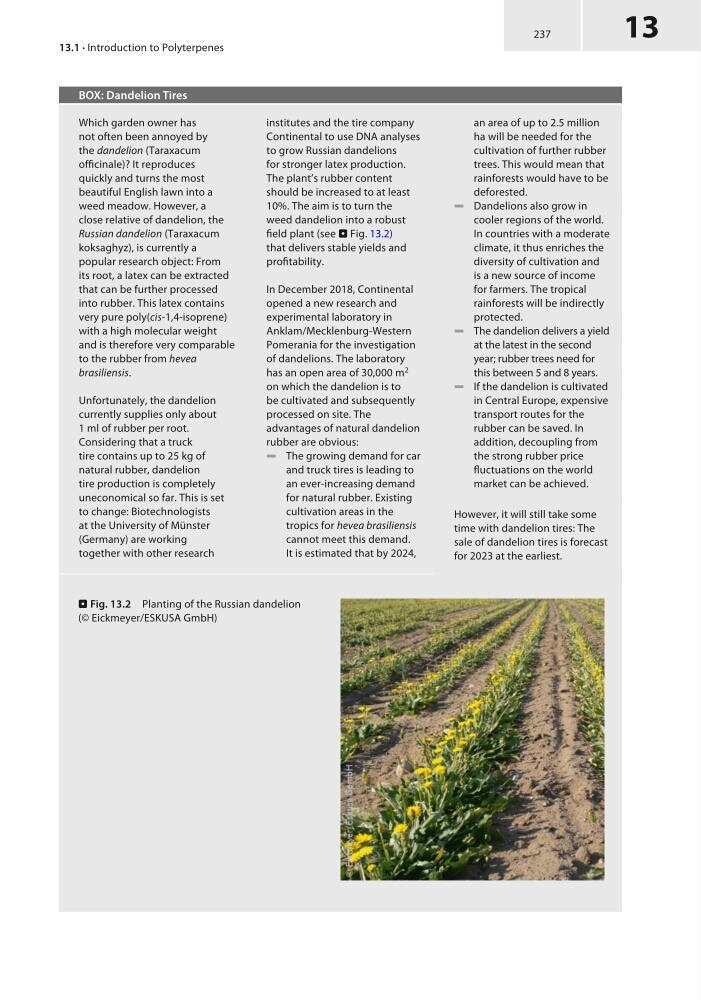
field plant (see . Fig. 13.2)
that delivers stable yields and
profitability.
In December 2018, Continental
opened a new research and
experimental laboratory in
Anklam/Mecklenburg-Western
Pomerania for the investigation
of dandelions. The laboratory
has an open area of 30,000 m 2
on which the dandelion is to
be cultivated and subsequently
processed on site. The
advantages of natural dandelion
rubber are obvious:
5 The growing demand for car
and truck tires is leading to
an ever-increasing demand
for natural rubber. Existing
cultivation areas in the
tropics for hevea brasiliensis
cannot meet this demand.
It is estimated that by 2024,
an area of up to 2.5 million
ha will be needed for the
cultivation of further rubber
trees. This would mean that
rainforests would have to be
deforested.
5 Dandelions also grow in
cooler regions of the world.
In countries with a moderate
climate, it thus enriches the
diversity of cultivation and
is a new source of income
for farmers. The tropical
rainforests will be indirectly
protected.
5 The dandelion delivers a yield
at the latest in the second
year; rubber trees need for
this between 5 and 8 years.
5 If the dandelion is cultivated
in Central Europe, expensive
transport routes for the
rubber can be saved. In
addition, decoupling from
the strong rubber price
fluctuations on the world
market can be achieved.
However, it will still take some
time with dandelion tires: The
sale of dandelion tires is forecast
for 2023 at the earliest.
. Fig. 13.2 Planting of the Russian dandelion
(© Eickmeyer/ESKUSA GmbH)
13.1 · Introduction to Polyterpenes
13
BOX: Dandelion Tires
Which garden owner has
not often been annoyed by
the dandelion (Taraxacum
officinale)? It reproduces
quickly and turns the most
beautiful English lawn into a
weed meadow. However, a
close relative of dandelion, the
Russian dandelion (Taraxacum
koksaghyz), is currently a
popular research object: From
its root, a latex can be extracted
that can be further processed
into rubber. This latex contains
very pure poly(cis-1,4-isoprene)
with a high molecular weight
and is therefore very comparable
to the rubber from hevea
brasiliensis.
Unfortunately, the dandelion
currently supplies only about
1 ml of rubber per root.
Considering that a truck
tire contains up to 25 kg of
natural rubber, dandelion
tire production is completely
uneconomical so far. This is set
to change: Biotechnologists
at the University of Münster
(Germany) are working
together with other research
institutes and the tire company
Continental to use DNA analyses
to grow Russian dandelions
for stronger latex production.
The plant’s rubber content
should be increased to at least
10%. The aim is to turn the
weed dandelion into a robust
field plant (see . Fig. 13.2)
that delivers stable yields and
profitability.
In December 2018, Continental
opened a new research and
experimental laboratory in
Anklam/Mecklenburg-Western
Pomerania for the investigation
of dandelions. The laboratory
has an open area of 30,000 m 2
on which the dandelion is to
be cultivated and subsequently
processed on site. The
advantages of natural dandelion
rubber are obvious:
5 The growing demand for car
and truck tires is leading to
an ever-increasing demand
for natural rubber. Existing
cultivation areas in the
tropics for hevea brasiliensis
cannot meet this demand.
It is estimated that by 2024,
an area of up to 2.5 million
ha will be needed for the
cultivation of further rubber
trees. This would mean that
rainforests would have to be
deforested.
5 Dandelions also grow in
cooler regions of the world.
In countries with a moderate
climate, it thus enriches the
diversity of cultivation and
is a new source of income
for farmers. The tropical
rainforests will be indirectly
protected.
5 The dandelion delivers a yield
at the latest in the second
year; rubber trees need for
this between 5 and 8 years.
5 If the dandelion is cultivated
in Central Europe, expensive
transport routes for the
rubber can be saved. In
addition, decoupling from
the strong rubber price
fluctuations on the world
market can be achieved.
However, it will still take some
time with dandelion tires: The
sale of dandelion tires is forecast
for 2023 at the earliest.
. Fig. 13.2 Planting of the Russian dandelion
(© Eickmeyer/ESKUSA GmbH)
13.1 · Introduction to Polyterpenes