

236
Chapter 13 · Elastomers from Nature! - Polyterpenes
13
trans-content is less than 0.01%. In nature, however, there are also isomers with a predominant
trans-configuration, such as the two compounds
gutta-percha and balata.
In nature, there are about 2000 plant species,
which contain aqueous dispersions of polyisoprene in their capillary tubes, the so-called
latex. As a secondary plant ingredient, these
latexes serve primarily as wound sealants for
plant injuries. Only in a few cases, it is profita ble to obtain the latex from the respective
plant. These plants include Hevea brasiliensis,
but also Ficus elastica and the creeper Landolphia owariensis. Cis-polyisoprene can also be
obtained from the roots of the Russian or Caucasian dandelion (see BOX: Dandelion tires) and
the Mexican guayule bush, but so far not in an
economic way, as the rubber content is only
5–10%. The advantages of the Guayule bush lie
in the facts that
5 mechanical harvesting is also possible, and
5 it grows in arid regions and therefore has no
competition to food production.
Chapter Timetable
5 We learn about natural rubber and its
manufacture from latex.
5 The special properties of natural rubber
lead to many interesting applications,
which we will discuss more in detail.
13.1 Introduction to Polyterpenes
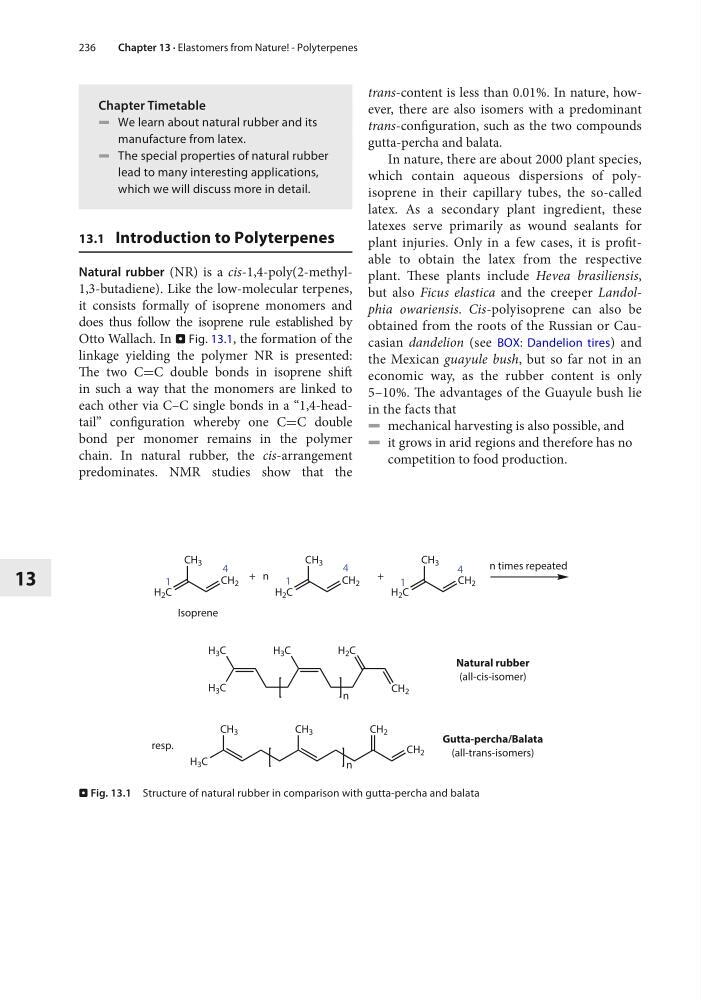
Natural rubber (NR) is a cis-1,4-poly(2-methyl1,3-butadiene). Like the low-molecular terpenes,
it consists formally of isoprene monomers and
does thus follow the isoprene rule established by
Otto Wallach. In . Fig. 13.1, the formation of the
linkage yielding the polymer NR is presented:
The two C=C double bonds in isoprene shift
in such a way that the monomers are linked to
each other via C–C single bonds in a “1,4-headtail” configuration whereby one C=C double
bond per monomer remains in the polymer
chain. In natural rubber, the cis-arrangement
predominates. NMR studies show that the
H 2 C
CH 2
CH 3
+
H 2 C
CH 2
CH 3
H 2 C
CH 2
CH 3
+
n
Isoprene
n times repeated
1
4
1
4
1
4
CH 2
H 3 C
H 2 C
H 3 C
H 3 C
n
resp.
H 3 C
CH 2
CH 3
CH 3
CH 2
n
Natural rubber
(all-cis-isomer)
Gutta-percha/Balata
(all-trans-isomers)
. Fig. 13.1 Structure of natural rubber in comparison with gutta-percha and balata
Chapter 13 · Elastomers from Nature! - Polyterpenes
13
trans-content is less than 0.01%. In nature, however, there are also isomers with a predominant
trans-configuration, such as the two compounds
gutta-percha and balata.
In nature, there are about 2000 plant species,
which contain aqueous dispersions of polyisoprene in their capillary tubes, the so-called
latex. As a secondary plant ingredient, these
latexes serve primarily as wound sealants for
plant injuries. Only in a few cases, it is profita ble to obtain the latex from the respective
plant. These plants include Hevea brasiliensis,
but also Ficus elastica and the creeper Landolphia owariensis. Cis-polyisoprene can also be
obtained from the roots of the Russian or Caucasian dandelion (see BOX: Dandelion tires) and
the Mexican guayule bush, but so far not in an
economic way, as the rubber content is only
5–10%. The advantages of the Guayule bush lie
in the facts that
5 mechanical harvesting is also possible, and
5 it grows in arid regions and therefore has no
competition to food production.
Chapter Timetable
5 We learn about natural rubber and its
manufacture from latex.
5 The special properties of natural rubber
lead to many interesting applications,
which we will discuss more in detail.
13.1 Introduction to Polyterpenes
Natural rubber (NR) is a cis-1,4-poly(2-methyl1,3-butadiene). Like the low-molecular terpenes,
it consists formally of isoprene monomers and
does thus follow the isoprene rule established by
Otto Wallach. In . Fig. 13.1, the formation of the
linkage yielding the polymer NR is presented:
The two C=C double bonds in isoprene shift
in such a way that the monomers are linked to
each other via C–C single bonds in a “1,4-headtail” configuration whereby one C=C double
bond per monomer remains in the polymer
chain. In natural rubber, the cis-arrangement
predominates. NMR studies show that the
H 2 C
CH 2
CH 3
+
H 2 C
CH 2
CH 3
H 2 C
CH 2
CH 3
+
n
Isoprene
n times repeated
1
4
1
4
1
4
CH 2
H 3 C
H 2 C
H 3 C
H 3 C
n
resp.
H 3 C
CH 2
CH 3
CH 3
CH 2
n
Natural rubber
(all-cis-isomer)
Gutta-percha/Balata
(all-trans-isomers)
. Fig. 13.1 Structure of natural rubber in comparison with gutta-percha and balata