

164
Chapter 8 · Products with a Little Twist - Starch
8
BOX: The Small Change from α to β
In the introductory chapter
on sugars, we have already
established that their
open-chain structure is not
preferred, but that they prefer
to close intramolecular rings
to form so-called semi-acetals.
From a stereochemical point
of view, this can happen
in two different ways: The
hydroxyl group of the formed
hemiacetal at carbon atom
C1 can either point upward
(β-conformation) or downward
(α- conformation). In d-glucose,
for example, the six-membered
ring called pyranose is
preferred. In aqueous solution,
free glucose can change
from the α-conformation
to the β-conformation, via
the so-called mutarotation.
Since most di-, oligo- and
polysaccharides are linked via
the position C1 of glucose, this
possibility of interconversion
is no longer given, the
configuration remains fixed in
these molecules.
This “small” change in the
orientation of the linkage leads
to two completely different
polyglucoses: Cellulose
(poly-β-1,4-d-glucopyranose,
7 Chap. 7) is used in plants
primarily as a robust (building)
material (plant fibers, cotton,
paper, etc.) and is a largely inert
substance. Starch (poly-α-1,4d-glucopyranose), on the other
hand, is formed by plants as an
energy storage. For this purpose,
the starch molecules must be
able to be easily broken down
again into usable sugar building
blocks, a task accomplished
by special enzymes, the
so-called amylases. However,
these can only hydrolyze the
α-1,4-glycosidic bond; the
β-1,4-glycosidic linkage of
cellulose remains intact. Anyone
who has chewed on a piece of
bread for a long time and for
comparison on a little cotton
wool knows that enzymes can
split starch into glucose units
but not cellulose: The starch in
bread is converted by enzymes
and the water, both contained in
saliva, into sugar building blocks
(especially maltose) and tastes
significantly sweet after some
time. Cellulose, on the other
hand, cannot be broken down
by our enzymes and its structure
is largely preserved; our body
cannot use it as food.
Sago
<20 µm
Corn
10 µm
Rice
4-5 µm
Potato
5-100 µm
Wheat
3-35 µm
Tapioca
~15 µm
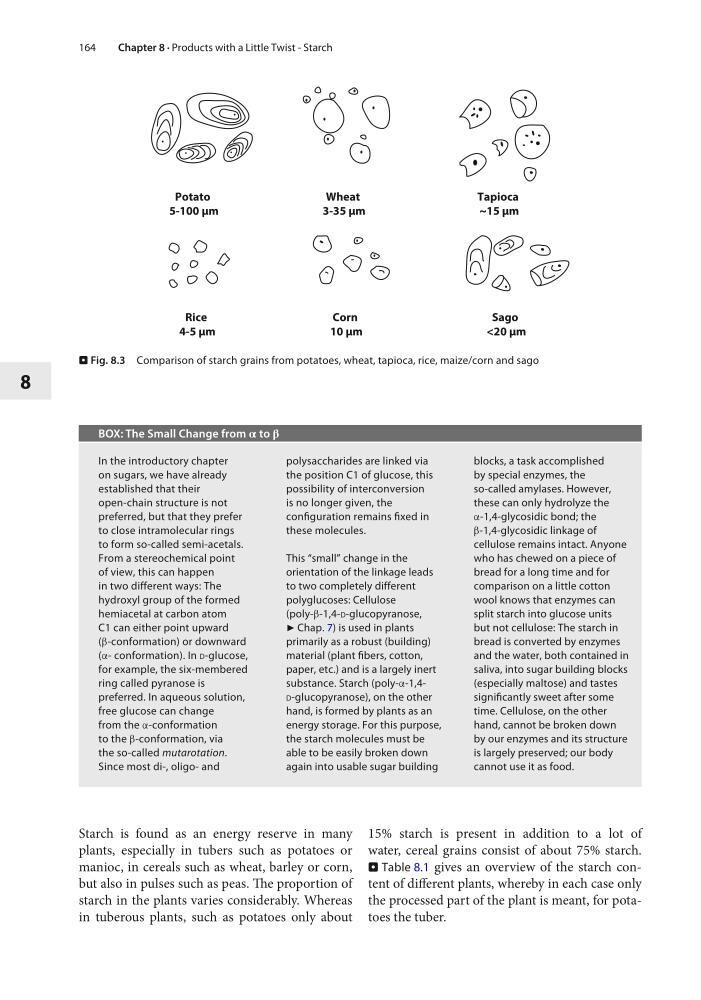
. Fig. 8.3 Comparison of starch grains from potatoes, wheat, tapioca, rice, maize/corn and sago
Starch is found as an energy reserve in many
plants, especially in tubers such as potatoes or
manioc, in cereals such as wheat, barley or corn,
but also in pulses such as peas. The proportion of
starch in the plants varies considerably. Whereas
in tuberous plants, such as potatoes only about
15% starch is present in addition to a lot of
water, cereal grains consist of about 75% starch.
. Table 8.1 gives an overview of the starch content of different plants, whereby in each case only
the processed part of the plant is meant, for potatoes the tuber.
Chapter 8 · Products with a Little Twist - Starch
8
BOX: The Small Change from α to β
In the introductory chapter
on sugars, we have already
established that their
open-chain structure is not
preferred, but that they prefer
to close intramolecular rings
to form so-called semi-acetals.
From a stereochemical point
of view, this can happen
in two different ways: The
hydroxyl group of the formed
hemiacetal at carbon atom
C1 can either point upward
(β-conformation) or downward
(α- conformation). In d-glucose,
for example, the six-membered
ring called pyranose is
preferred. In aqueous solution,
free glucose can change
from the α-conformation
to the β-conformation, via
the so-called mutarotation.
Since most di-, oligo- and
polysaccharides are linked via
the position C1 of glucose, this
possibility of interconversion
is no longer given, the
configuration remains fixed in
these molecules.
This “small” change in the
orientation of the linkage leads
to two completely different
polyglucoses: Cellulose
(poly-β-1,4-d-glucopyranose,
7 Chap. 7) is used in plants
primarily as a robust (building)
material (plant fibers, cotton,
paper, etc.) and is a largely inert
substance. Starch (poly-α-1,4d-glucopyranose), on the other
hand, is formed by plants as an
energy storage. For this purpose,
the starch molecules must be
able to be easily broken down
again into usable sugar building
blocks, a task accomplished
by special enzymes, the
so-called amylases. However,
these can only hydrolyze the
α-1,4-glycosidic bond; the
β-1,4-glycosidic linkage of
cellulose remains intact. Anyone
who has chewed on a piece of
bread for a long time and for
comparison on a little cotton
wool knows that enzymes can
split starch into glucose units
but not cellulose: The starch in
bread is converted by enzymes
and the water, both contained in
saliva, into sugar building blocks
(especially maltose) and tastes
significantly sweet after some
time. Cellulose, on the other
hand, cannot be broken down
by our enzymes and its structure
is largely preserved; our body
cannot use it as food.
Sago
<20 µm
Corn
10 µm
Rice
4-5 µm
Potato
5-100 µm
Wheat
3-35 µm
Tapioca
~15 µm
. Fig. 8.3 Comparison of starch grains from potatoes, wheat, tapioca, rice, maize/corn and sago
Starch is found as an energy reserve in many
plants, especially in tubers such as potatoes or
manioc, in cereals such as wheat, barley or corn,
but also in pulses such as peas. The proportion of
starch in the plants varies considerably. Whereas
in tuberous plants, such as potatoes only about
15% starch is present in addition to a lot of
water, cereal grains consist of about 75% starch.
. Table 8.1 gives an overview of the starch content of different plants, whereby in each case only
the processed part of the plant is meant, for potatoes the tuber.