

153
7
ing by condensation. Cellophane is also used to
sheathe electrical cables. Uncoated cellophane is
completely biodegradable.
In order to avoid the somewhat unpleasant
work with carbon disulfide and the accumulation of large quantities of salt, alternatives to the
viscose process were investigated intensively. An
interesting variant is the Lyocell process: The cellulose is dissolved in an aqueous solution of the
non-toxic solvent N-methylmorpholine-N-oxide
(NMMO). A homogeneous solution is formed,
which gives regenerated cellulose upon precipitation in an NMMO bath in which its solubility
is exceeded. This regenerated fiber is offered by
Lenzing AG under the brand name Tencel. The
Tencel fiber is used, among other things, for the
production of denim fabrics, sports textiles and
workwear. The great advantages of this fiber are
its wearing properties as well as its shine and feel.
An economic advantage is that cellulose of lower
purity (with a higher proportion of hemicellulose) can be used. Due to the virtually closed loop
of NMMO and the nearly emission-free process,
the Lyocell process is considered to be particularly
environment-friendly. For this reason, Lenzing AG
received the EU Environmental Award in 2000.
textiles, is produced by washing and stretching. It
is also used to cover umbrellas and as tire cord.
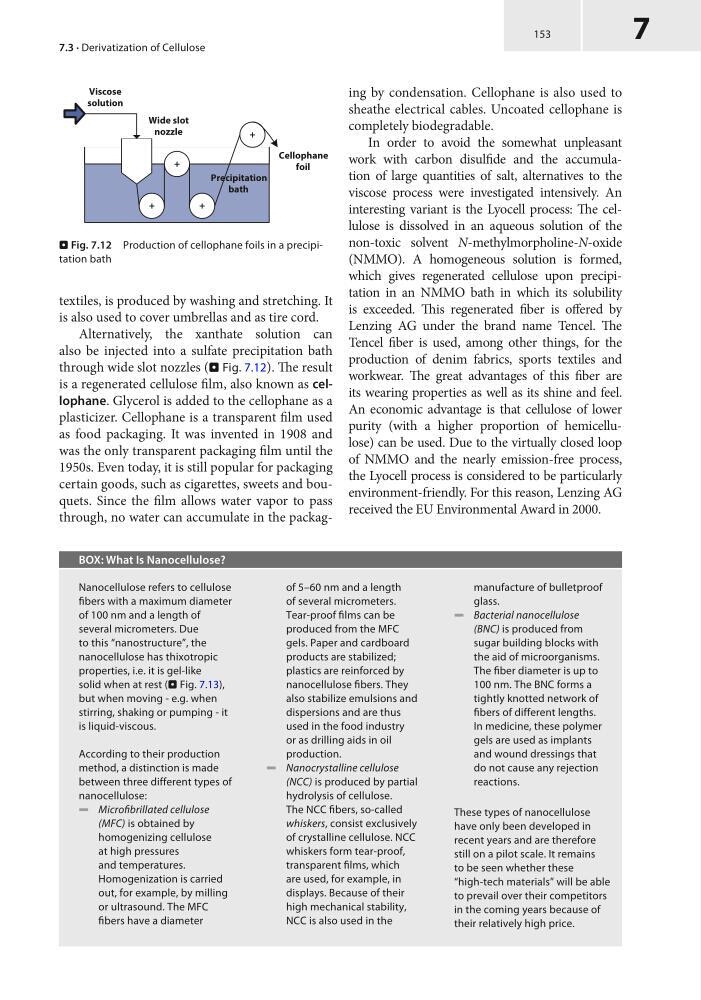
Alternatively, the xanthate solution can
also be injected into a sulfate precipitation bath
through wide slot nozzles (. Fig. 7.12). The result
is a regenerated cellulose film, also known as cellophane. Glycerol is added to the cellophane as a
plasticizer. Cellophane is a transparent film used
as food packaging. It was invented in 1908 and
was the only transparent packaging film until the
1950s. Even today, it is still popular for packaging
certain goods, such as cigarettes, sweets and bouquets. Since the film allows water vapor to pass
through, no water can accumulate in the packag7.3 · Derivatization of Cellulose
+
+
+
+
Viscose
solution
Wide slot
nozzle
Cellophane
foil
Precipitation
bath
. Fig. 7.12 Production of cellophane foils in a precipitation bath
BOX: What Is Nanocellulose?
Nanocellulose refers to cellulose
fibers with a maximum diameter
of 100 nm and a length of
several micrometers. Due
to this “nanostructure”, the
nanocellulose has thixotropic
properties, i.e. it is gel-like
solid when at rest (. Fig. 7.13),
but when moving - e.g. when
stirring, shaking or pumping - it
is liquid-viscous.
According to their production
method, a distinction is made
between three different types of
nanocellulose:
5 Microfibrillated cellulose
(MFC) is obtained by
homogenizing cellulose
at high pressures
and temperatures.
Homogenization is carried
out, for example, by milling
or ultrasound. The MFC
fibers have a diameter
of 5–60 nm and a length
of several micrometers.
Tear-proof films can be
produced from the MFC
gels. Paper and cardboard
products are stabilized;
plastics are reinforced by
nanocellulose fibers. They
also stabilize emulsions and
dispersions and are thus
used in the food industry
or as drilling aids in oil
production.
5 Nanocrystalline cellulose
(NCC) is produced by partial
hydrolysis of cellulose.
The NCC fibers, so-called
whiskers, consist exclusively
of crystalline cellulose. NCC
whiskers form tear-proof,
transparent films, which
are used, for example, in
displays. Because of their
high mechanical stability,
NCC is also used in the
manufacture of bulletproof
glass.
5 Bacterial nanocellulose
(BNC) is produced from
sugar building blocks with
the aid of microorganisms.
The fiber diameter is up to
100 nm. The BNC forms a
tightly knotted network of
fibers of different lengths.
In medicine, these polymer
gels are used as implants
and wound dressings that
do not cause any rejection
reactions.
These types of nanocellulose
have only been developed in
recent years and are therefore
still on a pilot scale. It remains
to be seen whether these
“high-tech materials” will be able
to prevail over their competitors
in the coming years because of
their relatively high price.
7
ing by condensation. Cellophane is also used to
sheathe electrical cables. Uncoated cellophane is
completely biodegradable.
In order to avoid the somewhat unpleasant
work with carbon disulfide and the accumulation of large quantities of salt, alternatives to the
viscose process were investigated intensively. An
interesting variant is the Lyocell process: The cellulose is dissolved in an aqueous solution of the
non-toxic solvent N-methylmorpholine-N-oxide
(NMMO). A homogeneous solution is formed,
which gives regenerated cellulose upon precipitation in an NMMO bath in which its solubility
is exceeded. This regenerated fiber is offered by
Lenzing AG under the brand name Tencel. The
Tencel fiber is used, among other things, for the
production of denim fabrics, sports textiles and
workwear. The great advantages of this fiber are
its wearing properties as well as its shine and feel.
An economic advantage is that cellulose of lower
purity (with a higher proportion of hemicellulose) can be used. Due to the virtually closed loop
of NMMO and the nearly emission-free process,
the Lyocell process is considered to be particularly
environment-friendly. For this reason, Lenzing AG
received the EU Environmental Award in 2000.
textiles, is produced by washing and stretching. It
is also used to cover umbrellas and as tire cord.
Alternatively, the xanthate solution can
also be injected into a sulfate precipitation bath
through wide slot nozzles (. Fig. 7.12). The result
is a regenerated cellulose film, also known as cellophane. Glycerol is added to the cellophane as a
plasticizer. Cellophane is a transparent film used
as food packaging. It was invented in 1908 and
was the only transparent packaging film until the
1950s. Even today, it is still popular for packaging
certain goods, such as cigarettes, sweets and bouquets. Since the film allows water vapor to pass
through, no water can accumulate in the packag7.3 · Derivatization of Cellulose
+
+
+
+
Viscose
solution
Wide slot
nozzle
Cellophane
foil
Precipitation
bath
. Fig. 7.12 Production of cellophane foils in a precipitation bath
BOX: What Is Nanocellulose?
Nanocellulose refers to cellulose
fibers with a maximum diameter
of 100 nm and a length of
several micrometers. Due
to this “nanostructure”, the
nanocellulose has thixotropic
properties, i.e. it is gel-like
solid when at rest (. Fig. 7.13),
but when moving - e.g. when
stirring, shaking or pumping - it
is liquid-viscous.
According to their production
method, a distinction is made
between three different types of
nanocellulose:
5 Microfibrillated cellulose
(MFC) is obtained by
homogenizing cellulose
at high pressures
and temperatures.
Homogenization is carried
out, for example, by milling
or ultrasound. The MFC
fibers have a diameter
of 5–60 nm and a length
of several micrometers.
Tear-proof films can be
produced from the MFC
gels. Paper and cardboard
products are stabilized;
plastics are reinforced by
nanocellulose fibers. They
also stabilize emulsions and
dispersions and are thus
used in the food industry
or as drilling aids in oil
production.
5 Nanocrystalline cellulose
(NCC) is produced by partial
hydrolysis of cellulose.
The NCC fibers, so-called
whiskers, consist exclusively
of crystalline cellulose. NCC
whiskers form tear-proof,
transparent films, which
are used, for example, in
displays. Because of their
high mechanical stability,
NCC is also used in the
manufacture of bulletproof
glass.
5 Bacterial nanocellulose
(BNC) is produced from
sugar building blocks with
the aid of microorganisms.
The fiber diameter is up to
100 nm. The BNC forms a
tightly knotted network of
fibers of different lengths.
In medicine, these polymer
gels are used as implants
and wound dressings that
do not cause any rejection
reactions.
These types of nanocellulose
have only been developed in
recent years and are therefore
still on a pilot scale. It remains
to be seen whether these
“high-tech materials” will be able
to prevail over their competitors
in the coming years because of
their relatively high price.