

152
Chapter 7 · From Wood to Pulp - Cellulose
7
heating in a 20% caustic soda solution, it can
swell to so-called alkali cellulose. This “activated”
cellulose can then be converted in the viscose
process with carbon disulfide into cellulose xanthate, which dissolves in 40% caustic soda solution. This solution is passed through a nozzle into
a coagulation bath of sulfuric acid and sulfates,
where a spinnable thread of regenerated cellulose is formed. The product is also known as viscose rayon or viscose silk. In this spinning process,
the carbon disulfide is released again and can be
recycled. A disadvantage is the formation of large
quantities of sodium sulfate as a by-product,
which is usually disposed of in underground
landfills. Alternatively, sodium sulfate can also
be electrolytically converted back into sodium
hydroxide solution and sulfuric acid. The entire
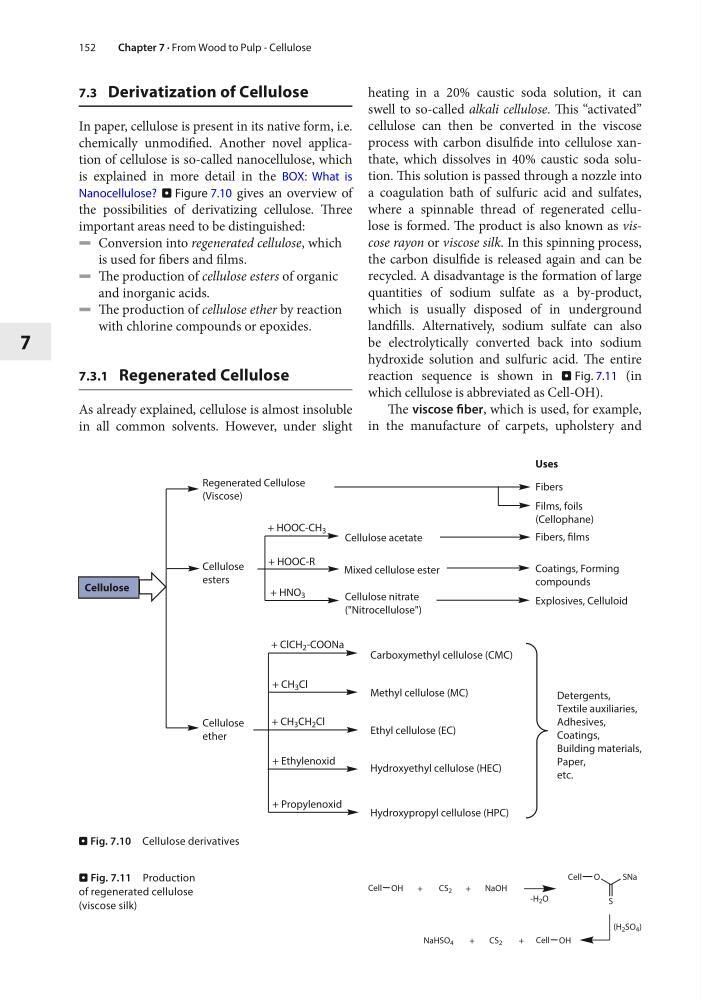
reaction sequence is shown in . Fig. 7.11 (in
which cellulose is abbreviated as Cell-OH).
The viscose fiber, which is used, for example,
in the manufacture of carpets, upholstery and
7.3 Derivatization of Cellulose
In paper, cellulose is present in its native form, i.e.
chemically unmodified. Another novel application of cellulose is so-called nanocellulose, which
is explained in more detail in the BOX: What is
Nanocellulose? . Figure 7.10 gives an overview of
the possibilities of derivatizing cellulose. Three
important areas need to be distinguished:
5 Conversion into regenerated cellulose, which
is used for fibers and films.
5 The production of cellulose esters of organic
and inorganic acids.
5 The production of cellulose ether by reaction
with chlorine compounds or epoxides.
7.3.1 Regenerated Cellulose
As already explained, cellulose is almost insoluble
in all common solvents. However, under slight
Cellulose
Regenerated Cellulose
(Viscose)
Cellulose
esters
Cellulose
ether
Uses
Fibers
Films, foils
(Cellophane)
+ HOOC-CH 3
+ HOOC-R
+ HNO 3
Cellulose acetate
Mixed cellulose ester
Cellulose nitrate
("Nitrocellulose")
Fibers, lms
Coatings, Forming
compounds
Explosives, Celluloid
+ ClCH 2 -COONa
+ CH 3 Cl
+ CH 3 CH 2 Cl
+ Ethylenoxid
+ Propylenoxid
Carboxymethyl cellulose (CMC)
Methyl cellulose (MC)
Ethyl cellulose (EC)
Hydroxyethyl cellulose (HEC)
Hydroxypropyl cellulose (HPC)
Detergents,
Textile auxiliaries,
Adhesives,
Coatings,
Building materials,
Paper,
etc.
. Fig. 7.10 Cellulose derivatives
. Fig. 7.11 Production
of regenerated cellulose
(viscose silk)
OH
Cell
+
NaOH
-H 2 O
S
O
SNa
Cell
CS 2
+
(H 2 SO 4 )
OH
Cell
+
CS 2
NaHSO 4
+
Chapter 7 · From Wood to Pulp - Cellulose
7
heating in a 20% caustic soda solution, it can
swell to so-called alkali cellulose. This “activated”
cellulose can then be converted in the viscose
process with carbon disulfide into cellulose xanthate, which dissolves in 40% caustic soda solution. This solution is passed through a nozzle into
a coagulation bath of sulfuric acid and sulfates,
where a spinnable thread of regenerated cellulose is formed. The product is also known as viscose rayon or viscose silk. In this spinning process,
the carbon disulfide is released again and can be
recycled. A disadvantage is the formation of large
quantities of sodium sulfate as a by-product,
which is usually disposed of in underground
landfills. Alternatively, sodium sulfate can also
be electrolytically converted back into sodium
hydroxide solution and sulfuric acid. The entire
reaction sequence is shown in . Fig. 7.11 (in
which cellulose is abbreviated as Cell-OH).
The viscose fiber, which is used, for example,
in the manufacture of carpets, upholstery and
7.3 Derivatization of Cellulose
In paper, cellulose is present in its native form, i.e.
chemically unmodified. Another novel application of cellulose is so-called nanocellulose, which
is explained in more detail in the BOX: What is
Nanocellulose? . Figure 7.10 gives an overview of
the possibilities of derivatizing cellulose. Three
important areas need to be distinguished:
5 Conversion into regenerated cellulose, which
is used for fibers and films.
5 The production of cellulose esters of organic
and inorganic acids.
5 The production of cellulose ether by reaction
with chlorine compounds or epoxides.
7.3.1 Regenerated Cellulose
As already explained, cellulose is almost insoluble
in all common solvents. However, under slight
Cellulose
Regenerated Cellulose
(Viscose)
Cellulose
esters
Cellulose
ether
Uses
Fibers
Films, foils
(Cellophane)
+ HOOC-CH 3
+ HOOC-R
+ HNO 3
Cellulose acetate
Mixed cellulose ester
Cellulose nitrate
("Nitrocellulose")
Fibers, lms
Coatings, Forming
compounds
Explosives, Celluloid
+ ClCH 2 -COONa
+ CH 3 Cl
+ CH 3 CH 2 Cl
+ Ethylenoxid
+ Propylenoxid
Carboxymethyl cellulose (CMC)
Methyl cellulose (MC)
Ethyl cellulose (EC)
Hydroxyethyl cellulose (HEC)
Hydroxypropyl cellulose (HPC)
Detergents,
Textile auxiliaries,
Adhesives,
Coatings,
Building materials,
Paper,
etc.
. Fig. 7.10 Cellulose derivatives
. Fig. 7.11 Production
of regenerated cellulose
(viscose silk)
OH
Cell
+
NaOH
-H 2 O
S
O
SNa
Cell
CS 2
+
(H 2 SO 4 )
OH
Cell
+
CS 2
NaHSO 4
+