

136
Chapter 6 · Sweet Chemistry - Mono- and Disaccharides
6
place particularly at the primary hydroxyl groups
and leads predominantly to mixtures of monoand dicarboxylic acids of sucrose.
The enzymatic isomerization of sucrose leads
to isomaltulose (. Fig. 6.25). In this molecule,
the fructose unit of the disaccharide is no longer
bound to the C-atom 1 of the glucose unit via
the secondary OH group at the C-atom 2, but
via the primary OH group. This reaction is also
known as transglucosylation; the corresponding
enzymes are glucosyltransferases.
This reaction to isomaltulose was first discovered by the German company Südzucker in
its laboratories in Neuoffstein in the Palatinate.
After the Latin word palatium for Palatinate, the
product was given the trade name “Palatinose”.
The sweetness of isomaltulose is comparable to
that of sucrose. However, isomaltulose is not cariogenic (does not produce caries) and degrades
more slowly in the body than sucrose. As a
result, the energy from isomaltulose is available
to the body over a longer period of time and the
blood sugar level remains relatively stable.
Hydrogenation of isomaltulose with hydrogen in an aqueous solution in the presence of
heterogeneous nickel catalysts forms a sugar
alcohol, isomalt (. Fig. 6.25). Isomalt tastes like
natural sugar, but contains only half the calories.
Sucralose can be obtained by chlorinating
sucrose. In order to selectively introduce three
chlorine atoms into the molecule, protective
group chemistry must be applied (. Fig. 6.24):
Initially, sucrose is selectively acetylated at the
OH group 6 of the glucose unit. The sucrose-6
acetate thus formed is then chlorinated at the
C-atom 4 of the glucose and at the C-atoms
1′ and 6′ of the fructose. Finally, sucralose is
formed by deacetylation, i.e. by splitting off the
protective group.
Sucralose is used as a sweetener, which tastes
600 times sweeter than sucrose. It is mainly produced in the USA but has also been authorised
as a sweetener in Europe since 2005. The ADI
value, the “acceptable daily intake” of sucralose,
is 15 mg per kilogram body weight. Like most
organochlorine compounds, sucralose is difficult
to degrade in the environment.
The oxidation of sucrose leads to polyhydroxypolycarboxylic acids, which can be used as
complexing agents in detergents. “Hard water” is
rich in calcium ions, which disturb during laundering, but can be removed in this way. Initial
research work on oxidation began with periodate
and hypobromites as oxidizing agents; today, oxidation with oxygen in the presence of supported
platinum catalysts is preferred. Oxidation takes
O
OH
HO
OH
OH
O
HO
HO
OH
O
OH
Sucrose
Selective
Acetylation
O
OH
HO
OH
OH
O
HO
HO
OH
O
OAc
Sucrose-6-acetate
Regioselective
Chlorination
O
Cl
HO
Cl
OH
O
Cl
HO
OH
O
OAc
Deacetylation
O
Cl
HO
Cl
OH
O
Cl
HO
OH
O
OH
Sucralose
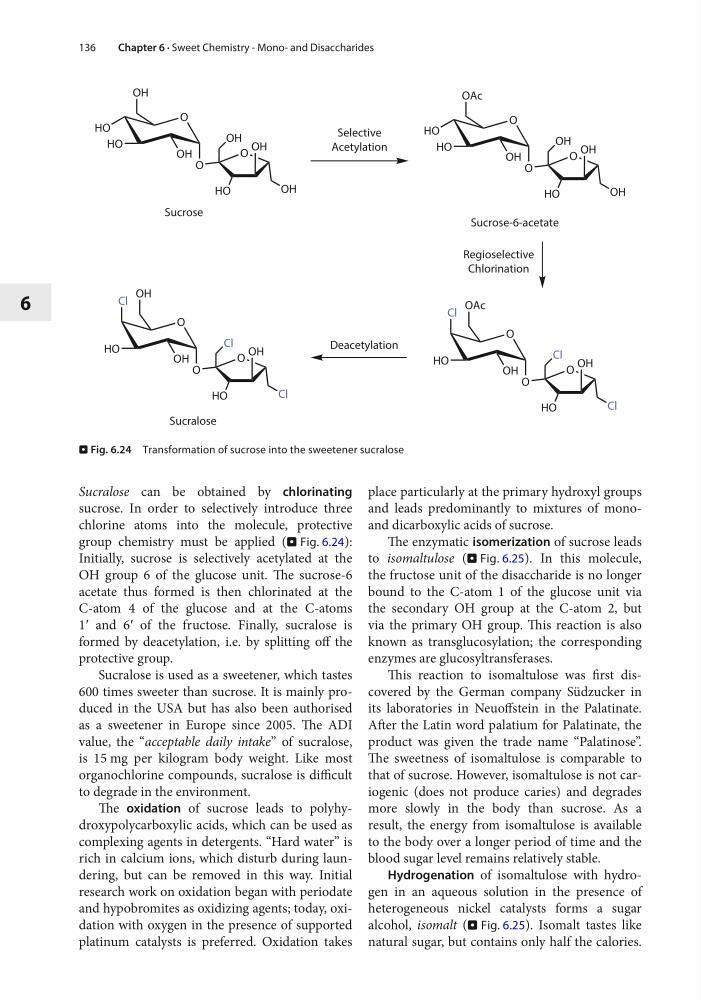
. Fig. 6.24 Transformation of sucrose into the sweetener sucralose
Chapter 6 · Sweet Chemistry - Mono- and Disaccharides
6
place particularly at the primary hydroxyl groups
and leads predominantly to mixtures of monoand dicarboxylic acids of sucrose.
The enzymatic isomerization of sucrose leads
to isomaltulose (. Fig. 6.25). In this molecule,
the fructose unit of the disaccharide is no longer
bound to the C-atom 1 of the glucose unit via
the secondary OH group at the C-atom 2, but
via the primary OH group. This reaction is also
known as transglucosylation; the corresponding
enzymes are glucosyltransferases.
This reaction to isomaltulose was first discovered by the German company Südzucker in
its laboratories in Neuoffstein in the Palatinate.
After the Latin word palatium for Palatinate, the
product was given the trade name “Palatinose”.
The sweetness of isomaltulose is comparable to
that of sucrose. However, isomaltulose is not cariogenic (does not produce caries) and degrades
more slowly in the body than sucrose. As a
result, the energy from isomaltulose is available
to the body over a longer period of time and the
blood sugar level remains relatively stable.
Hydrogenation of isomaltulose with hydrogen in an aqueous solution in the presence of
heterogeneous nickel catalysts forms a sugar
alcohol, isomalt (. Fig. 6.25). Isomalt tastes like
natural sugar, but contains only half the calories.
Sucralose can be obtained by chlorinating
sucrose. In order to selectively introduce three
chlorine atoms into the molecule, protective
group chemistry must be applied (. Fig. 6.24):
Initially, sucrose is selectively acetylated at the
OH group 6 of the glucose unit. The sucrose-6
acetate thus formed is then chlorinated at the
C-atom 4 of the glucose and at the C-atoms
1′ and 6′ of the fructose. Finally, sucralose is
formed by deacetylation, i.e. by splitting off the
protective group.
Sucralose is used as a sweetener, which tastes
600 times sweeter than sucrose. It is mainly produced in the USA but has also been authorised
as a sweetener in Europe since 2005. The ADI
value, the “acceptable daily intake” of sucralose,
is 15 mg per kilogram body weight. Like most
organochlorine compounds, sucralose is difficult
to degrade in the environment.
The oxidation of sucrose leads to polyhydroxypolycarboxylic acids, which can be used as
complexing agents in detergents. “Hard water” is
rich in calcium ions, which disturb during laundering, but can be removed in this way. Initial
research work on oxidation began with periodate
and hypobromites as oxidizing agents; today, oxidation with oxygen in the presence of supported
platinum catalysts is preferred. Oxidation takes
O
OH
HO
OH
OH
O
HO
HO
OH
O
OH
Sucrose
Selective
Acetylation
O
OH
HO
OH
OH
O
HO
HO
OH
O
OAc
Sucrose-6-acetate
Regioselective
Chlorination
O
Cl
HO
Cl
OH
O
Cl
HO
OH
O
OAc
Deacetylation
O
Cl
HO
Cl
OH
O
Cl
HO
OH
O
OH
Sucralose
. Fig. 6.24 Transformation of sucrose into the sweetener sucralose