

Studies on Recycled Polyester
63
0
1
2
3
4
5
Tenacity (cN/dtex)
Elongation at break (%)
Fiber fineness (denier)
0
90
180
270
360
0
40
80
120
(a)
(b)
(c)
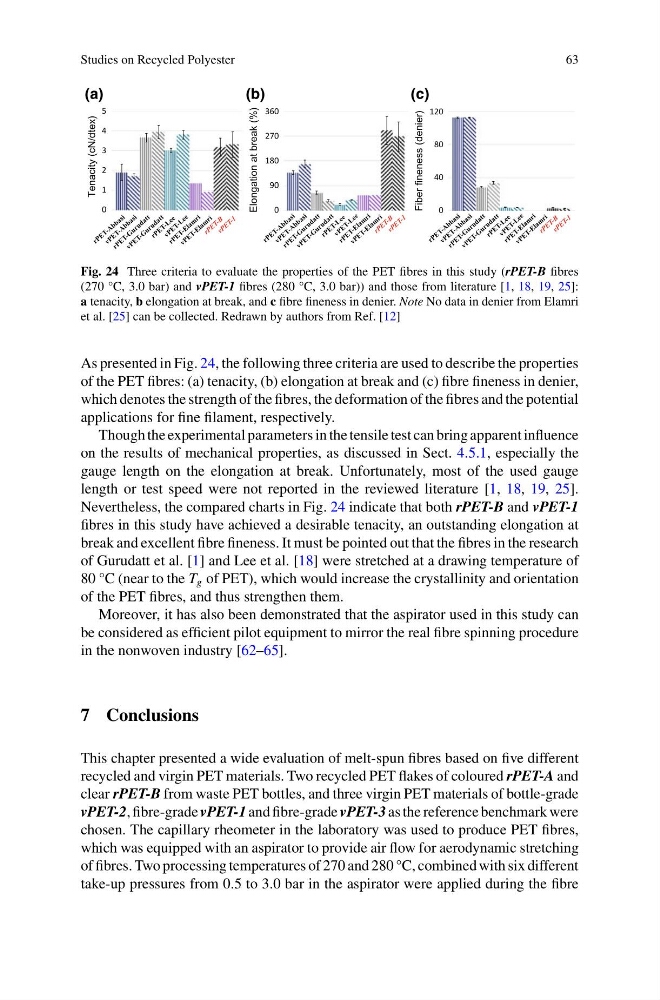
Fig. 24 Three criteria to evaluate the properties of the PET fibres in this study (rPET-B fibres
(270 °C, 3.0 bar) and vPET-1 fibres (280 °C, 3.0 bar)) and those from literature [1, 18, 19, 25]:
a tenacity, b elongation at break, and c fibre fineness in denier. Note No data in denier from Elamri
et al. [25] can be collected. Redrawn by authors from Ref. [12]
As presented in Fig. 24, the following three criteria are used to describe the properties
of the PET fibres: (a) tenacity, (b) elongation at break and (c) fibre fineness in denier,
which denotes the strength of the fibres, the deformation of the fibres and the potential
applications for fine filament, respectively.
Though the experimental parameters in the tensile test can bring apparent influence
on the results of mechanical properties, as discussed in Sect. 4.5.1, especially the
gauge length on the elongation at break. Unfortunately, most of the used gauge
length or test speed were not reported in the reviewed literature [1, 18, 19, 25].
Nevertheless, the compared charts in Fig. 24 indicate that both rPET-B and vPET-1
fibres in this study have achieved a desirable tenacity, an outstanding elongation at
break and excellent fibre fineness. It must be pointed out that the fibres in the research
of Gurudatt et al. [1] and Lee et al. [18] were stretched at a drawing temperature of
80 °C (near to the T g of PET), which would increase the crystallinity and orientation
of the PET fibres, and thus strengthen them.
Moreover, it has also been demonstrated that the aspirator used in this study can
be considered as efficient pilot equipment to mirror the real fibre spinning procedure
in the nonwoven industry [62–65].
7 Conclusions
This chapter presented a wide evaluation of melt-spun fibres based on five different
recycled and virgin PET materials. Two recycled PET flakes of coloured rPET-A and
clear rPET-B from waste PET bottles, and three virgin PET materials of bottle-grade
vPET-2, fibre-grade vPET-1 and fibre-grade vPET-3 as the reference benchmark were
chosen. The capillary rheometer in the laboratory was used to produce PET fibres,
which was equipped with an aspirator to provide air flow for aerodynamic stretching
of fibres. Two processing temperatures of 270 and 280 °C, combined with six different
take-up pressures from 0.5 to 3.0 bar in the aspirator were applied during the fibre
63
0
1
2
3
4
5
Tenacity (cN/dtex)
Elongation at break (%)
Fiber fineness (denier)
0
90
180
270
360
0
40
80
120
(a)
(b)
(c)
Fig. 24 Three criteria to evaluate the properties of the PET fibres in this study (rPET-B fibres
(270 °C, 3.0 bar) and vPET-1 fibres (280 °C, 3.0 bar)) and those from literature [1, 18, 19, 25]:
a tenacity, b elongation at break, and c fibre fineness in denier. Note No data in denier from Elamri
et al. [25] can be collected. Redrawn by authors from Ref. [12]
As presented in Fig. 24, the following three criteria are used to describe the properties
of the PET fibres: (a) tenacity, (b) elongation at break and (c) fibre fineness in denier,
which denotes the strength of the fibres, the deformation of the fibres and the potential
applications for fine filament, respectively.
Though the experimental parameters in the tensile test can bring apparent influence
on the results of mechanical properties, as discussed in Sect. 4.5.1, especially the
gauge length on the elongation at break. Unfortunately, most of the used gauge
length or test speed were not reported in the reviewed literature [1, 18, 19, 25].
Nevertheless, the compared charts in Fig. 24 indicate that both rPET-B and vPET-1
fibres in this study have achieved a desirable tenacity, an outstanding elongation at
break and excellent fibre fineness. It must be pointed out that the fibres in the research
of Gurudatt et al. [1] and Lee et al. [18] were stretched at a drawing temperature of
80 °C (near to the T g of PET), which would increase the crystallinity and orientation
of the PET fibres, and thus strengthen them.
Moreover, it has also been demonstrated that the aspirator used in this study can
be considered as efficient pilot equipment to mirror the real fibre spinning procedure
in the nonwoven industry [62–65].
7 Conclusions
This chapter presented a wide evaluation of melt-spun fibres based on five different
recycled and virgin PET materials. Two recycled PET flakes of coloured rPET-A and
clear rPET-B from waste PET bottles, and three virgin PET materials of bottle-grade
vPET-2, fibre-grade vPET-1 and fibre-grade vPET-3 as the reference benchmark were
chosen. The capillary rheometer in the laboratory was used to produce PET fibres,
which was equipped with an aspirator to provide air flow for aerodynamic stretching
of fibres. Two processing temperatures of 270 and 280 °C, combined with six different
take-up pressures from 0.5 to 3.0 bar in the aspirator were applied during the fibre