

62
Y. Qin et al.
(a)
(b)
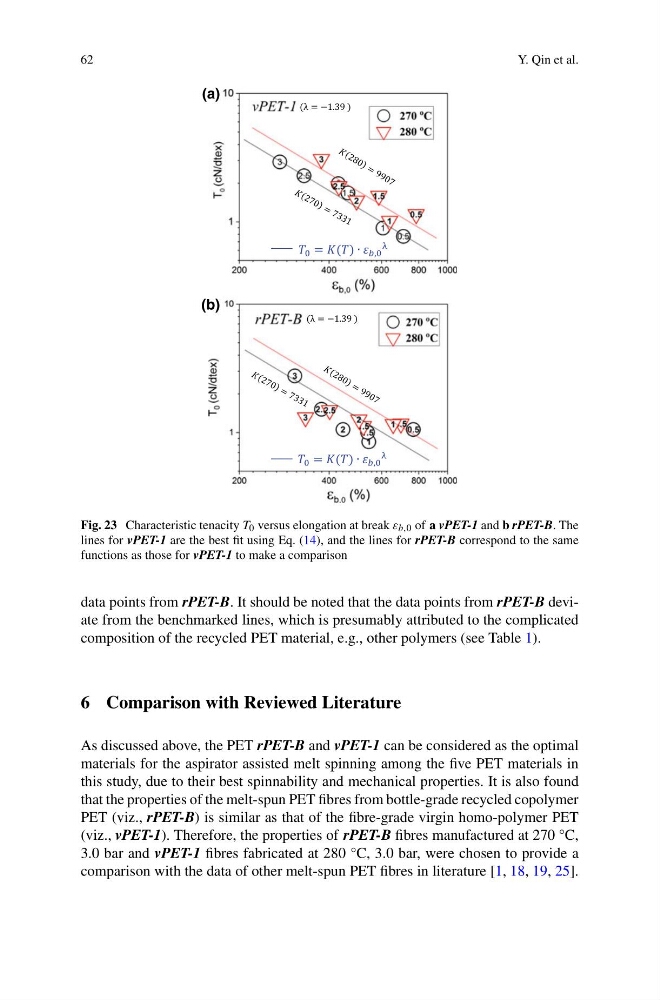
Fig. 23 Characteristic tenacity T 0 versus elongation at break ε b,0 of a vPET-1 and b rPET-B. The
lines for vPET-1 are the best fit using Eq. (14), and the lines for rPET-B correspond to the same
functions as those for vPET-1 to make a comparison
data points from rPET-B. It should be noted that the data points from rPET-B deviate from the benchmarked lines, which is presumably attributed to the complicated
composition of the recycled PET material, e.g., other polymers (see Table 1).
6 Comparison with Reviewed Literature
As discussed above, the PET rPET-B and vPET-1 can be considered as the optimal
materials for the aspirator assisted melt spinning among the five PET materials in
this study, due to their best spinnability and mechanical properties. It is also found
that the properties of the melt-spun PET fibres from bottle-grade recycled copolymer
PET (viz., rPET-B) is similar as that of the fibre-grade virgin homo-polymer PET
(viz., vPET-1). Therefore, the properties of rPET-B fibres manufactured at 270 °C,
3.0 bar and vPET-1 fibres fabricated at 280 °C, 3.0 bar, were chosen to provide a
comparison with the data of other melt-spun PET fibres in literature [1, 18, 19, 25].
Y. Qin et al.
(a)
(b)
Fig. 23 Characteristic tenacity T 0 versus elongation at break ε b,0 of a vPET-1 and b rPET-B. The
lines for vPET-1 are the best fit using Eq. (14), and the lines for rPET-B correspond to the same
functions as those for vPET-1 to make a comparison
data points from rPET-B. It should be noted that the data points from rPET-B deviate from the benchmarked lines, which is presumably attributed to the complicated
composition of the recycled PET material, e.g., other polymers (see Table 1).
6 Comparison with Reviewed Literature
As discussed above, the PET rPET-B and vPET-1 can be considered as the optimal
materials for the aspirator assisted melt spinning among the five PET materials in
this study, due to their best spinnability and mechanical properties. It is also found
that the properties of the melt-spun PET fibres from bottle-grade recycled copolymer
PET (viz., rPET-B) is similar as that of the fibre-grade virgin homo-polymer PET
(viz., vPET-1). Therefore, the properties of rPET-B fibres manufactured at 270 °C,
3.0 bar and vPET-1 fibres fabricated at 280 °C, 3.0 bar, were chosen to provide a
comparison with the data of other melt-spun PET fibres in literature [1, 18, 19, 25].