

48
Y. Qin et al.
rPET-A
rPET-B
P 0.5
P 0.5
P 0.5
P 0.5
P 3.0
P 3.0
P 3.0
P 3.0
270 °C
280 °C
vPET-2
vPET-3
vPET-1
P 0.5
P 3.0
P 0.5
P 0.5
P 0.5
P 0.5
P 0.5
P 2.0
P 3.0
P 3.0
P 3.0
P 2.0
50 um
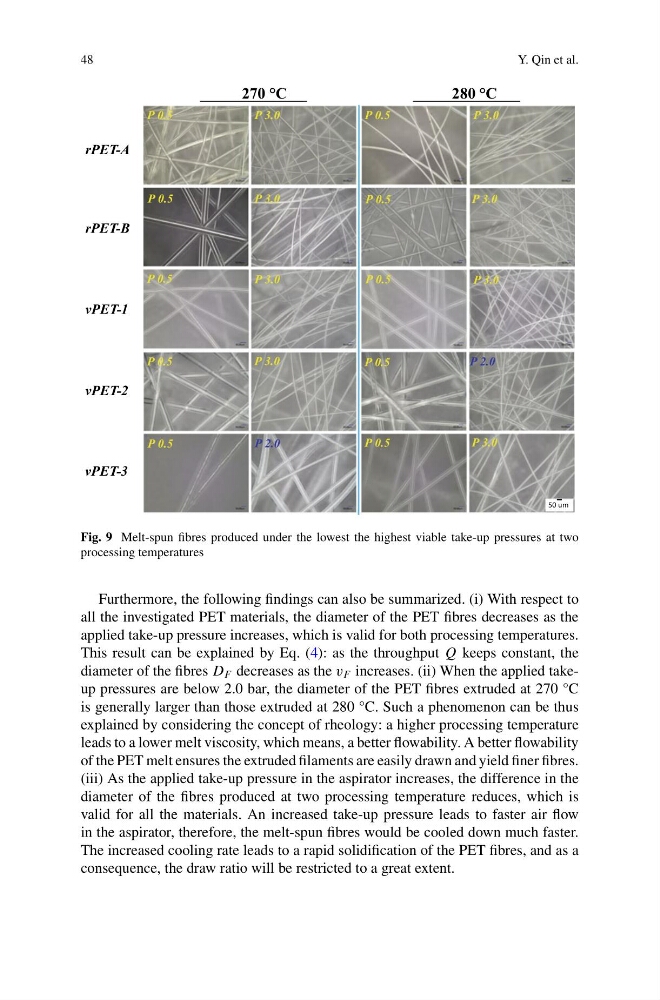
Fig. 9 Melt-spun fibres produced under the lowest the highest viable take-up pressures at two
processing temperatures
Furthermore, the following findings can also be summarized. (i) With respect to
all the investigated PET materials, the diameter of the PET fibres decreases as the
applied take-up pressure increases, which is valid for both processing temperatures.
This result can be explained by Eq. (4): as the throughput Q keeps constant, the
diameter of the fibres D F decreases as the v F increases. (ii) When the applied takeup pressures are below 2.0 bar, the diameter of the PET fibres extruded at 270 °C
is generally larger than those extruded at 280 °C. Such a phenomenon can be thus
explained by considering the concept of rheology: a higher processing temperature
leads to a lower melt viscosity, which means, a better flowability. A better flowability
of the PET melt ensures the extruded filaments are easily drawn and yield finer fibres.
(iii) As the applied take-up pressure in the aspirator increases, the difference in the
diameter of the fibres produced at two processing temperature reduces, which is
valid for all the materials. An increased take-up pressure leads to faster air flow
in the aspirator, therefore, the melt-spun fibres would be cooled down much faster.
The increased cooling rate leads to a rapid solidification of the PET fibres, and as a
consequence, the draw ratio will be restricted to a great extent.
Y. Qin et al.
rPET-A
rPET-B
P 0.5
P 0.5
P 0.5
P 0.5
P 3.0
P 3.0
P 3.0
P 3.0
270 °C
280 °C
vPET-2
vPET-3
vPET-1
P 0.5
P 3.0
P 0.5
P 0.5
P 0.5
P 0.5
P 0.5
P 2.0
P 3.0
P 3.0
P 3.0
P 2.0
50 um
Fig. 9 Melt-spun fibres produced under the lowest the highest viable take-up pressures at two
processing temperatures
Furthermore, the following findings can also be summarized. (i) With respect to
all the investigated PET materials, the diameter of the PET fibres decreases as the
applied take-up pressure increases, which is valid for both processing temperatures.
This result can be explained by Eq. (4): as the throughput Q keeps constant, the
diameter of the fibres D F decreases as the v F increases. (ii) When the applied takeup pressures are below 2.0 bar, the diameter of the PET fibres extruded at 270 °C
is generally larger than those extruded at 280 °C. Such a phenomenon can be thus
explained by considering the concept of rheology: a higher processing temperature
leads to a lower melt viscosity, which means, a better flowability. A better flowability
of the PET melt ensures the extruded filaments are easily drawn and yield finer fibres.
(iii) As the applied take-up pressure in the aspirator increases, the difference in the
diameter of the fibres produced at two processing temperature reduces, which is
valid for all the materials. An increased take-up pressure leads to faster air flow
in the aspirator, therefore, the melt-spun fibres would be cooled down much faster.
The increased cooling rate leads to a rapid solidification of the PET fibres, and as a
consequence, the draw ratio will be restricted to a great extent.