

642
B. de Souza Fonseca et al.
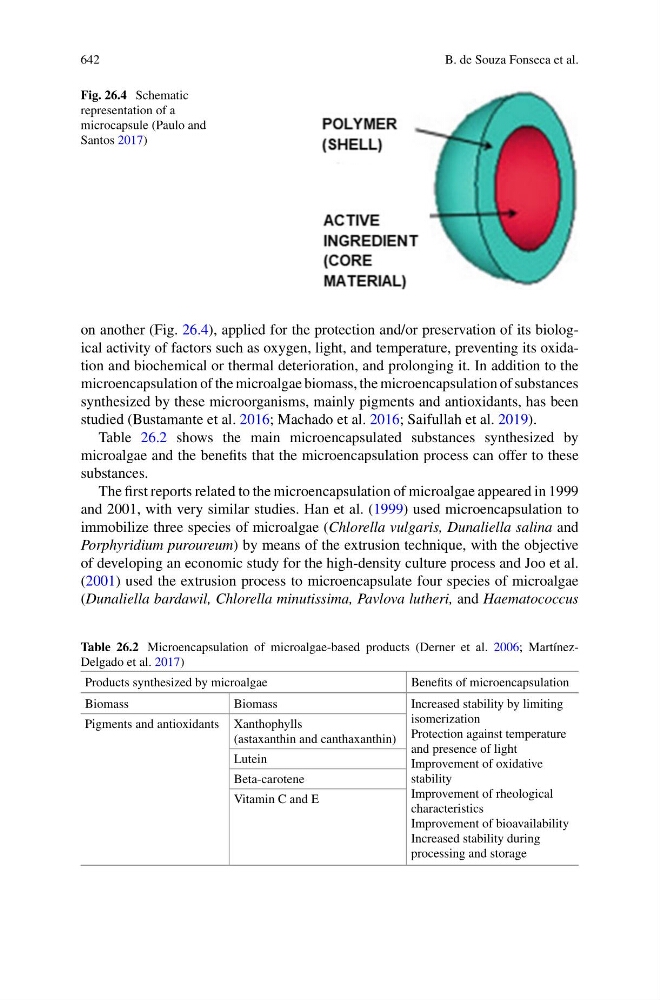
Fig. 26.4 Schematic
representation of a
microcapsule (Paulo and
Santos 2017)
on another (Fig. 26.4), applied for the protection and/or preservation of its biological activity of factors such as oxygen, light, and temperature, preventing its oxidation and biochemical or thermal deterioration, and prolonging it. In addition to the
microencapsulation of the microalgae biomass, the microencapsulation of substances
synthesized by these microorganisms, mainly pigments and antioxidants, has been
studied (Bustamante et al. 2016; Machado et al. 2016; Saifullah et al. 2019).
Table 26.2 shows the main microencapsulated substances synthesized by
microalgae and the benefits that the microencapsulation process can offer to these
substances.
The first reports related to the microencapsulation of microalgae appeared in 1999
and 2001, with very similar studies. Han et al. (1999) used microencapsulation to
immobilize three species of microalgae (Chlorella vulgaris, Dunaliella salina and
Porphyridium puroureum) by means of the extrusion technique, with the objective
of developing an economic study for the high-density culture process and Joo et al.
(2001) used the extrusion process to microencapsulate four species of microalgae
(Dunaliella bardawil, Chlorella minutissima, Pavlova lutheri, and Haematococcus
Table 26.2 Microencapsulation of microalgae-based products (Derner et al. 2006; MartínezDelgado et al. 2017)
Products synthesized by microalgae
Benefits of microencapsulation
Biomass
Biomass
Increased stability by limiting
isomerization
Protection against temperature
and presence of light
Improvement of oxidative
stability
Improvement of rheological
characteristics
Improvement of bioavailability
Increased stability during
processing and storage
Pigments and antioxidants Xanthophylls
(astaxanthin and canthaxanthin)
Lutein
Beta-carotene
Vitamin C and E