

640
B. de Souza Fonseca et al.
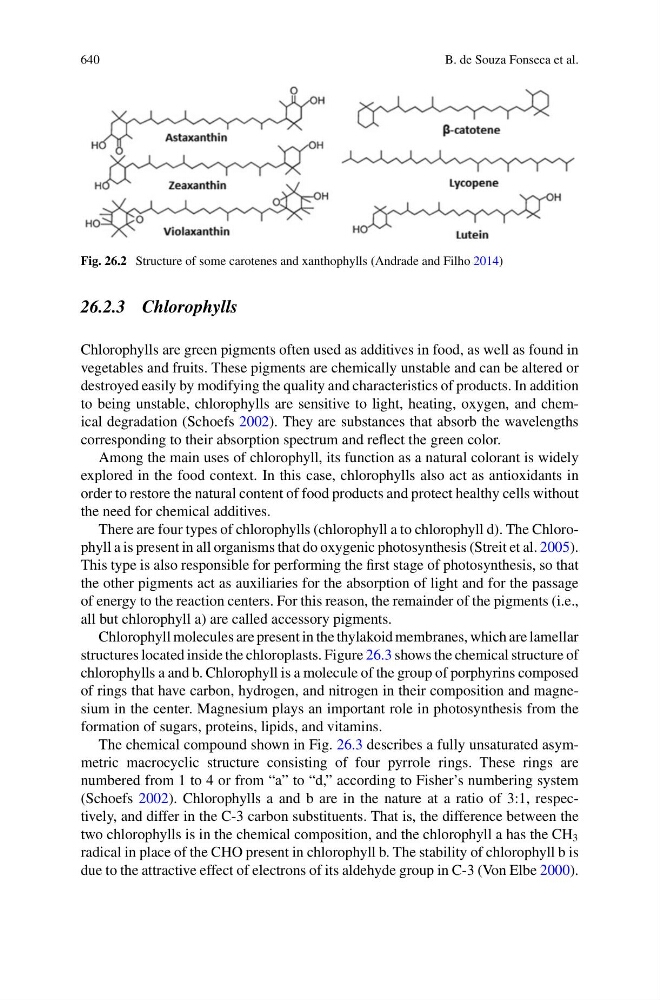
Fig. 26.2 Structure of some carotenes and xanthophylls (Andrade and Filho 2014)
26.2.3 Chlorophylls
Chlorophylls are green pigments often used as additives in food, as well as found in
vegetables and fruits. These pigments are chemically unstable and can be altered or
destroyed easily by modifying the quality and characteristics of products. In addition
to being unstable, chlorophylls are sensitive to light, heating, oxygen, and chemical degradation (Schoefs 2002). They are substances that absorb the wavelengths
corresponding to their absorption spectrum and reflect the green color.
Among the main uses of chlorophyll, its function as a natural colorant is widely
explored in the food context. In this case, chlorophylls also act as antioxidants in
order to restore the natural content of food products and protect healthy cells without
the need for chemical additives.
There are four types of chlorophylls (chlorophyll a to chlorophyll d). The Chlorophyll a is present in all organisms that do oxygenic photosynthesis (Streit et al. 2005).
This type is also responsible for performing the first stage of photosynthesis, so that
the other pigments act as auxiliaries for the absorption of light and for the passage
of energy to the reaction centers. For this reason, the remainder of the pigments (i.e.,
all but chlorophyll a) are called accessory pigments.
Chlorophyll molecules are present in the thylakoid membranes, which are lamellar
structures located inside the chloroplasts. Figure 26.3 shows the chemical structure of
chlorophylls a and b. Chlorophyll is a molecule of the group of porphyrins composed
of rings that have carbon, hydrogen, and nitrogen in their composition and magnesium in the center. Magnesium plays an important role in photosynthesis from the
formation of sugars, proteins, lipids, and vitamins.
The chemical compound shown in Fig. 26.3 describes a fully unsaturated asymmetric macrocyclic structure consisting of four pyrrole rings. These rings are
numbered from 1 to 4 or from “a” to “d,” according to Fisher’s numbering system
(Schoefs 2002). Chlorophylls a and b are in the nature at a ratio of 3:1, respectively, and differ in the C-3 carbon substituents. That is, the difference between the
two chlorophylls is in the chemical composition, and the chlorophyll a has the CH 3
radical in place of the CHO present in chlorophyll b. The stability of chlorophyll b is
due to the attractive effect of electrons of its aldehyde group in C-3 (Von Elbe 2000).