

24 Diagnostic Applications of Phycobiliproteins
597
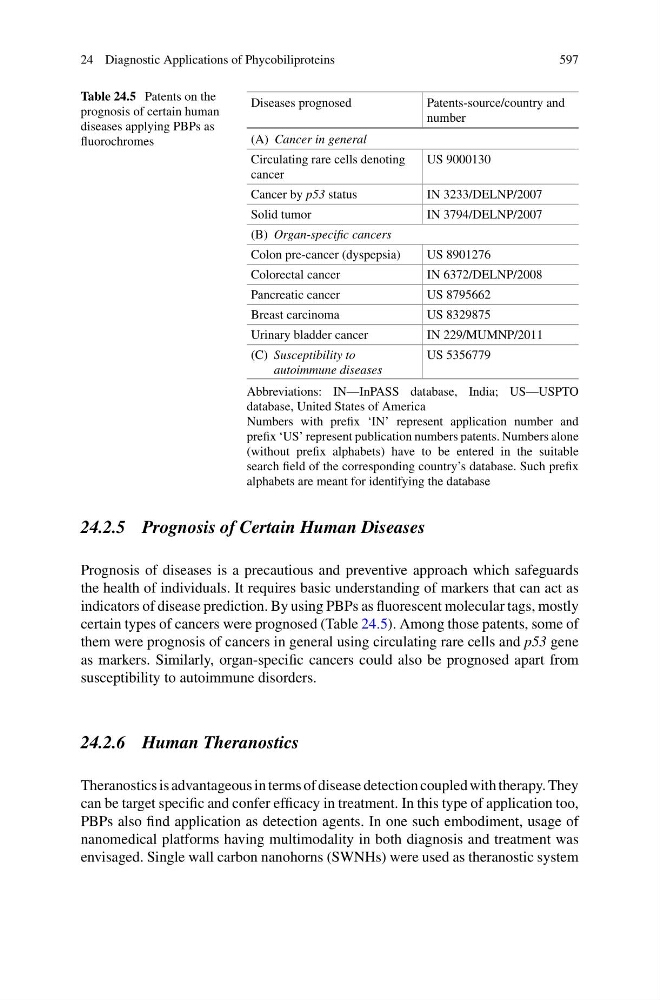
Table 24.5 Patents on the
prognosis of certain human
diseases applying PBPs as
fluorochromes
Diseases prognosed
Patents-source/country and
number
(A) Cancer in general
Circulating rare cells denoting
cancer
US 9000130
Cancer by p53 status
IN 3233/DELNP/2007
Solid tumor
IN 3794/DELNP/2007
(B) Organ-specific cancers
Colon pre-cancer (dyspepsia)
US 8901276
Colorectal cancer
IN 6372/DELNP/2008
Pancreatic cancer
US 8795662
Breast carcinoma
US 8329875
Urinary bladder cancer
IN 229/MUMNP/2011
(C) Susceptibility to
autoimmune diseases
US 5356779
Abbreviations: IN—InPASS database, India; US—USPTO
database, United States of America
Numbers with prefix ‘IN’ represent application number and
prefix ‘US’ represent publication numbers patents. Numbers alone
(without prefix alphabets) have to be entered in the suitable
search field of the corresponding country’s database. Such prefix
alphabets are meant for identifying the database
24.2.5 Prognosis of Certain Human Diseases
Prognosis of diseases is a precautious and preventive approach which safeguards
the health of individuals. It requires basic understanding of markers that can act as
indicators of disease prediction. By using PBPs as fluorescent molecular tags, mostly
certain types of cancers were prognosed (Table 24.5). Among those patents, some of
them were prognosis of cancers in general using circulating rare cells and p53 gene
as markers. Similarly, organ-specific cancers could also be prognosed apart from
susceptibility to autoimmune disorders.
24.2.6 Human Theranostics
Theranostics is advantageous in terms of disease detection coupled with therapy. They
can be target specific and confer efficacy in treatment. In this type of application too,
PBPs also find application as detection agents. In one such embodiment, usage of
nanomedical platforms having multimodality in both diagnosis and treatment was
envisaged. Single wall carbon nanohorns (SWNHs) were used as theranostic system