

430
Á. Farkas et al.
17.2.4 β-Carotene
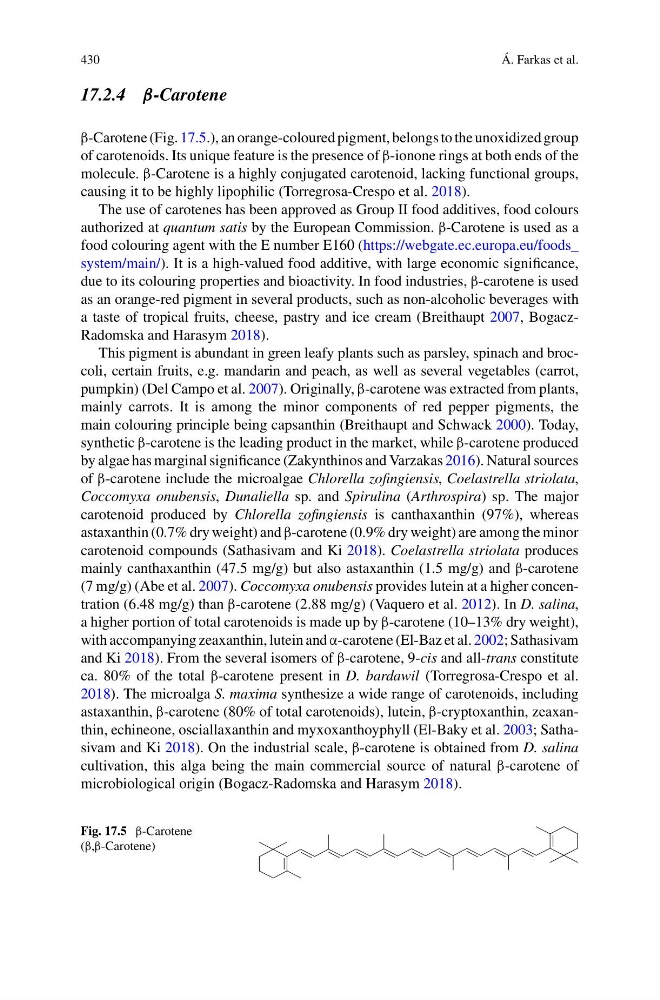
β-Carotene (Fig. 17.5.), an orange-coloured pigment, belongs to the unoxidized group
of carotenoids. Its unique feature is the presence of β-ionone rings at both ends of the
molecule. β-Carotene is a highly conjugated carotenoid, lacking functional groups,
causing it to be highly lipophilic (Torregrosa-Crespo et al. 2018).
The use of carotenes has been approved as Group II food additives, food colours
authorized at quantum satis by the European Commission. β-Carotene is used as a
food colouring agent with the E number E160 (https://webgate.ec.europa.eu/foods_
system/main/). It is a high-valued food additive, with large economic significance,
due to its colouring properties and bioactivity. In food industries, β-carotene is used
as an orange-red pigment in several products, such as non-alcoholic beverages with
a taste of tropical fruits, cheese, pastry and ice cream (Breithaupt 2007, BogaczRadomska and Harasym 2018).
This pigment is abundant in green leafy plants such as parsley, spinach and broccoli, certain fruits, e.g. mandarin and peach, as well as several vegetables (carrot,
pumpkin) (Del Campo et al. 2007). Originally, β-carotene was extracted from plants,
mainly carrots. It is among the minor components of red pepper pigments, the
main colouring principle being capsanthin (Breithaupt and Schwack 2000). Today,
synthetic β-carotene is the leading product in the market, while β-carotene produced
by algae has marginal significance (Zakynthinos and Varzakas 2016). Natural sources
of β-carotene include the microalgae Chlorella zofingiensis, Coelastrella striolata,
Coccomyxa onubensis, Dunaliella sp. and Spirulina (Arthrospira) sp. The major
carotenoid produced by Chlorella zofingiensis is canthaxanthin (97%), whereas
astaxanthin (0.7% dry weight) and β-carotene (0.9% dry weight) are among the minor
carotenoid compounds (Sathasivam and Ki 2018). Coelastrella striolata produces
mainly canthaxanthin (47.5 mg/g) but also astaxanthin (1.5 mg/g) and β-carotene
(7 mg/g) (Abe et al. 2007). Coccomyxa onubensis provides lutein at a higher concentration (6.48 mg/g) than β-carotene (2.88 mg/g) (Vaquero et al. 2012). In D. salina,
a higher portion of total carotenoids is made up by β-carotene (10–13% dry weight),
with accompanying zeaxanthin, lutein and α-carotene (El-Baz et al. 2002; Sathasivam
and Ki 2018). From the several isomers of β-carotene, 9-cis and all-trans constitute
ca. 80% of the total β-carotene present in D. bardawil (Torregrosa-Crespo et al.
2018). The microalga S. maxima synthesize a wide range of carotenoids, including
astaxanthin, β-carotene (80% of total carotenoids), lutein, β-cryptoxanthin, zeaxanthin, echineone, osciallaxanthin and myxoxanthoyphyll (El-Baky et al. 2003; Sathasivam and Ki 2018). On the industrial scale, β-carotene is obtained from D. salina
cultivation, this alga being the main commercial source of natural β-carotene of
microbiological origin (Bogacz-Radomska and Harasym 2018).
Fig. 17.5 β-Carotene
(β,β-Carotene)
Á. Farkas et al.
17.2.4 β-Carotene
β-Carotene (Fig. 17.5.), an orange-coloured pigment, belongs to the unoxidized group
of carotenoids. Its unique feature is the presence of β-ionone rings at both ends of the
molecule. β-Carotene is a highly conjugated carotenoid, lacking functional groups,
causing it to be highly lipophilic (Torregrosa-Crespo et al. 2018).
The use of carotenes has been approved as Group II food additives, food colours
authorized at quantum satis by the European Commission. β-Carotene is used as a
food colouring agent with the E number E160 (https://webgate.ec.europa.eu/foods_
system/main/). It is a high-valued food additive, with large economic significance,
due to its colouring properties and bioactivity. In food industries, β-carotene is used
as an orange-red pigment in several products, such as non-alcoholic beverages with
a taste of tropical fruits, cheese, pastry and ice cream (Breithaupt 2007, BogaczRadomska and Harasym 2018).
This pigment is abundant in green leafy plants such as parsley, spinach and broccoli, certain fruits, e.g. mandarin and peach, as well as several vegetables (carrot,
pumpkin) (Del Campo et al. 2007). Originally, β-carotene was extracted from plants,
mainly carrots. It is among the minor components of red pepper pigments, the
main colouring principle being capsanthin (Breithaupt and Schwack 2000). Today,
synthetic β-carotene is the leading product in the market, while β-carotene produced
by algae has marginal significance (Zakynthinos and Varzakas 2016). Natural sources
of β-carotene include the microalgae Chlorella zofingiensis, Coelastrella striolata,
Coccomyxa onubensis, Dunaliella sp. and Spirulina (Arthrospira) sp. The major
carotenoid produced by Chlorella zofingiensis is canthaxanthin (97%), whereas
astaxanthin (0.7% dry weight) and β-carotene (0.9% dry weight) are among the minor
carotenoid compounds (Sathasivam and Ki 2018). Coelastrella striolata produces
mainly canthaxanthin (47.5 mg/g) but also astaxanthin (1.5 mg/g) and β-carotene
(7 mg/g) (Abe et al. 2007). Coccomyxa onubensis provides lutein at a higher concentration (6.48 mg/g) than β-carotene (2.88 mg/g) (Vaquero et al. 2012). In D. salina,
a higher portion of total carotenoids is made up by β-carotene (10–13% dry weight),
with accompanying zeaxanthin, lutein and α-carotene (El-Baz et al. 2002; Sathasivam
and Ki 2018). From the several isomers of β-carotene, 9-cis and all-trans constitute
ca. 80% of the total β-carotene present in D. bardawil (Torregrosa-Crespo et al.
2018). The microalga S. maxima synthesize a wide range of carotenoids, including
astaxanthin, β-carotene (80% of total carotenoids), lutein, β-cryptoxanthin, zeaxanthin, echineone, osciallaxanthin and myxoxanthoyphyll (El-Baky et al. 2003; Sathasivam and Ki 2018). On the industrial scale, β-carotene is obtained from D. salina
cultivation, this alga being the main commercial source of natural β-carotene of
microbiological origin (Bogacz-Radomska and Harasym 2018).
Fig. 17.5 β-Carotene
(β,β-Carotene)