

428
Á. Farkas et al.
There are only limited toxicological data on annatto extracts, possibly because
they are listed as exempt of certification in the United States (due to they derive
from natural sources) (Hallagan et al. 1995), whereas its use is more restricted in
the EU (Mortensen 2006). The Joint FAO/WHO Expert Committee on Food Additives (JECFA) estimated the acceptable daily intake for annatto as 0–2.5 mg/kg body
weight/day (JECFA 2012). Annatto extracts did not exhibit any mutagenic, carcinogenic or genotoxic effects in low amounts: 5330 ppm for mice bone marrow cells
and 0.1% for rats (Alves de Lima et al. 2003; Hagiwara et al. 2003).
17.2.3 Canthaxanthin
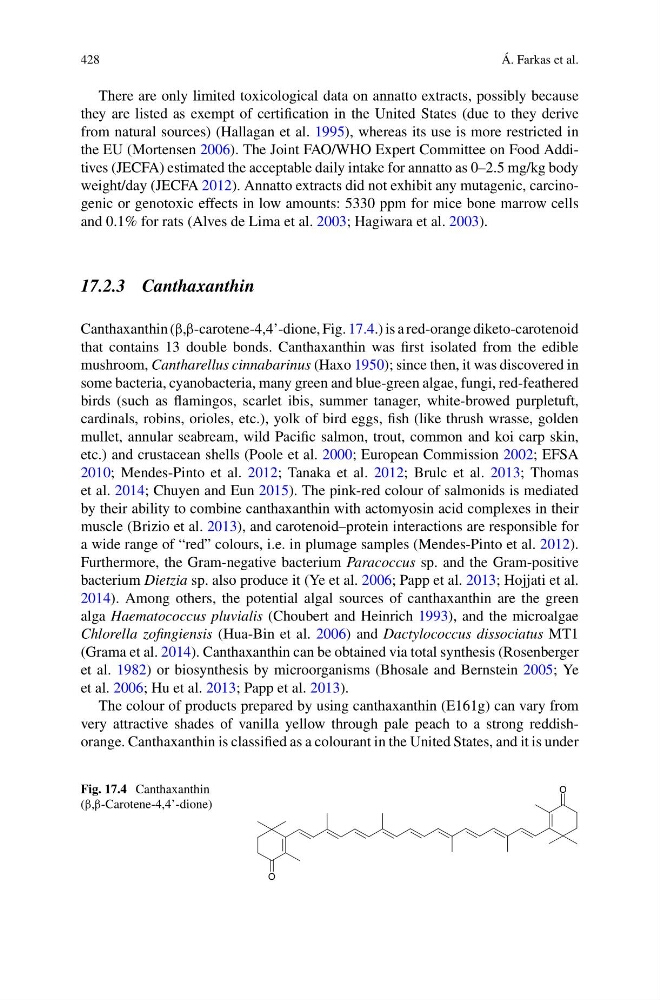
Canthaxanthin (β,β-carotene-4,4’-dione, Fig. 17.4.) is a red-orange diketo-carotenoid
that contains 13 double bonds. Canthaxanthin was first isolated from the edible
mushroom, Cantharellus cinnabarinus (Haxo 1950); since then, it was discovered in
some bacteria, cyanobacteria, many green and blue-green algae, fungi, red-feathered
birds (such as flamingos, scarlet ibis, summer tanager, white-browed purpletuft,
cardinals, robins, orioles, etc.), yolk of bird eggs, fish (like thrush wrasse, golden
mullet, annular seabream, wild Pacific salmon, trout, common and koi carp skin,
etc.) and crustacean shells (Poole et al. 2000; European Commission 2002; EFSA
2010; Mendes-Pinto et al. 2012; Tanaka et al. 2012; Brulc et al. 2013; Thomas
et al. 2014; Chuyen and Eun 2015). The pink-red colour of salmonids is mediated
by their ability to combine canthaxanthin with actomyosin acid complexes in their
muscle (Brizio et al. 2013), and carotenoid–protein interactions are responsible for
a wide range of “red” colours, i.e. in plumage samples (Mendes-Pinto et al. 2012).
Furthermore, the Gram-negative bacterium Paracoccus sp. and the Gram-positive
bacterium Dietzia sp. also produce it (Ye et al. 2006; Papp et al. 2013; Hojjati et al.
2014). Among others, the potential algal sources of canthaxanthin are the green
alga Haematococcus pluvialis (Choubert and Heinrich 1993), and the microalgae
Chlorella zofingiensis (Hua-Bin et al. 2006) and Dactylococcus dissociatus MT1
(Grama et al. 2014). Canthaxanthin can be obtained via total synthesis (Rosenberger
et al. 1982) or biosynthesis by microorganisms (Bhosale and Bernstein 2005; Ye
et al. 2006; Hu et al. 2013; Papp et al. 2013).
The colour of products prepared by using canthaxanthin (E161g) can vary from
very attractive shades of vanilla yellow through pale peach to a strong reddishorange. Canthaxanthin is classified as a colourant in the United States, and it is under
Fig. 17.4 Canthaxanthin
(β,β-Carotene-4,4’-dione)
O
O
Á. Farkas et al.
There are only limited toxicological data on annatto extracts, possibly because
they are listed as exempt of certification in the United States (due to they derive
from natural sources) (Hallagan et al. 1995), whereas its use is more restricted in
the EU (Mortensen 2006). The Joint FAO/WHO Expert Committee on Food Additives (JECFA) estimated the acceptable daily intake for annatto as 0–2.5 mg/kg body
weight/day (JECFA 2012). Annatto extracts did not exhibit any mutagenic, carcinogenic or genotoxic effects in low amounts: 5330 ppm for mice bone marrow cells
and 0.1% for rats (Alves de Lima et al. 2003; Hagiwara et al. 2003).
17.2.3 Canthaxanthin
Canthaxanthin (β,β-carotene-4,4’-dione, Fig. 17.4.) is a red-orange diketo-carotenoid
that contains 13 double bonds. Canthaxanthin was first isolated from the edible
mushroom, Cantharellus cinnabarinus (Haxo 1950); since then, it was discovered in
some bacteria, cyanobacteria, many green and blue-green algae, fungi, red-feathered
birds (such as flamingos, scarlet ibis, summer tanager, white-browed purpletuft,
cardinals, robins, orioles, etc.), yolk of bird eggs, fish (like thrush wrasse, golden
mullet, annular seabream, wild Pacific salmon, trout, common and koi carp skin,
etc.) and crustacean shells (Poole et al. 2000; European Commission 2002; EFSA
2010; Mendes-Pinto et al. 2012; Tanaka et al. 2012; Brulc et al. 2013; Thomas
et al. 2014; Chuyen and Eun 2015). The pink-red colour of salmonids is mediated
by their ability to combine canthaxanthin with actomyosin acid complexes in their
muscle (Brizio et al. 2013), and carotenoid–protein interactions are responsible for
a wide range of “red” colours, i.e. in plumage samples (Mendes-Pinto et al. 2012).
Furthermore, the Gram-negative bacterium Paracoccus sp. and the Gram-positive
bacterium Dietzia sp. also produce it (Ye et al. 2006; Papp et al. 2013; Hojjati et al.
2014). Among others, the potential algal sources of canthaxanthin are the green
alga Haematococcus pluvialis (Choubert and Heinrich 1993), and the microalgae
Chlorella zofingiensis (Hua-Bin et al. 2006) and Dactylococcus dissociatus MT1
(Grama et al. 2014). Canthaxanthin can be obtained via total synthesis (Rosenberger
et al. 1982) or biosynthesis by microorganisms (Bhosale and Bernstein 2005; Ye
et al. 2006; Hu et al. 2013; Papp et al. 2013).
The colour of products prepared by using canthaxanthin (E161g) can vary from
very attractive shades of vanilla yellow through pale peach to a strong reddishorange. Canthaxanthin is classified as a colourant in the United States, and it is under
Fig. 17.4 Canthaxanthin
(β,β-Carotene-4,4’-dione)
O
O