

426
Á. Farkas et al.
Commission Regulation 1288/2004 (EC), additive E161z is astaxanthin produced by
P. rhodozyma and can be used in salmon and trout feed at a maximum concentration
of 100 mg/kg of the complete feed, whereas Commission Regulation (EC) 393/2008
lists E161j as astaxanthin dimethylsuccinate with the same purpose. Astaxanthin
can also be produced in Paracoccus carotinifaciens and added to feed at a maximum
concentration of 100 mg/kg (Commission Regulation 721/2008). It is furthermore
an attractive component for pharmaceutical, nutraceutical and cosmetic applications
with antioxidant activities (e.g. in human dietary supplements, soft gels, tablets,
capsules, syrups, oils or creams) (Iwamoto et al. 2000; Dufosse et al. 2005; HigueraCiapara et al. 2006; Zhu et al. 2009; Fassett and Coombes 2011; Li et al. 2011), and to
a lesser extent, in poultry feed to produce an advantageous pink flesh colour pigmentation according to the regulatory requirements and consumers’ demand (to boost
and improve the product quality and price). Moreover, it also presents other physiological benefits such as various improvements in survival, growth performance,
reproductive capacity, stress tolerance, disease resistance and immune-related gene
expression in aquaculture (Lim et al. 2017). To the best of our knowledge, no notable
negative impacts of dietary astaxanthin intake have been published on animal health
regardless whether it was of a natural or synthetic origin, and several studies proved
its safety in humans as well (Fassett and Coombes 2011). Astaxanthin is fairly stable
in coconut, gingelly (sesame), groundnut, mustard, olive, rice bran, sunflower and
palm oils when stored at room temperature for four straight months. The stability
of astaxanthin in edible oils is attributed to the presence of other compounds such
as flavonoids, polyphenols and tocopherols which are known to have stabilizing
activity (Ambati 2014). Astaxanthin-enriched caseinate-stabilized emulsions were
also found to be relatively stable over a range of light exposures, storage temperatures and salt levels (Liu et al. 2016). The polarity and thereby the water solubility of
astaxanthin can be modified either through hemisynthesis or through molecular engineering, e.g. disodium disuccinate astaxanthin (CardaxTM) has water dispersibility
of 8.64 mg/mL (Gateau et al. 2017).
17.2.2 Bixin, 9-Cis-Norbixin
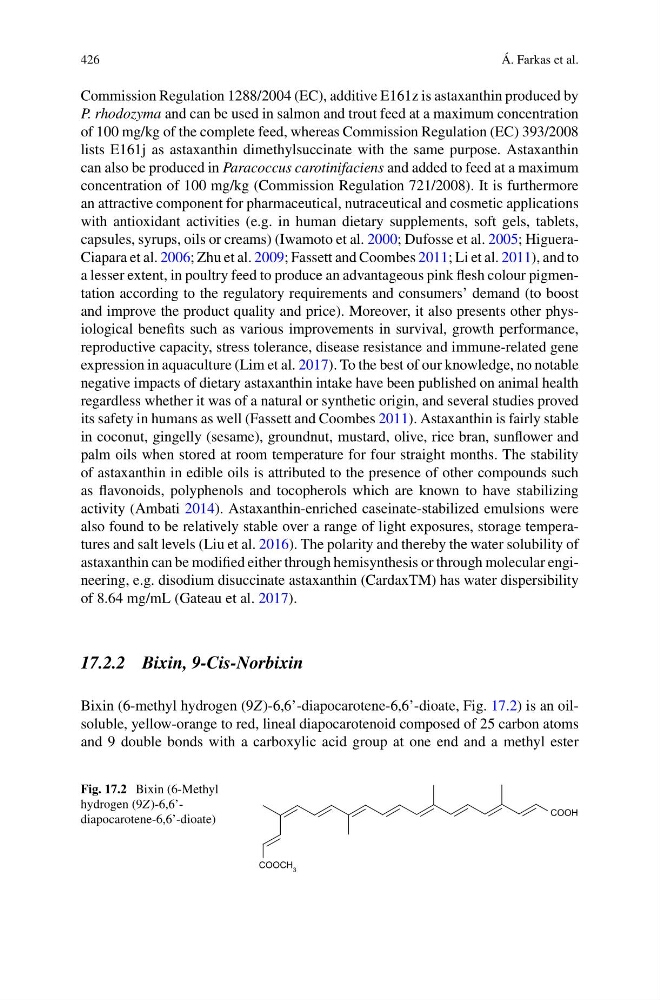
Bixin (6-methyl hydrogen (9Z)-6,6’-diapocarotene-6,6’-dioate, Fig. 17.2) is an oilsoluble, yellow-orange to red, lineal diapocarotenoid composed of 25 carbon atoms
and 9 double bonds with a carboxylic acid group at one end and a methyl ester
Fig. 17.2 Bixin (6-Methyl
hydrogen (9Z)-6,6’diapocarotene-6,6’-dioate)
COOH
COOCH 3
Á. Farkas et al.
Commission Regulation 1288/2004 (EC), additive E161z is astaxanthin produced by
P. rhodozyma and can be used in salmon and trout feed at a maximum concentration
of 100 mg/kg of the complete feed, whereas Commission Regulation (EC) 393/2008
lists E161j as astaxanthin dimethylsuccinate with the same purpose. Astaxanthin
can also be produced in Paracoccus carotinifaciens and added to feed at a maximum
concentration of 100 mg/kg (Commission Regulation 721/2008). It is furthermore
an attractive component for pharmaceutical, nutraceutical and cosmetic applications
with antioxidant activities (e.g. in human dietary supplements, soft gels, tablets,
capsules, syrups, oils or creams) (Iwamoto et al. 2000; Dufosse et al. 2005; HigueraCiapara et al. 2006; Zhu et al. 2009; Fassett and Coombes 2011; Li et al. 2011), and to
a lesser extent, in poultry feed to produce an advantageous pink flesh colour pigmentation according to the regulatory requirements and consumers’ demand (to boost
and improve the product quality and price). Moreover, it also presents other physiological benefits such as various improvements in survival, growth performance,
reproductive capacity, stress tolerance, disease resistance and immune-related gene
expression in aquaculture (Lim et al. 2017). To the best of our knowledge, no notable
negative impacts of dietary astaxanthin intake have been published on animal health
regardless whether it was of a natural or synthetic origin, and several studies proved
its safety in humans as well (Fassett and Coombes 2011). Astaxanthin is fairly stable
in coconut, gingelly (sesame), groundnut, mustard, olive, rice bran, sunflower and
palm oils when stored at room temperature for four straight months. The stability
of astaxanthin in edible oils is attributed to the presence of other compounds such
as flavonoids, polyphenols and tocopherols which are known to have stabilizing
activity (Ambati 2014). Astaxanthin-enriched caseinate-stabilized emulsions were
also found to be relatively stable over a range of light exposures, storage temperatures and salt levels (Liu et al. 2016). The polarity and thereby the water solubility of
astaxanthin can be modified either through hemisynthesis or through molecular engineering, e.g. disodium disuccinate astaxanthin (CardaxTM) has water dispersibility
of 8.64 mg/mL (Gateau et al. 2017).
17.2.2 Bixin, 9-Cis-Norbixin
Bixin (6-methyl hydrogen (9Z)-6,6’-diapocarotene-6,6’-dioate, Fig. 17.2) is an oilsoluble, yellow-orange to red, lineal diapocarotenoid composed of 25 carbon atoms
and 9 double bonds with a carboxylic acid group at one end and a methyl ester
Fig. 17.2 Bixin (6-Methyl
hydrogen (9Z)-6,6’diapocarotene-6,6’-dioate)
COOH
COOCH 3