

14 The Bioeconomy of Production of Microalgal Pigments
335
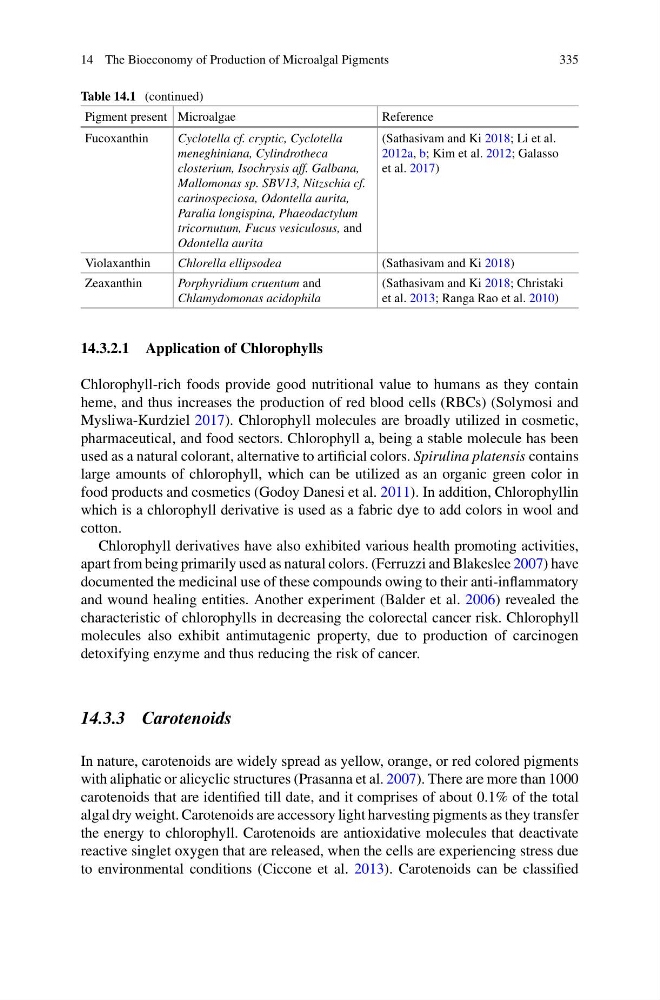
Table 14.1 (continued)
Pigment present Microalgae
Reference
Fucoxanthin
Cyclotella cf. cryptic, Cyclotella
meneghiniana, Cylindrotheca
closterium, Isochrysis aff. Galbana,
Mallomonas sp. SBV13, Nitzschia cf.
carinospeciosa, Odontella aurita,
Paralia longispina, Phaeodactylum
tricornutum, Fucus vesiculosus, and
Odontella aurita
(Sathasivam and Ki 2018; Li et al.
2012a, b; Kim et al. 2012; Galasso
et al. 2017)
Violaxanthin
Chlorella ellipsodea
(Sathasivam and Ki 2018)
Zeaxanthin
Porphyridium cruentum and
Chlamydomonas acidophila
(Sathasivam and Ki 2018; Christaki
et al. 2013; Ranga Rao et al. 2010)
14.3.2.1 Application of Chlorophylls
Chlorophyll-rich foods provide good nutritional value to humans as they contain
heme, and thus increases the production of red blood cells (RBCs) (Solymosi and
Mysliwa-Kurdziel 2017). Chlorophyll molecules are broadly utilized in cosmetic,
pharmaceutical, and food sectors. Chlorophyll a, being a stable molecule has been
used as a natural colorant, alternative to artificial colors. Spirulina platensis contains
large amounts of chlorophyll, which can be utilized as an organic green color in
food products and cosmetics (Godoy Danesi et al. 2011). In addition, Chlorophyllin
which is a chlorophyll derivative is used as a fabric dye to add colors in wool and
cotton.
Chlorophyll derivatives have also exhibited various health promoting activities,
apart from being primarily used as natural colors. (Ferruzzi and Blakeslee 2007) have
documented the medicinal use of these compounds owing to their anti-inflammatory
and wound healing entities. Another experiment (Balder et al. 2006) revealed the
characteristic of chlorophylls in decreasing the colorectal cancer risk. Chlorophyll
molecules also exhibit antimutagenic property, due to production of carcinogen
detoxifying enzyme and thus reducing the risk of cancer.
14.3.3 Carotenoids
In nature, carotenoids are widely spread as yellow, orange, or red colored pigments
with aliphatic or alicyclic structures (Prasanna et al. 2007). There are more than 1000
carotenoids that are identified till date, and it comprises of about 0.1% of the total
algal dry weight. Carotenoids are accessory light harvesting pigments as they transfer
the energy to chlorophyll. Carotenoids are antioxidative molecules that deactivate
reactive singlet oxygen that are released, when the cells are experiencing stress due
to environmental conditions (Ciccone et al. 2013). Carotenoids can be classified
335
Table 14.1 (continued)
Pigment present Microalgae
Reference
Fucoxanthin
Cyclotella cf. cryptic, Cyclotella
meneghiniana, Cylindrotheca
closterium, Isochrysis aff. Galbana,
Mallomonas sp. SBV13, Nitzschia cf.
carinospeciosa, Odontella aurita,
Paralia longispina, Phaeodactylum
tricornutum, Fucus vesiculosus, and
Odontella aurita
(Sathasivam and Ki 2018; Li et al.
2012a, b; Kim et al. 2012; Galasso
et al. 2017)
Violaxanthin
Chlorella ellipsodea
(Sathasivam and Ki 2018)
Zeaxanthin
Porphyridium cruentum and
Chlamydomonas acidophila
(Sathasivam and Ki 2018; Christaki
et al. 2013; Ranga Rao et al. 2010)
14.3.2.1 Application of Chlorophylls
Chlorophyll-rich foods provide good nutritional value to humans as they contain
heme, and thus increases the production of red blood cells (RBCs) (Solymosi and
Mysliwa-Kurdziel 2017). Chlorophyll molecules are broadly utilized in cosmetic,
pharmaceutical, and food sectors. Chlorophyll a, being a stable molecule has been
used as a natural colorant, alternative to artificial colors. Spirulina platensis contains
large amounts of chlorophyll, which can be utilized as an organic green color in
food products and cosmetics (Godoy Danesi et al. 2011). In addition, Chlorophyllin
which is a chlorophyll derivative is used as a fabric dye to add colors in wool and
cotton.
Chlorophyll derivatives have also exhibited various health promoting activities,
apart from being primarily used as natural colors. (Ferruzzi and Blakeslee 2007) have
documented the medicinal use of these compounds owing to their anti-inflammatory
and wound healing entities. Another experiment (Balder et al. 2006) revealed the
characteristic of chlorophylls in decreasing the colorectal cancer risk. Chlorophyll
molecules also exhibit antimutagenic property, due to production of carcinogen
detoxifying enzyme and thus reducing the risk of cancer.
14.3.3 Carotenoids
In nature, carotenoids are widely spread as yellow, orange, or red colored pigments
with aliphatic or alicyclic structures (Prasanna et al. 2007). There are more than 1000
carotenoids that are identified till date, and it comprises of about 0.1% of the total
algal dry weight. Carotenoids are accessory light harvesting pigments as they transfer
the energy to chlorophyll. Carotenoids are antioxidative molecules that deactivate
reactive singlet oxygen that are released, when the cells are experiencing stress due
to environmental conditions (Ciccone et al. 2013). Carotenoids can be classified