

12 Industrial Extraction of Microalgal Pigments
293
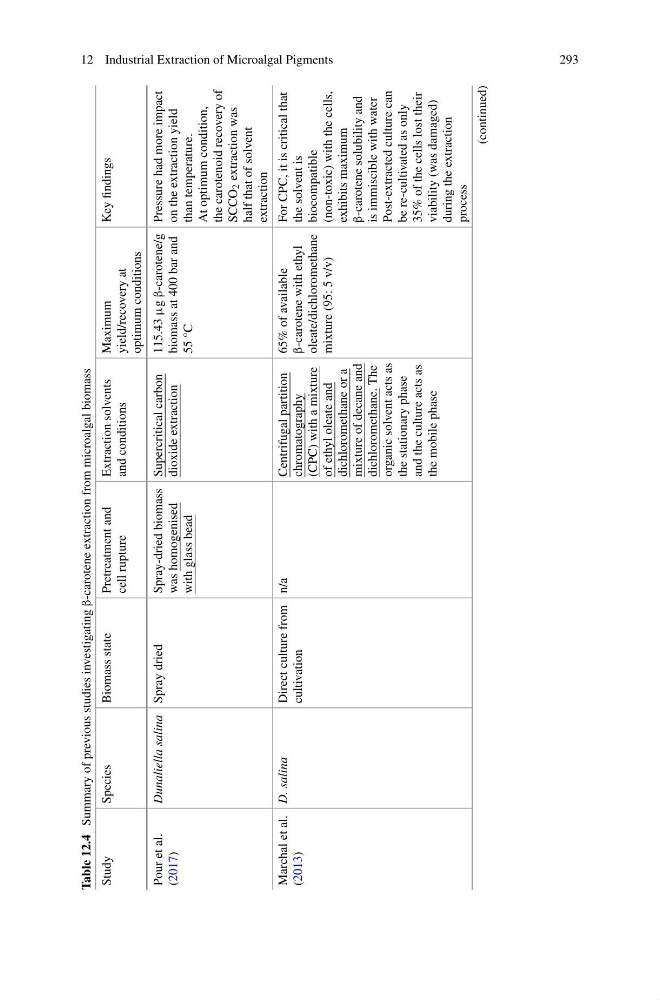
Table 12.4
Summary of previous studies investigating
β-carotene extraction from microalgal biomass
Study
Species
Biomass state
Pretreatment and
cell rupture
Extraction solvents
and conditions
Maximum
yield/recovery at
optimum conditions
Key findings
Pour et al.
(2017)
Dunaliella salina
Spray dried
Spray-dried biomass
was
homogenised
with glass bead
Supercritical carbon
dioxide extraction
115.43
μg β-carotene/g
biomass at 400 bar and
55 °C
Pressure had more impact
on the extraction yield
than temperature.
At optimum condition,
the carotenoid recovery of
SCCO
2 extraction was
half that of solvent
extraction
Marchal et al.
(2013)
D. salina
Direct culture from
cultivation
n/a
Centrifugal partition
chromatography
(CPC) with a mixture
of ethyl oleate and
dichloromethane or a
mixture of decane and
dichloromethane. The
organic solvent acts as
the stationary phase
and the culture acts as
the mobile phase
65% of available
β-carotene with ethyl
oleate/dichloromethane
mixture (95: 5 v/v)
For CPC, it is critical that
the solvent is
biocompatible
(non-toxic) with the cells,
exhibits maximum
β-carotene solubility and
is immiscible with water
Post-extracted culture can
be re-cultivated as only
35% of the cells lost their
viability (was damaged)
during the extraction
process
(continued)
293
Table 12.4
Summary of previous studies investigating
β-carotene extraction from microalgal biomass
Study
Species
Biomass state
Pretreatment and
cell rupture
Extraction solvents
and conditions
Maximum
yield/recovery at
optimum conditions
Key findings
Pour et al.
(2017)
Dunaliella salina
Spray dried
Spray-dried biomass
was
homogenised
with glass bead
Supercritical carbon
dioxide extraction
115.43
μg β-carotene/g
biomass at 400 bar and
55 °C
Pressure had more impact
on the extraction yield
than temperature.
At optimum condition,
the carotenoid recovery of
SCCO
2 extraction was
half that of solvent
extraction
Marchal et al.
(2013)
D. salina
Direct culture from
cultivation
n/a
Centrifugal partition
chromatography
(CPC) with a mixture
of ethyl oleate and
dichloromethane or a
mixture of decane and
dichloromethane. The
organic solvent acts as
the stationary phase
and the culture acts as
the mobile phase
65% of available
β-carotene with ethyl
oleate/dichloromethane
mixture (95: 5 v/v)
For CPC, it is critical that
the solvent is
biocompatible
(non-toxic) with the cells,
exhibits maximum
β-carotene solubility and
is immiscible with water
Post-extracted culture can
be re-cultivated as only
35% of the cells lost their
viability (was damaged)
during the extraction
process
(continued)