

270
R. Halim
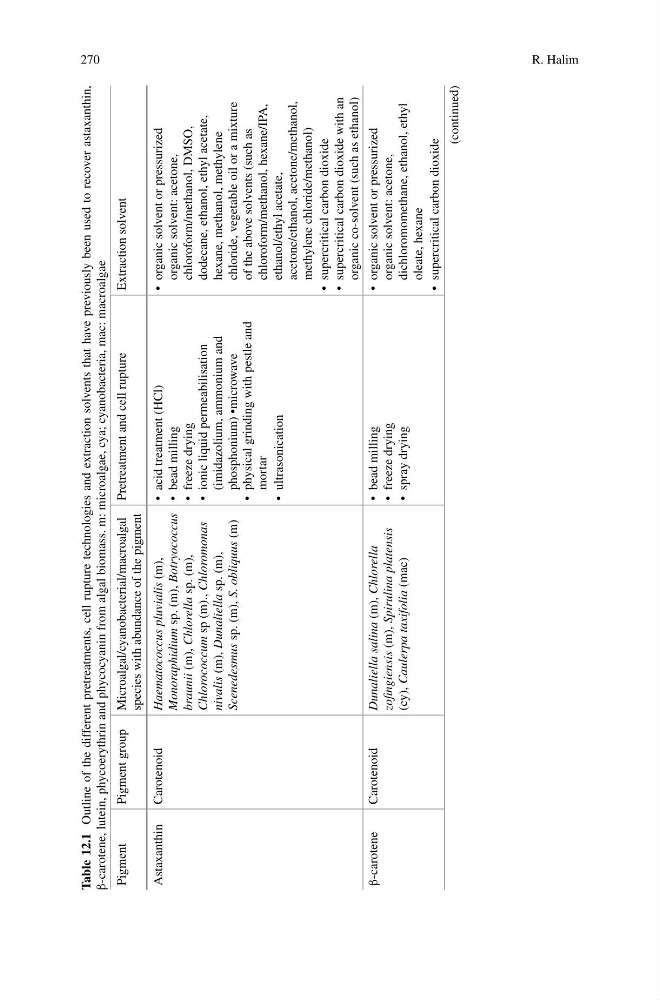
Table 12.1
Outline of the different pretreatments, cell rupture technologies and extraction solvents that have previously been used to recover astaxanthin,
β-carotene, lutein, phycoerythrin and phycocyanin from algal biomass. m: microalgae, cya; cyanobacteria, mac: macroalgae
Pigment
Pigment group Microalgal/cyanobacterial/macroalgal
species with abundance of the pigment
Pretreatment and cell rupture
Extraction solvent
Astaxanthin
Carotenoid
Haematococcus pluvialis
(m),
Monoraphidium
sp. (m), Botryococcus
braunii
(m), Chlorella
sp. (m),
Chlorococcum
sp (m)., Chloromonas
nivalis
(m), Dunaliella
sp. (m),
Scenedesmus
sp. (m), S. obliquus
(m)
• acid treatment (HCl)
• bead milling
• freeze drying
• ionic liquid permeabilisation
(imidazolium, ammonium and
phosphonium) •microwave
• physical grinding with pestle and
mortar
• ultrasonication
• organic solvent or pressurized
organic solvent: acetone,
chloroform/methanol, DMSO,
dodecane, ethanol, ethyl acetate,
hexane, methanol, methylene
chloride, vegetable oil or a mixture
of the above solvents (such as
chloroform/methanol, hexane/IPA,
ethanol/ethyl acetate,
acetone/ethanol, acetone/methanol,
methylene chloride/methanol)
• supercritical carbon dioxide
• supercritical carbon dioxide with an
organic co-solvent (such as ethanol)
β-carotene
Carotenoid
Dunaliella salina
(m), Chlorella
zofingiensis
(m), Spirulina platensis
(cy), Caulerpa taxifolia
(mac)
• bead milling
• freeze drying
• spray drying
• organic solvent or pressurized
organic solvent: acetone,
dichloromomethane, ethanol, ethyl
oleate, hexane
• supercritical carbon dioxide
(continued)
R. Halim
Table 12.1
Outline of the different pretreatments, cell rupture technologies and extraction solvents that have previously been used to recover astaxanthin,
β-carotene, lutein, phycoerythrin and phycocyanin from algal biomass. m: microalgae, cya; cyanobacteria, mac: macroalgae
Pigment
Pigment group Microalgal/cyanobacterial/macroalgal
species with abundance of the pigment
Pretreatment and cell rupture
Extraction solvent
Astaxanthin
Carotenoid
Haematococcus pluvialis
(m),
Monoraphidium
sp. (m), Botryococcus
braunii
(m), Chlorella
sp. (m),
Chlorococcum
sp (m)., Chloromonas
nivalis
(m), Dunaliella
sp. (m),
Scenedesmus
sp. (m), S. obliquus
(m)
• acid treatment (HCl)
• bead milling
• freeze drying
• ionic liquid permeabilisation
(imidazolium, ammonium and
phosphonium) •microwave
• physical grinding with pestle and
mortar
• ultrasonication
• organic solvent or pressurized
organic solvent: acetone,
chloroform/methanol, DMSO,
dodecane, ethanol, ethyl acetate,
hexane, methanol, methylene
chloride, vegetable oil or a mixture
of the above solvents (such as
chloroform/methanol, hexane/IPA,
ethanol/ethyl acetate,
acetone/ethanol, acetone/methanol,
methylene chloride/methanol)
• supercritical carbon dioxide
• supercritical carbon dioxide with an
organic co-solvent (such as ethanol)
β-carotene
Carotenoid
Dunaliella salina
(m), Chlorella
zofingiensis
(m), Spirulina platensis
(cy), Caulerpa taxifolia
(mac)
• bead milling
• freeze drying
• spray drying
• organic solvent or pressurized
organic solvent: acetone,
dichloromomethane, ethanol, ethyl
oleate, hexane
• supercritical carbon dioxide
(continued)