

252
M. M. Maroneze et al.
Regardless of the desired final product, almost all commercial production of A.
platensis is conducted in open raceway ponds. As with other commercial microalgae,
some factors regulate the yield of C-phycocyanin in A. platensis. Abiotic signals,
as light, temperature, and nutrient availability, are closely linked to C-phycocyanin
biosynthesis. Temperatures around 25 to 35 °C, a pH of 8 to 10, a NaCl concentration
of 0.02 to 0.2 M, and a light intensity around 2500 lx are indicated for biosynthesis
this pigment as from A. platensis (Pagels et al. 2019).
This microorganism grows naturally in tropical and subtropical alkaline lakes,
which is why its performance is better at high pH and high temperatures (35–38 °C)
and require minimum temperatures of 15–20 °C. In regions where the weather conditions are less than optimal, the production system can raceway ponds under plastic
greenhouses, common facilities in the northern and central regions of China. In
some more extreme cases, such as at Earthrise Farms, located in California, USA,
the company only operates seven months a year because of the low temperatures
recorded in winter (Borowitzka 2018).
The seawater is a source of trace elements and is commonly used for cultivation
in the commercial when the plants are located near to this resource. The cultivation
medium may employ a mixture of seawater, freshwater, and sodium bicarbonate. For
A. platensis cultivation, pH control is critically important. This parameter is adjusted
by supplying CO 2 gas to the medium, which besides providing pH control, also is
the source of carbon for photosynthesis (Beley 2013).
The extreme cultivation conditions make the use of open systems suitable for
these microorganisms. However, studies showed that C-phycocyanin productivity is
increased when cultivated in closed photobioreactors since these systems provide
better control of the cultivation parameters, and the culture can be kept axenic.
However, currently, the operation of large-scale A. platensis culture in closed systems
does not feature a competitive cost (Eriksen et al. 2008; Soni et al. 2017).
The harvesting, as in other production processes, is performed by centrifugation or
filtration. The filtration is done through inclined or vibrating screens, or a combination
of both, with up to 95% biomass removal efficiency. The water can be recycled
and return to the ponds for the next cultivation cycle. The final harvest paste is
typically dried by spray dryer or drying drum. Some companies employ exclusive
processes to eliminate the oxidation that occurs in this operation (Cyanotech 2019).
The cell disruption is conducted at pH 6 to 7 and then centrifuged, and phycocyanin
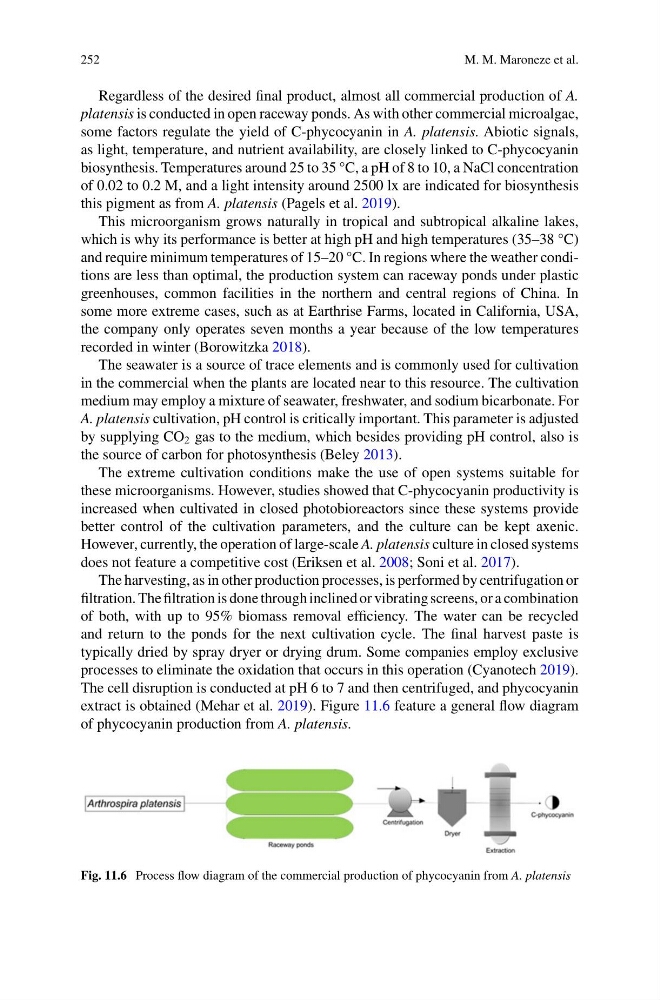
extract is obtained (Mehar et al. 2019). Figure 11.6 feature a general flow diagram
of phycocyanin production from A. platensis.
Fig. 11.6 Process flow diagram of the commercial production of phycocyanin from A. platensis
M. M. Maroneze et al.
Regardless of the desired final product, almost all commercial production of A.
platensis is conducted in open raceway ponds. As with other commercial microalgae,
some factors regulate the yield of C-phycocyanin in A. platensis. Abiotic signals,
as light, temperature, and nutrient availability, are closely linked to C-phycocyanin
biosynthesis. Temperatures around 25 to 35 °C, a pH of 8 to 10, a NaCl concentration
of 0.02 to 0.2 M, and a light intensity around 2500 lx are indicated for biosynthesis
this pigment as from A. platensis (Pagels et al. 2019).
This microorganism grows naturally in tropical and subtropical alkaline lakes,
which is why its performance is better at high pH and high temperatures (35–38 °C)
and require minimum temperatures of 15–20 °C. In regions where the weather conditions are less than optimal, the production system can raceway ponds under plastic
greenhouses, common facilities in the northern and central regions of China. In
some more extreme cases, such as at Earthrise Farms, located in California, USA,
the company only operates seven months a year because of the low temperatures
recorded in winter (Borowitzka 2018).
The seawater is a source of trace elements and is commonly used for cultivation
in the commercial when the plants are located near to this resource. The cultivation
medium may employ a mixture of seawater, freshwater, and sodium bicarbonate. For
A. platensis cultivation, pH control is critically important. This parameter is adjusted
by supplying CO 2 gas to the medium, which besides providing pH control, also is
the source of carbon for photosynthesis (Beley 2013).
The extreme cultivation conditions make the use of open systems suitable for
these microorganisms. However, studies showed that C-phycocyanin productivity is
increased when cultivated in closed photobioreactors since these systems provide
better control of the cultivation parameters, and the culture can be kept axenic.
However, currently, the operation of large-scale A. platensis culture in closed systems
does not feature a competitive cost (Eriksen et al. 2008; Soni et al. 2017).
The harvesting, as in other production processes, is performed by centrifugation or
filtration. The filtration is done through inclined or vibrating screens, or a combination
of both, with up to 95% biomass removal efficiency. The water can be recycled
and return to the ponds for the next cultivation cycle. The final harvest paste is
typically dried by spray dryer or drying drum. Some companies employ exclusive
processes to eliminate the oxidation that occurs in this operation (Cyanotech 2019).
The cell disruption is conducted at pH 6 to 7 and then centrifuged, and phycocyanin
extract is obtained (Mehar et al. 2019). Figure 11.6 feature a general flow diagram
of phycocyanin production from A. platensis.
Fig. 11.6 Process flow diagram of the commercial production of phycocyanin from A. platensis