

11 Microalgae-Based Processes for Pigments Production
251
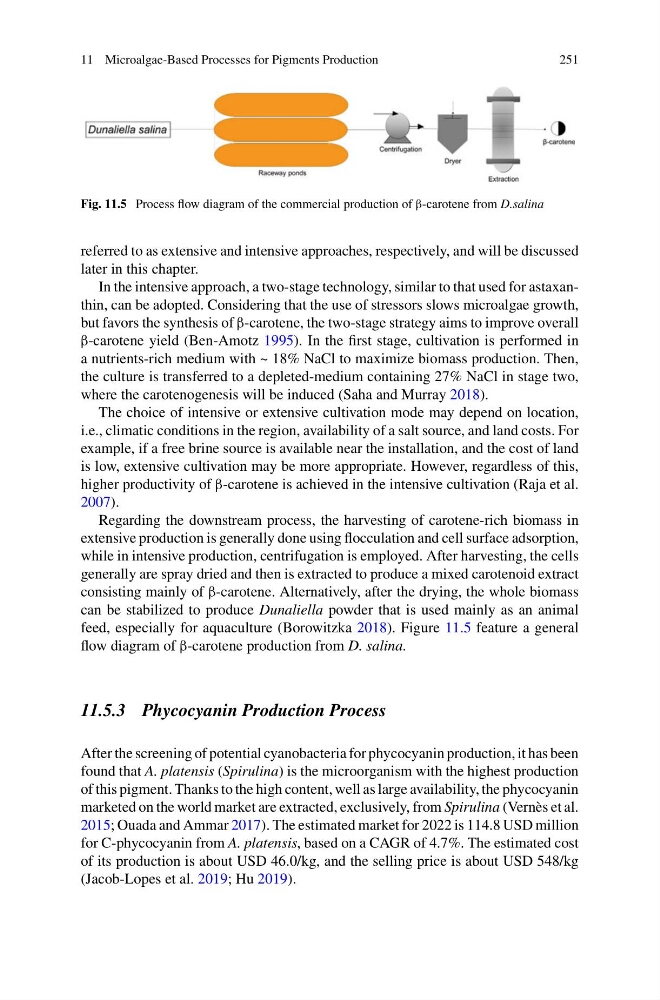
Fig. 11.5 Process flow diagram of the commercial production of β-carotene from D.salina
referred to as extensive and intensive approaches, respectively, and will be discussed
later in this chapter.
In the intensive approach, a two-stage technology, similar to that used for astaxanthin, can be adopted. Considering that the use of stressors slows microalgae growth,
but favors the synthesis of β-carotene, the two-stage strategy aims to improve overall
β-carotene yield (Ben-Amotz 1995). In the first stage, cultivation is performed in
a nutrients-rich medium with ~ 18% NaCl to maximize biomass production. Then,
the culture is transferred to a depleted-medium containing 27% NaCl in stage two,
where the carotenogenesis will be induced (Saha and Murray 2018).
The choice of intensive or extensive cultivation mode may depend on location,
i.e., climatic conditions in the region, availability of a salt source, and land costs. For
example, if a free brine source is available near the installation, and the cost of land
is low, extensive cultivation may be more appropriate. However, regardless of this,
higher productivity of β-carotene is achieved in the intensive cultivation (Raja et al.
2007).
Regarding the downstream process, the harvesting of carotene-rich biomass in
extensive production is generally done using flocculation and cell surface adsorption,
while in intensive production, centrifugation is employed. After harvesting, the cells
generally are spray dried and then is extracted to produce a mixed carotenoid extract
consisting mainly of β-carotene. Alternatively, after the drying, the whole biomass
can be stabilized to produce Dunaliella powder that is used mainly as an animal
feed, especially for aquaculture (Borowitzka 2018). Figure 11.5 feature a general
flow diagram of β-carotene production from D. salina.
11.5.3 Phycocyanin Production Process
After the screening of potential cyanobacteria for phycocyanin production, it has been
found that A. platensis (Spirulina) is the microorganism with the highest production
of this pigment. Thanks to the high content, well as large availability, the phycocyanin
marketed on the world market are extracted, exclusively, from Spirulina (Vernès et al.
2015; Ouada and Ammar 2017). The estimated market for 2022 is 114.8 USD million
for C-phycocyanin from A. platensis, based on a CAGR of 4.7%. The estimated cost
of its production is about USD 46.0/kg, and the selling price is about USD 548/kg
(Jacob-Lopes et al. 2019; Hu 2019).
251
Fig. 11.5 Process flow diagram of the commercial production of β-carotene from D.salina
referred to as extensive and intensive approaches, respectively, and will be discussed
later in this chapter.
In the intensive approach, a two-stage technology, similar to that used for astaxanthin, can be adopted. Considering that the use of stressors slows microalgae growth,
but favors the synthesis of β-carotene, the two-stage strategy aims to improve overall
β-carotene yield (Ben-Amotz 1995). In the first stage, cultivation is performed in
a nutrients-rich medium with ~ 18% NaCl to maximize biomass production. Then,
the culture is transferred to a depleted-medium containing 27% NaCl in stage two,
where the carotenogenesis will be induced (Saha and Murray 2018).
The choice of intensive or extensive cultivation mode may depend on location,
i.e., climatic conditions in the region, availability of a salt source, and land costs. For
example, if a free brine source is available near the installation, and the cost of land
is low, extensive cultivation may be more appropriate. However, regardless of this,
higher productivity of β-carotene is achieved in the intensive cultivation (Raja et al.
2007).
Regarding the downstream process, the harvesting of carotene-rich biomass in
extensive production is generally done using flocculation and cell surface adsorption,
while in intensive production, centrifugation is employed. After harvesting, the cells
generally are spray dried and then is extracted to produce a mixed carotenoid extract
consisting mainly of β-carotene. Alternatively, after the drying, the whole biomass
can be stabilized to produce Dunaliella powder that is used mainly as an animal
feed, especially for aquaculture (Borowitzka 2018). Figure 11.5 feature a general
flow diagram of β-carotene production from D. salina.
11.5.3 Phycocyanin Production Process
After the screening of potential cyanobacteria for phycocyanin production, it has been
found that A. platensis (Spirulina) is the microorganism with the highest production
of this pigment. Thanks to the high content, well as large availability, the phycocyanin
marketed on the world market are extracted, exclusively, from Spirulina (Vernès et al.
2015; Ouada and Ammar 2017). The estimated market for 2022 is 114.8 USD million
for C-phycocyanin from A. platensis, based on a CAGR of 4.7%. The estimated cost
of its production is about USD 46.0/kg, and the selling price is about USD 548/kg
(Jacob-Lopes et al. 2019; Hu 2019).